

What This Calculator Does
This energy use calculator answers the first question of every off-grid plan: how much electricity do you actually use?
You list your devices, and it adds them up into one number per day, per month and per year. Every other calculator on this site starts from that number, so it is worth getting right.
How To Use This Energy Use Calculator
- Look at the list under Devices and daily runtime. It starts with six common devices, like a fridge, a laptop and a wifi router. Keep the ones you own and remove the rest with the cross.
- Add your own devices with the add button. Give each one a name, so the breakdown makes sense later.
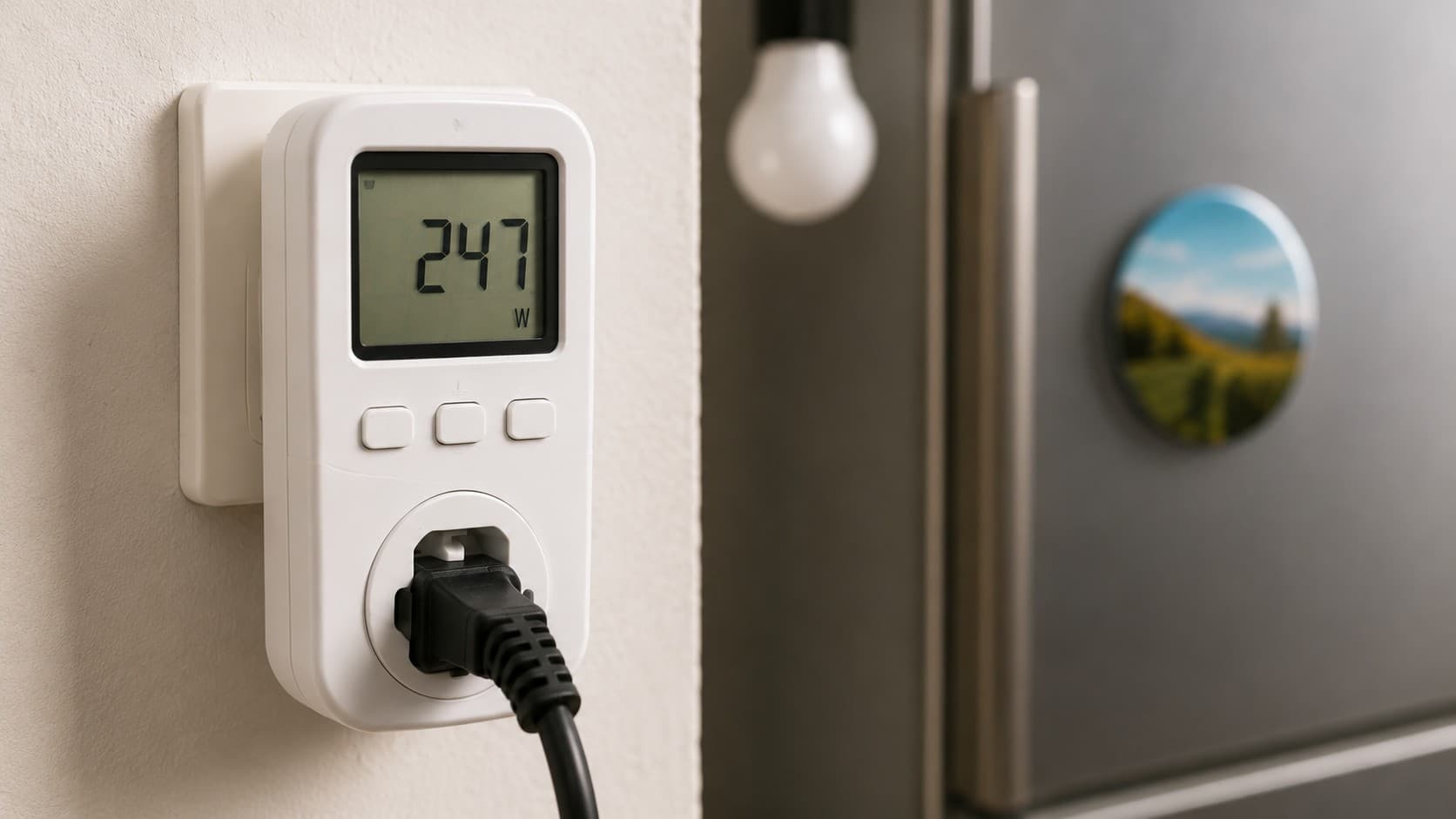
- In Watts, type how much power the device pulls. You can find it on the label or charger. Don't know it? Open How do I find the wattage of a device? for typical values, or measure it with a plug-in energy meter.
- In Hours / day, type how long it really works each day, not how long it sits plugged in.
- Read the result card. Daily, Monthly and Yearly show your total in kWh, and the Breakdown ranks your devices from hungriest to smallest.
- Use Next steps to carry your yearly number straight into the solar panel calculator.
The Formula, In Plain Words
For each device, the calculator multiplies watts by hours. That gives watt-hours, or "Wh".
Scientists call a thousand of those a kilowatt-hour, or "kWh". That's just the unit on your power bill.
Then it adds every device together. Daily kWh is that total divided by 1,000, monthly is daily times 30, and yearly is daily times 365. Each device also gets a share, which is its own Wh divided by the total.
A Worked Example
Take the six starting devices as they are.
A 150 W fridge for 8 hours is 1,200 Wh. LED lights at 60 W for 6 hours add 360 Wh. The laptop adds 250 Wh, the TV 320 Wh, the router 360 Wh and one washing machine run 600 Wh.
Together that's 3,090 Wh, or 3.09 kWh a day. Times 30 is about 93 kWh a month, and times 365 is about 1,128 kWh a year.
The fridge alone is 39% of the total. That's why it sits on top of the breakdown.
What To Watch Out For
The number on a label is usually the most a device can pull, not what it uses on a normal day. A fridge only draws full power while its motor runs, so 24 hours at label watts would be far too high. Use 6 to 10 hours, or measure it.
Things that run now and then, like a washing machine, are easy to forget. So are seasonal ones, like a heater in winter. If you plan for the darkest months, list the winter devices too.
If you want more ways to find your real usage, read how much wattage you use every day. When your total looks right, take the yearly number to the solar panel calculator and the daily number to the battery calculator.
Planning something smaller, like a portable power station? Compare your daily Wh with the watt-hours it can store.
Hard Words
| Term | What it means |
|---|---|
| Watt (W) | How fast a device uses electricity right now, like the speed on a bike computer. |
| Watt-hour (Wh) | Watts multiplied by hours. It is the amount of energy used, like the distance you biked. |
| Kilowatt-hour (kWh) | 1,000 watt-hours. The unit your power bill counts in. |
| Plug-in energy meter | A small box between the wall socket and a device that measures how much power it really uses. |
| Share | The part of your daily total that one device is responsible for, as a percentage. |
Common Questions
How do I calculate my daily energy use?
Multiply each device's watts by the hours it runs per day, then add all devices together. The result is watt-hours. Divide by 1,000 to get kilowatt-hours, the unit on your power bill. A fridge at 150 watts for 8 hours uses 1,200 watt-hours, or 1.2 kWh, each day.
How many kWh does a house use per day?
It depends a lot on the house, the climate and what runs on electricity. A small off-grid cabin with efficient devices can get by on a few kWh a day, while a fully electric family home can use much more. The only reliable answer is your own device list or your power bill.
Should I use the watts on the device label?
Use the label as a starting point, but know it is usually the maximum draw. Many devices, like fridges and laptop chargers, use far less on average. A plug-in energy meter shows the real number over a day or a week, which gives a much more honest total for sizing solar panels and batteries.
How do I turn daily kWh into yearly kWh?
Multiply your daily kWh by 365. If you use 3.09 kWh a day, that is about 1,128 kWh a year. This calculator does it for you and also shows a monthly figure, which is the daily number times 30. Remember that winter and summer use can differ a lot.
What do I do with my energy use number?
Use the yearly kWh to work out how many solar panels you need, and the daily kWh to size your battery bank. Both calculators on this site take those numbers as their starting point. Getting your energy use right first stops you from buying too much or too little equipment.