

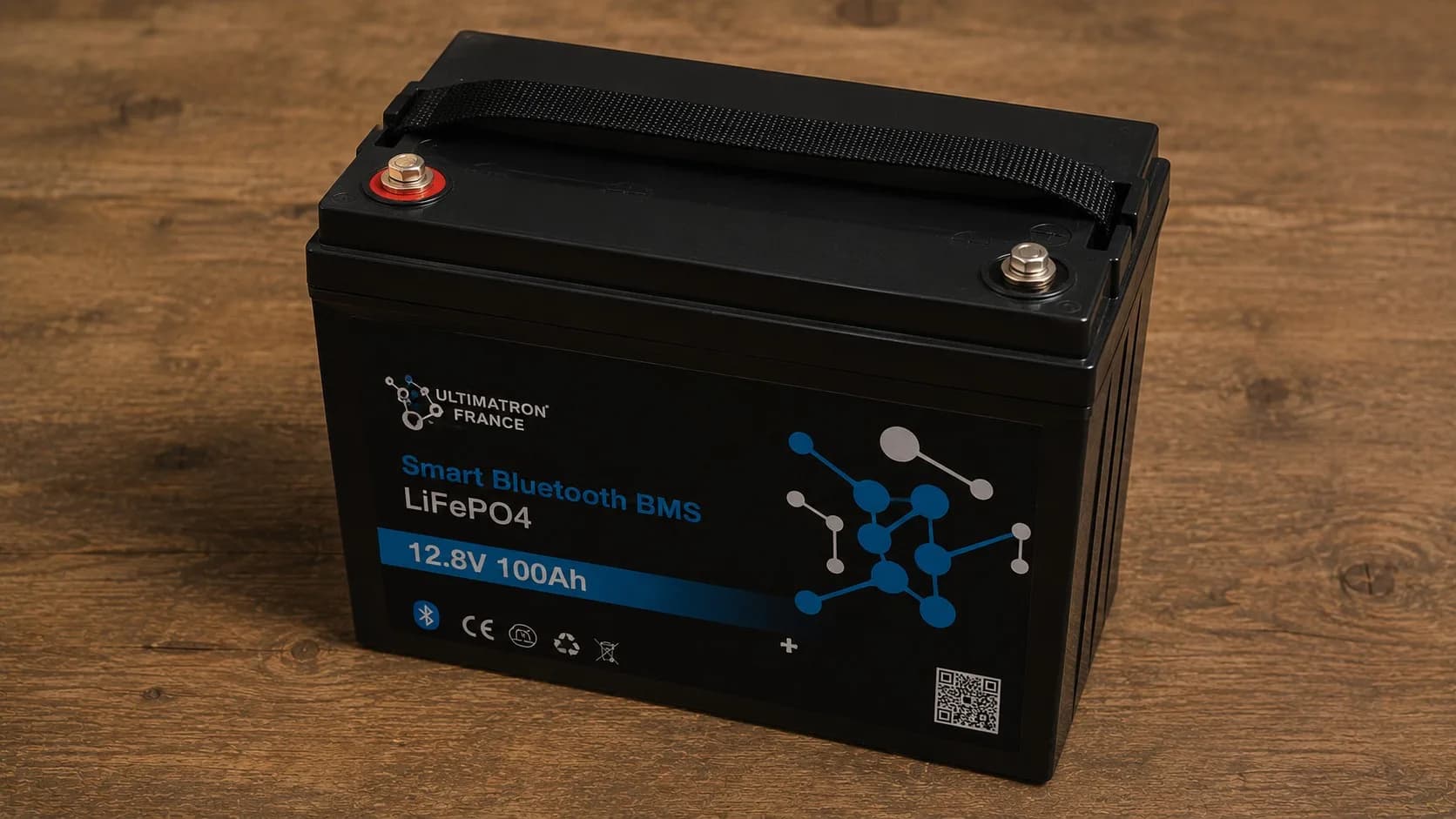
What This Calculator Does
This off-grid battery size calculator works out how big your battery bank has to be to keep the lights on when the sun stays away.
You tell it what you use per day, how many dark days you want to cover, and what kind of battery you have. It gives back a size in amp-hours, the number battery shops sell by.
How To Use This Calculator
- Under Daily load: devices and runtime, you start with six example devices: a fridge, lights, a laptop, a TV, a router and a washing machine, 3,090 Wh a day together. Change them into your own: a Name, the Watts and the Hours it runs per day. Add rows as you go. Daily total shows your watt-hours. Already used the energy use calculator? You can type its daily Wh as one row, like "Whole house", with hours set to 1.
- In Battery pack voltage, pick your system voltage. Not sure? 12 V is common in vans and boats, and 48 V in houses.
- In Days without sunlight (autonomy), pick how many cloudy days the battery must cover alone. 3 to 5 is a common starting point.
- In Depth of Discharge (DoD), pick how far you will empty the battery. Use 80% for lithium (LiFePO4) and 50% for lead-acid if you don't know. The DoD reference table below the result lists the cycle life of each type.
- In Efficiency (inverter + cables), keep 90% if your devices run on 230 V through an inverter. Type 100 if everything runs straight on DC, like in many vans.
- Read the result card. The big number is the amp-hours you need at your voltage. The line under it shows the energy your devices use over all your days, and the battery size in kWh.
The Formula, In Plain Words
First the calculator adds up watts times hours for every device. That is your daily use in watt-hours.
Then it multiplies by your autonomy days. People who build these systems call those days "autonomy". That's just how long the battery can run the house with no help from the sun.
Next it divides by the DoD and by the efficiency. Dividing by the DoD adds the part of the battery you promise not to use. Dividing by the efficiency adds the energy the inverter turns into heat on the way.
Last, it divides by the voltage. That turns watt-hours into amp-hours.
A Worked Example
Say you use 3,090 Wh a day, the total of the starter devices. You pick 48 V, 3 days, 80% DoD and 90% efficiency.
Three days is 9,270 Wh. Then 9,270 ÷ (0.8 × 0.9) = 12,875 Wh the battery must hold. Divided by 48 V, that's about 268 Ah.
Switch to a lead-acid bank at 50% DoD, and the same need grows to about 429 Ah. At 12 V and 80% it becomes about 1,073 Ah. Same energy, but a lower voltage needs far more amp-hours.
What To Watch Out For
DoD is a trade, because emptying a battery deeper wears it out faster.
Victron's lithium datasheet lists about 2,500 cycles at 80% DoD and about 5,000 at 50%.
Lead-acid batteries are usually kept above half full. Read lead-acid batteries to see why.
The efficiency field covers the inverter, not the cold. A cold battery holds less, and most lithium batteries must not be charged below freezing.
Leave some extra room if your battery sits somewhere cold.
It also does not size the solar side. A big battery only helps if your panels can fill it again after a dark spell. The next step is the inverter size calculator.
Hard Words
| Term | What it means |
|---|---|
| Amp-hour (Ah) | How much charge a battery holds at its voltage. 100 Ah at 12 V is 1,200 Wh. |
| Watt-hour (Wh) | An amount of energy: watts multiplied by hours. |
| Autonomy | How many days a battery can run your home with no sun at all. |
| Depth of discharge (DoD) | How much of the battery you use before charging again. 80% DoD means you leave 20% inside. |
| Efficiency | The share of battery energy that reaches your devices. 90% means 10% turns into heat in the inverter. |
| LiFePO4 | A type of lithium battery, also called lithium iron phosphate, popular for homes because it lasts many cycles. |
| Cycle | One full empty-and-refill of a battery. |
Common Questions
How do I calculate battery size for off-grid solar?
Add up your daily watt-hours and multiply by the days you want to run without sun. Divide by the depth of discharge, by the inverter efficiency and by the battery voltage. For 3,090 Wh a day, 3 days, 80% DoD, 90% efficiency and 48 V, that gives about 268 amp-hours.
How many days of autonomy do I need?
A common starting point is 3 to 5 days without useful sun. Penn State's solar design course uses about 3 days in a sunny place, and about 10 days for critical loads in a place with less sun. More days means a safer supply but a bigger, pricier battery. If you have a backup generator, you can often plan for fewer days, because the generator fills the gap during a long cloudy spell.
What depth of discharge should I use?
For LiFePO4 lithium batteries, 80% is a common safe choice. Lead-acid batteries are usually kept to about 50% to protect their life. Using a battery less deeply makes it last more cycles, so a lower DoD means a bigger bank that wears out more slowly.
Why does a 12 V battery need so many more amp-hours?
Amp-hours only tell half the story, because energy is amp-hours times voltage. To store the same energy at 12 V you need four times the amp-hours of a 48 V bank. That is why bigger homes use 48 V: fewer amps, thinner cables and smaller fuses.
How do I turn amp-hours into kWh?
Multiply the amp-hours by the battery voltage, then divide by 1,000. A 268 Ah battery at 48 V holds about 12.9 kWh. This is the total size. How much you can actually use depends on the depth of discharge you picked for your battery type.