


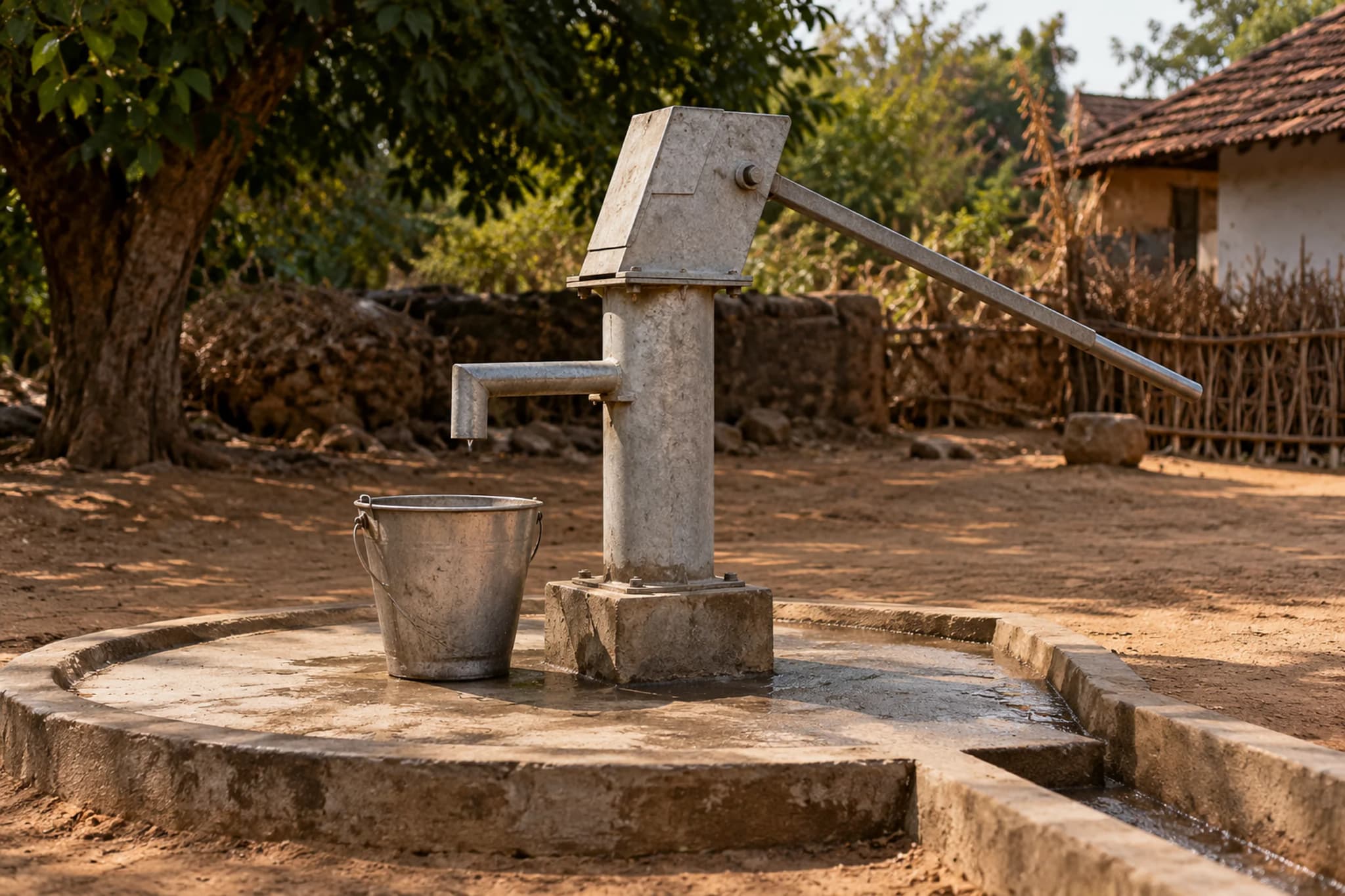
The Short Answer
An off-grid water system is a water supply system you run yourself: the water you find, store and clean, with no water company behind it. It has four big components. A water source, like a well or a rain tank. A pump that moves the water. Filtration that makes it safe to drink. And a way to send used water back out, often to the garden.
The right setup depends on your land, your weather and how much you use. Those factors will shape each part, which is why a good system is designed around the water source.
Turn your roof into a water supply
Catching Water
Here is a strange fact. Almost all the water on Earth is salty. Only about 2.5% of it is fresh, and most of that fresh water is frozen in ice and glaciers, the US Geological Survey says.
Where is the rest? Around 30% of all fresh water sits in the ground, under our feet. It hides in the tiny gaps between grains of sand, gravel and rock, a bit like water in a kitchen sponge.
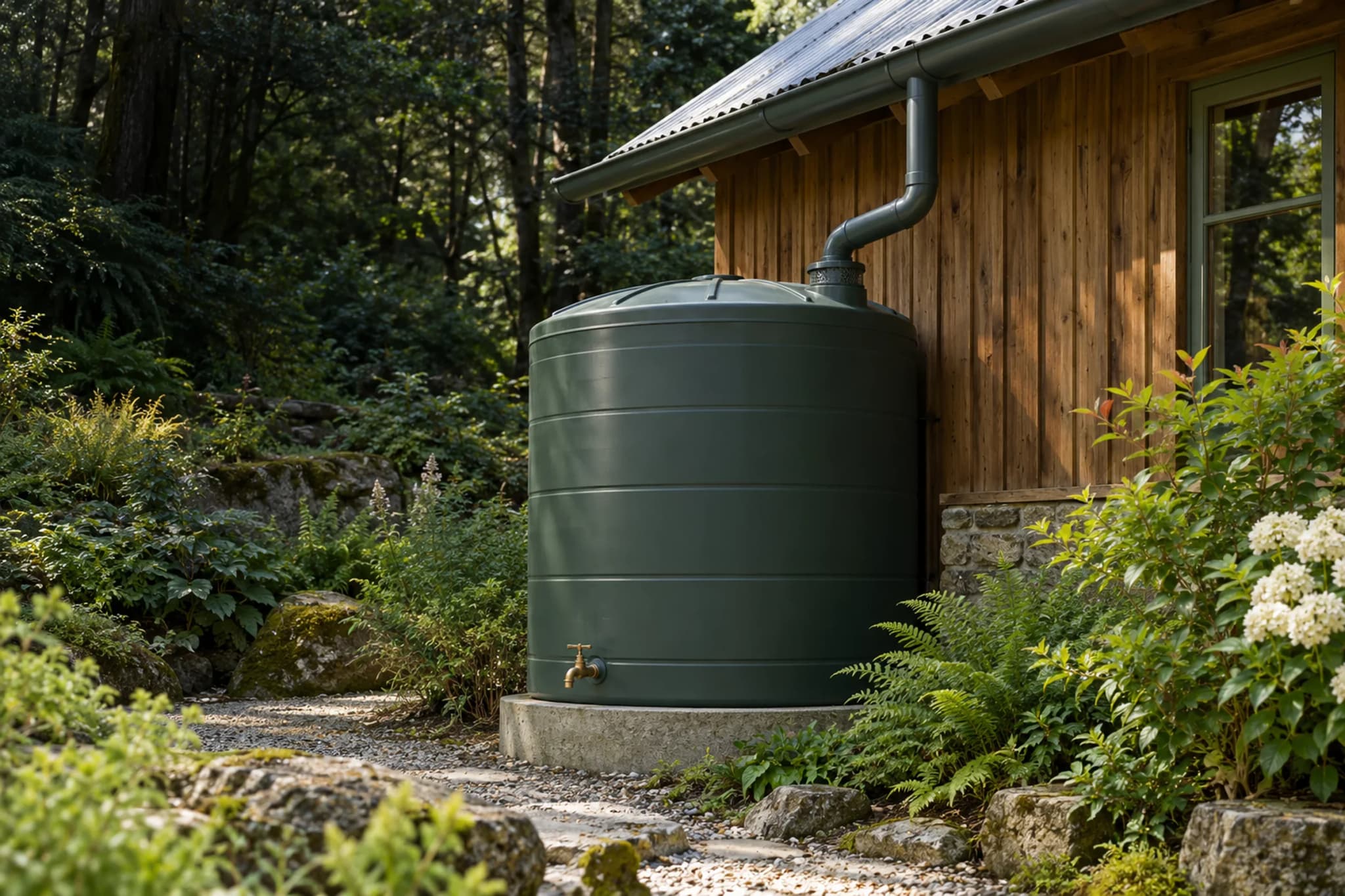
That is why people have dug wells for thousands of years, and why a well is still the starting point for many off-grid homes. The other big option falls from the sky. Every roof is a large rain catcher. People call it the catchment area, and with gutters it can fill a tank of your own. The bigger the catchment, the more rain it can catch.
What's Happening Under The Ground And On The Roof
Scientists call the top of that wet layer the "water table". It is just the level below which all the gaps in the soil are full of water, and its height goes up and down with the weather. A well is a hole that reaches below that level, so water seeps in from the sides and fills the bottom.
A good well has a tube inside it, called the casing, and a seal of grout around the outside. Together they stop dirt and extra water from the surface getting into the well. Think of it like a straw with a cap around the top, so only the water you want gets in.
Rain takes another route. It lands on the roof, slides into the gutters and flows down a downspout into a tank. But the first rain of a storm washes the roof clean, so it carries the most dirt, germs and chemicals. A little device called a first flush diverter sends that dirty early water away, which helps reduce the dirt that ends up in your tank.
Wells, Rain And Rivers: Three Places Off-Grid Water Comes From
Most off-grid homes get their water from one of three places, and some use a second water source for backup. Having two is handy in locations with long dry spells.
A Well Into The Groundwater
A well reaches groundwater and goes on giving through dry weeks, as long as the aquifer under you holds water, which makes it a highly reliable source. Scientists call that underground layer of wet sand or rock an "aquifer". A new well costs real money to install, and the water still needs testing. Our guide to wells and boreholes explains dug and drilled ones and how deep to go.
Rainwater Harvesting From Your Roof
Rain is free once the gutters and tank are installed, and it does the job almost anywhere it rains enough. The catch is storage: a rainwater system needs a tank or other container large enough to carry you through the dry months. Read how rainwater harvesting works to see how much a roof can catch.
Surface Water From A River, Lake Or Spring
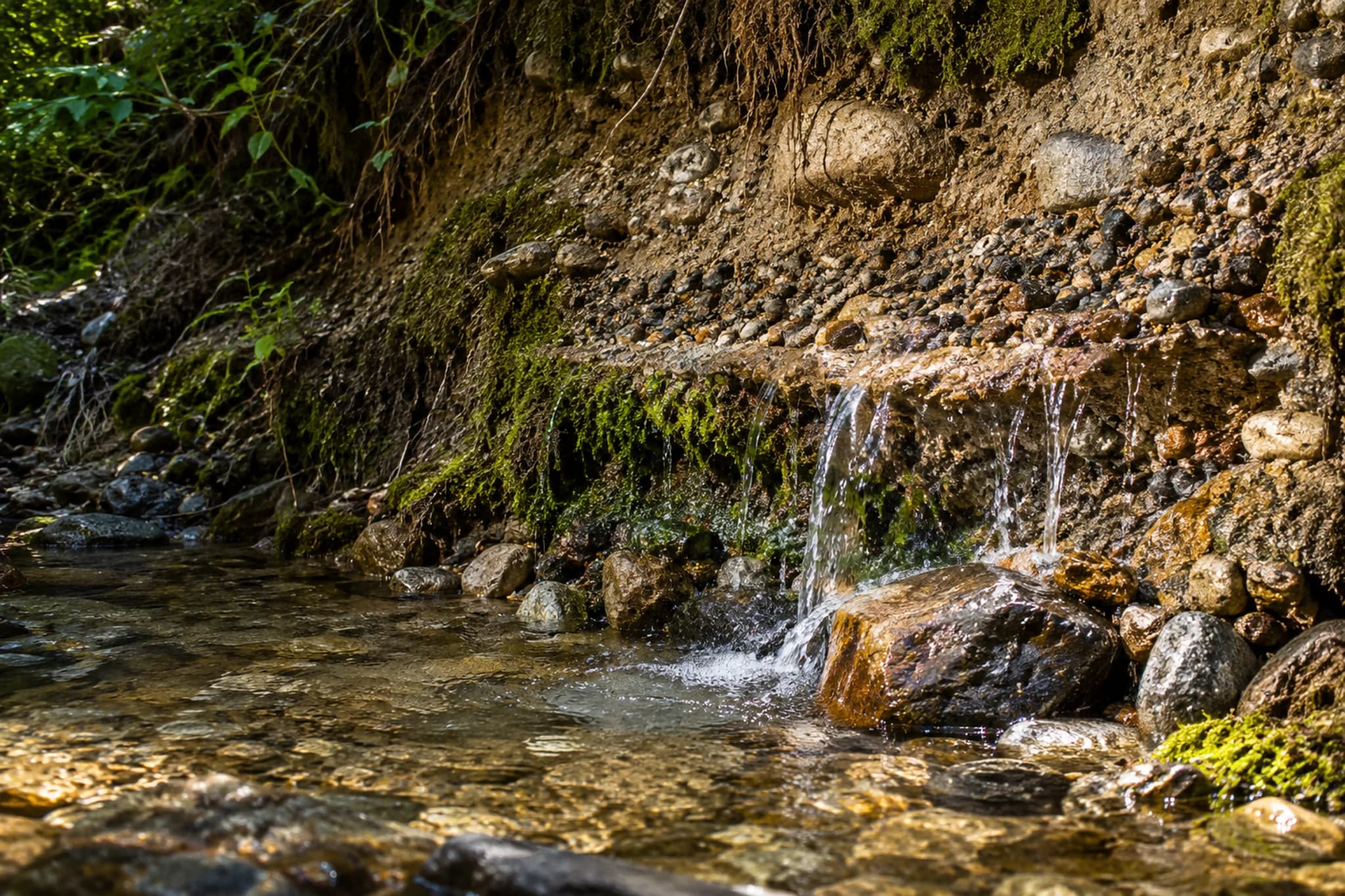
Some property has surface water right there. It is out in the open, which means a surface water system will require the same careful treatment as rain before anyone drinks it.
Which water source is best? That depends on your property, and the answer may differ even between neighbours. Where you have access to good groundwater, a well is usually the most reliable option. Where rain is plentiful and drilling is hard, the roof wins, and solar can power the small pump that moves rain from the tank.
From Source To Tap: Pumps, Pressure And Gravity
Water does not climb uphill by itself. Something has to push it, and that something is a pump.
A pump that sits on top of the well can only suck water up from a shallow depth, and every pump needs some kind of power to move it. Shallow-well jet pumps are used when the water is less than 25 feet (about 7.5 metres) below the surface, and deep-well jet pumps from 25 to 250 feet. For a deep well, most people install a submersible pump in the well itself. It is designed to sit under the surface: its pump and its motor are one long tube that pushes the water up.
The Pressure Tank
Next is the pressure tank. As the pump fills it, the air inside gets squeezed, and that squeezed air pushes back on the water. That is what lets the tank provide a strong flow at the tap without the pump starting each time you open it. Think of a squeezed balloon that goes on pushing water out.
From the tank, distribution pipes carry the flow to each tap, the shower and the garden hose. That distribution side is the plumbing you see inside the house.
How Does A Gravity-Fed Water System Work?
A gravity-fed water system puts the tank higher than the house, on a hill or a tower, and lets gravity push the water down to the taps. It can provide pressure with no power at all.
The pump only has to fill the high tank now and then, for example on sunny days with a solar pump. After that, the weight of what is in the tank does the rest, like a slide that never needs a push. That also helps during a power cut, because the taps still flow while the tank holds water.
Solar Water Pumps
Most pumps require electricity, and off the grid that usually means energy from the sun. If you are new to that, start with how off-grid solar power works. Our guide to off-grid water pumps, the heart of any pump system, covers hand pumps, solar pumps and how to size a pump, and you can estimate how many solar panels you need once you know how much power the pump uses. Running a pump at night means storing that power, so size a battery bank for it too. Batteries add cost and more components to look after, depending on how often you will need water after dark. Some people keep a small fuel-powered generator as a backup for the pump during long cloudy spells.
Making Water Safe To Drink
This is the part people skip, and it is the most important part. Clear water can still make you sick, and no single filtration step can catch everything.
Rainwater is not necessarily safe to drink without removing contaminants like germs and chemicals. The same goes for a well. In the US, private well owners are responsible for the safety of their own water, because federal law does not cover private wells, the EPA says.
How do you clean it? A filter is like a sieve with very tiny holes. One with an absolute pore size of 1 micron or smaller catches parasites, and bacteria need 0.3 micron or smaller. A micron is far thinner than one of your hairs. But filters cannot remove some types of harmful substances, which is why a single filter is rarely the whole answer.
Boiling kills germs. Bring clear water to a rolling boil for 1 minute, or 3 minutes above 6,500 feet, the CDC advises. Boiling does not remove chemicals, though.
That is why testing goes before any filtration system. A water quality test is how you find out whether what flows from the tap is safe. Test regularly, pick treatment methods that target what is actually in it (each removes other things), and ask the health department in your area what to test for. Our water filtration guide walks through methods like boiling, sand, carbon, UV light and reverse osmosis, and what each can and cannot remove.
Water Storage And Keeping Pipes From Freezing
A storage tank is your water bank, and most off-grid systems include one. Without access to mains water, storage is what carries you through. It lets a slow well catch up and lets rain from a wet month last into a dry one, to provide the household with a consistent supply.
Cold is the next enemy. Water grows when it freezes, and frozen plumbing can crack, which is why the plumbing from tank to tap needs protection, including any plumbing that runs outside. The US farm conservation service tells builders to bury water lines deep enough to protect them from freezing temperatures. How deep depends on how cold your winters get, so check the frost depth where you live before you dig.
Greywater: Using Water Twice
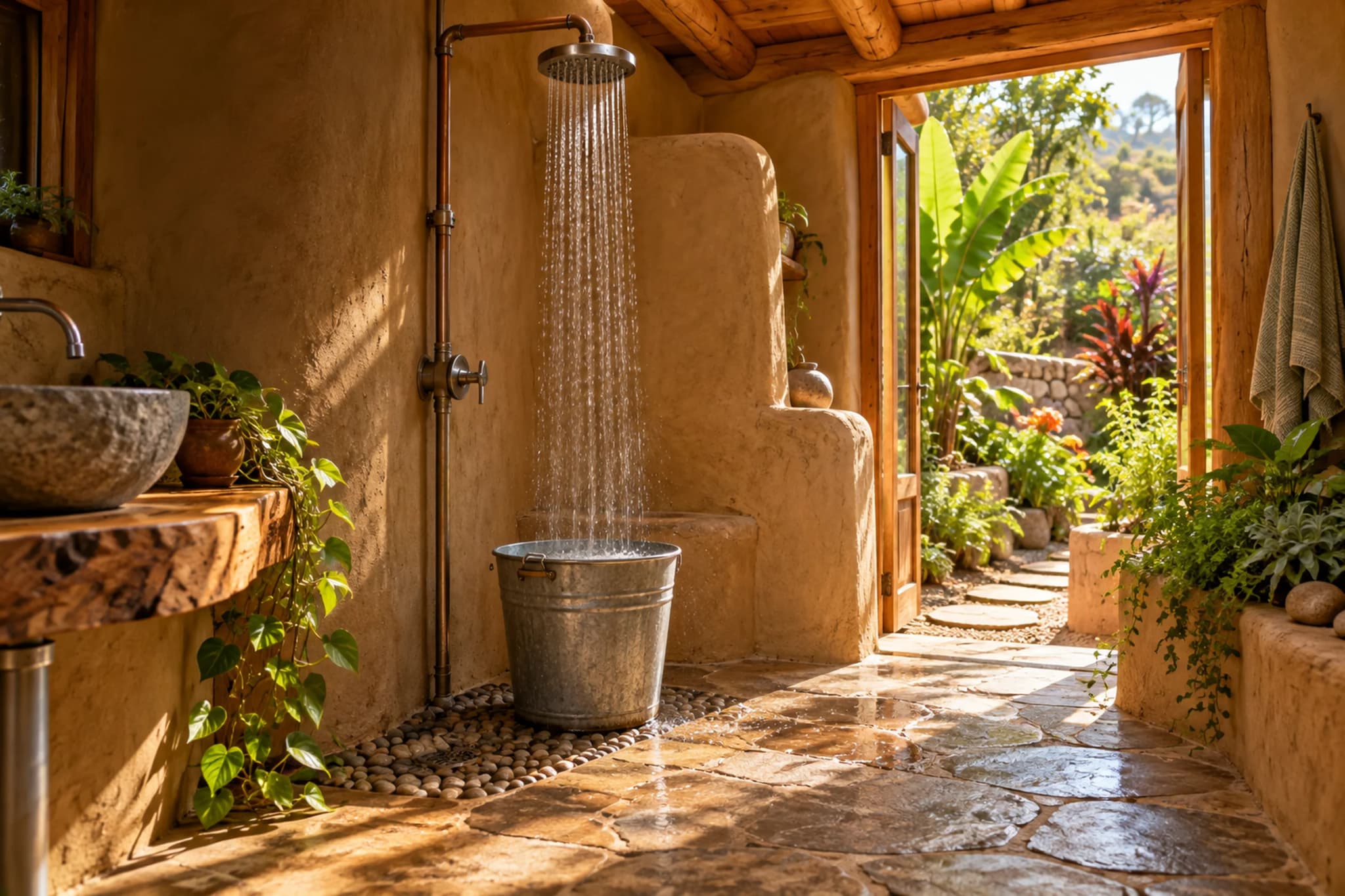
Here is a neat trick. The water from your shower, bath, bathroom sink and washing machine is called greywater. Water from the kitchen sink, the dishwasher and the toilet is not, because it carries food, grease or worse.
Greywater can soak your garden instead of going down the drain, and a common simple setup needs no extra pump. The washing machine's pump pushes it out, and a 3-way valve lets you send it to the garden or to the sewer.
One rule never changes: do not store greywater more than 24 hours. It goes smelly fast. Our greywater guide explains the setups, the soaps and the permits, and toilet water belongs in a septic system instead.
Going Off-Grid With Water
Before you build or install any equipment, count how much you use. An American uses about 80 to 100 gallons (300 to 380 litres) a day indoors, though estimates vary. Off-grid homes often use far less once each drop has to be pumped and cleaned, and that makes the whole system smaller and more self-reliant.
For a well, a domestic supply usually needs about 5 gallons (19 litres) a minute. A slower well can still do the job with a large storage tank that builds up a reserve between uses.
You would not be alone with an off-grid water system. Around 15% of people in the US, over 43 million, rely on private wells for their drinking water. Rules on digging a well, collecting rain and reusing greywater differ by country and by state, and some may require a permit. Check them for your property and follow the rules in your area before you start.
Why People Pick Their Own Water
No water bill, no water company, and water you control yourself, even when the town has a problem. That is the payoff of an off-grid water system, and for many people a real step to a self-sufficient life.
The trade-off is that you become the water company. You choose the source, maintain the pump and the plumbing, do the maintenance on the tanks, change the filters and test what you drink. Bear those parts in mind and get them right, and every glass from your tap is water you caught yourself.
Sources
- USGS Water Science School: Where is Earth's water?
- USGS Water Science School: Groundwater wells
- CDC: Collecting rainwater and your health
- University of Nebraska-Lincoln Extension: Water well pumps (G2152)
- Texas A&M AgriLife Extension: Catchment area
- Fort Wayne City Utilities: Water towers use gravity to deliver water (2022)
- EPA: Private drinking water wells
- CDC: Choosing home water filters
- CDC: Boil water advisory
- USDA NRCS: Conservation Practice Standard 516, Livestock Pipeline (2020)
- UC Cooperative Extension: Greywater basics
- Greywater Action: Laundry to landscape
- USGS Water Science School: Water use questions and answers
Hard Words
| Term | What it means |
|---|---|
| Groundwater | Water that fills the tiny gaps between sand, gravel and rock under the ground. |
| Water table | The level under the ground below which all the gaps are full of water. |
| Aquifer | A layer of wet sand, gravel or rock that holds enough water for a well. |
| Casing | The pipe that lines a well and keeps the walls from caving in. |
| First flush diverter | A device that sends the dirtiest early rain off the roof away from your tank. |
| Pressure tank | A tank that holds water under pressure so the tap flows without the pump starting each time. |
| Submersible pump | A pump that sits under the water inside the well and pushes it up. |
| Micron | One thousandth of a millimetre. Filter holes are measured in microns. |
| Greywater | Used water from showers, baths, bathroom sinks and washing machines. Not from toilets or the kitchen. |
Common Questions
What is an off-grid water system?
It is a home water supply you run yourself, including a source such as a well or a rain tank, a pump, filters, storage, and sometimes a greywater hose to the garden. Nothing arrives from the town.
What is the best water source off the grid?
That depends on your land. Where you can reach good groundwater, a well is the most dependable. Where it rains a lot and a well is hard to dig, a roof and a big tank can be enough. Many homes have both, to allow for a dry year.
Is rainwater safe to drink?
Not without treatment. Rainwater can carry germs and chemicals, so remove them, test it regularly and ask your local health department what to test for.
How much does an off grid water system cost?
There is no single price. A drilled well, a rain tank, a pump and filters each cost something else, and the price changes with how deep the water is and how much you need. Our guides to drilling a well and collecting rainwater give the cost ranges for each.
How do you keep water from freezing off the grid?
Bury pipes deep enough to stay below the frost, and put the pump and tank somewhere out of the cold. US conservation rules say buried water lines must sit deep enough to be safe from freezing.
Check the frost depth in your area.
How much water does a home use?
About 80 to 100 gallons (300 to 380 litres) per person per day for indoor use in the US, though estimates vary.