

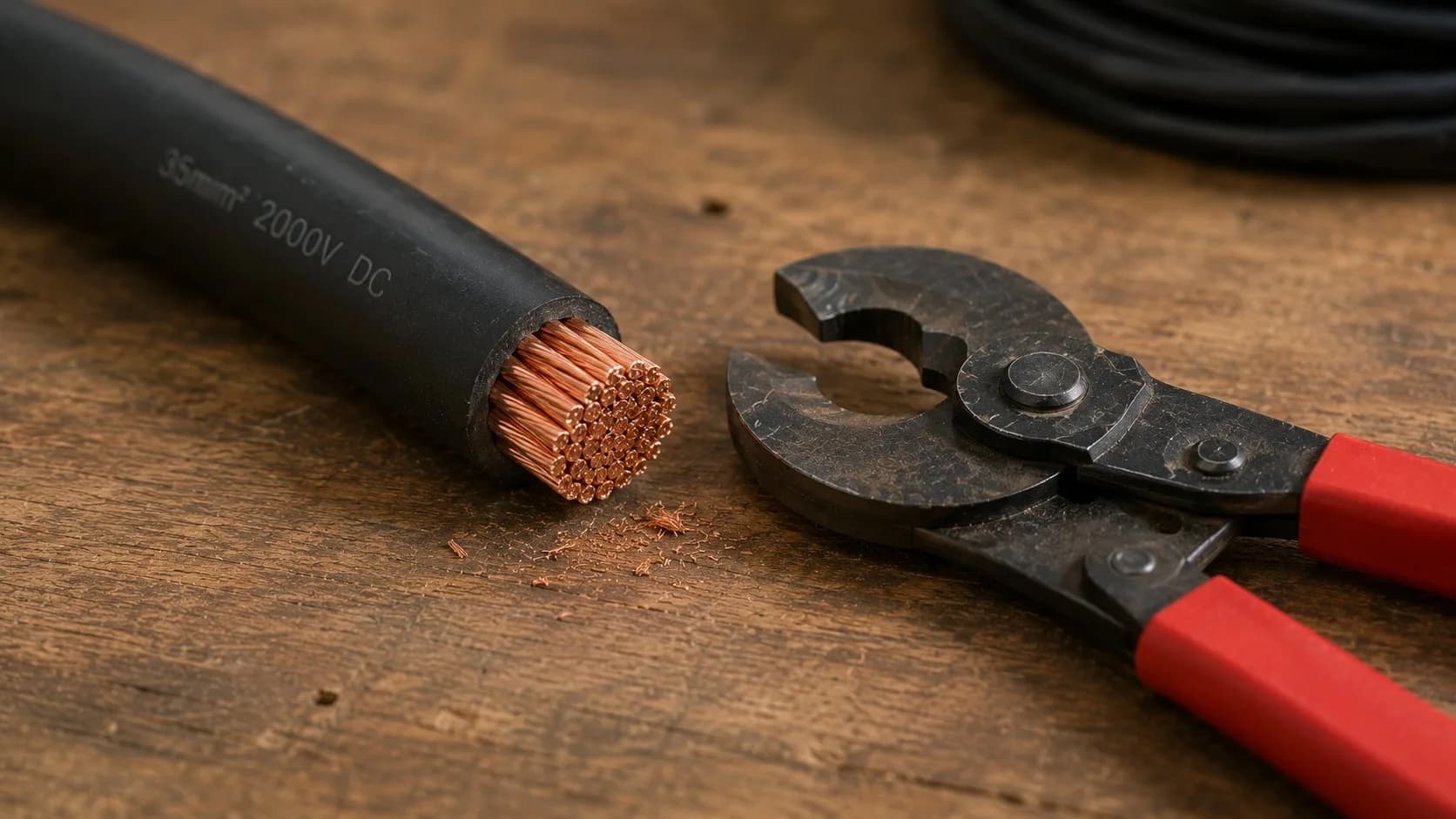
What This Calculator Does
This DC cable size calculator finds how thick the cable between your battery and inverter has to be, in square millimetres (mm²).
Battery cables carry a lot of current at low voltage. Too thin, and the cable gets hot and wastes power on the way. Think of a garden hose: push a lot of water through a thin one, and the pressure at the end drops.
How To Use This Calculator
- In Inverter AC power, type the inverter's rated watts from its datasheet.
- In Inverter efficiency, type the percentage from the datasheet. Don't know it? Leave it at 90, a cautious figure: Victron lists a best-case efficiency of 93 to 96% for its MultiPlus-II.
- In Battery voltage (DC), type your battery bank voltage, like 12, 24 or 48.
- In One-way cable length, type the distance from the battery to the inverter in metres. Only one way: the tool doubles it for you.
- In Allowable voltage drop, type how much voltage you accept losing. 3% is a sensible default.
- In Conductor material, pick copper or aluminium. Most battery cable is copper.
- In Insulation temperature rating, pick what's printed on the cable jacket. Not sure? Keep 70 °C, the safe side.
- Read the result card. You see the current, the fuse that belongs on it, the minimum size to carry that fuse, the size the voltage drop demands, and the Recommended standard size. Buy that one.
The Formula, In Plain Words
First the calculator works out the current: inverter watts divided by battery voltage times efficiency. The inverter loses a little power as heat, so the battery has to send a bit more.
Then it checks two things. The first is heat.
Every cable needs a fuse, and the fuse is 125% of the current, rounded up to a size you can buy. The cable must carry at least that fuse rating, or the fuse can't protect it. The amps per size come from ISO 10133, a standard for low-voltage DC wiring on boats, for one cable in 30 °C air.
The second is voltage drop. It multiplies 2 by the cable length, the current and a number for how well the metal carries power.
Copper gets 0.0175 and aluminium 0.0283. It divides that by the volts you allow to lose.
The 2 is there because current has to go out and come back.
Whichever check asks for the thicker cable wins. The result rounds up to the next size you can buy.
A Worked Example
Say you have a 2,000 W inverter at 90% efficiency on a 24 V battery, 3 metres away, copper cable with 70 °C insulation and 3% drop.
The current is 2,000 ÷ (24 × 0.9) = about 92.6 A. The fuse must be at least 92.6 × 1.25 = 115.7 A, so it's a 125 A fuse.
25 mm² carries 120 A, just short of 125 A. 35 mm² carries 160 A, so heat asks for 35 mm². Voltage drop asks for only about 13.5 mm².
35 mm² is the thicker one, so the answer is 35 mm². With 105 °C battery cable, 16 mm² carries 130 A and would be enough.
What To Watch Out For
The fuse steps are Class T sizes. If your fuse type lacks that size, the next one up needs a cable that carries it.
Inverter manuals often ask for a bigger fuse: Victron wants 125 A and 35 mm² on a MultiPlus-II 48/3000. The tool shows that box when your watts match a MultiPlus-II's continuous watts, like 2,400 W for the 3000 VA model. Use the manual's cable size, never thinner.
The amps table holds for one cable in 30 °C air. Hot spaces, like an engine room, and bundled cables carry less. Your inverter's manual often lists a cable size and fuse, and that comes first.
The current is based on the normal battery voltage. A nearly empty battery has a lower voltage, so the real current is a few percent higher. The 25% fuse margin leaves room for that.
Above 150 mm² the standard has no amps figure, so for very big currents the tool tells you to split the run into two cables side by side.
Every cable from the battery also needs a fuse. Size it with the DC fuse size calculator.
Using wire sold in AWG? The AWG to mm² chart translates it.
Hard Words
| Term | What it means |
|---|---|
| mm² | Square millimetres. The size of the copper inside a cable, measured across its cut end. |
| Current (A) | How much electricity flows through the cable, measured in amps. |
| Voltage drop | The voltage lost along a cable because the metal resists the flow a little. |
| Ampacity | How many amps a cable can carry before it gets too hot. |
| Resistivity | A number for how hard a metal makes it for electricity to flow. Copper is better than aluminium. |
| Efficiency | How much of the power going in comes out as useful power. 90% means 10% turns into heat. |
| Insulation rating | The highest temperature the plastic around the copper can take. Higher means more amps. |
Common Questions
What size cable do I need from battery to inverter?
It depends on the inverter power, battery voltage, cable length and insulation. A 2,000 W inverter on 24 V, 3 metres away, draws about 93 A. It needs a 125 A fuse and 35 mm² copper cable with standard 70 °C insulation. Always check the inverter manual too, because it often gives a minimum size.
Why do battery cables need to be so thick?
Batteries run at low voltage, so the same power needs a lot of current. A 2,000 W load on 24 V pulls over 80 amps, while the same load on a 230 V socket pulls under 10. All that current heats a thin cable and wastes energy, so low-voltage cables must be much thicker.
What voltage drop is acceptable on DC cables?
Many solar calculators and installers keep DC voltage drop at 3% or less. Victron aims for under 2.5% on battery cables, because a big drop can set off the inverter's low-voltage alarm under heavy load. Check your inverter manual and use the stricter number when in doubt.
Is cable length one way or round trip?
In this calculator you type the one-way distance, from battery to inverter. The calculator doubles it, because current flows out on the positive cable and back on the negative one. Many mistakes come from entering the round-trip length and then doubling it again, which gives a cable that is thicker than needed.
Can I use aluminium instead of copper cable?
You can, but aluminium carries power less easily than copper, so it must be thicker for the same job. This calculator uses 0.0283 for aluminium against 0.0175 for copper, and lets aluminium carry about 77% of the amps. Aluminium also needs connectors made for it. For short battery cables, copper is the normal choice.
Sources
- ISO 10133:2000, Small craft, extra-low-voltage DC installations. Values based on ISO 10133:2000, since replaced by ISO 13297:2020.
- ISO 13297:2020, Small craft, AC and DC installations
- Victron Energy, Wiring Unlimited
- Victron Energy, MultiPlus-II installation manual, connection of battery cables
- Victron Energy, MultiPlus-II datasheet