

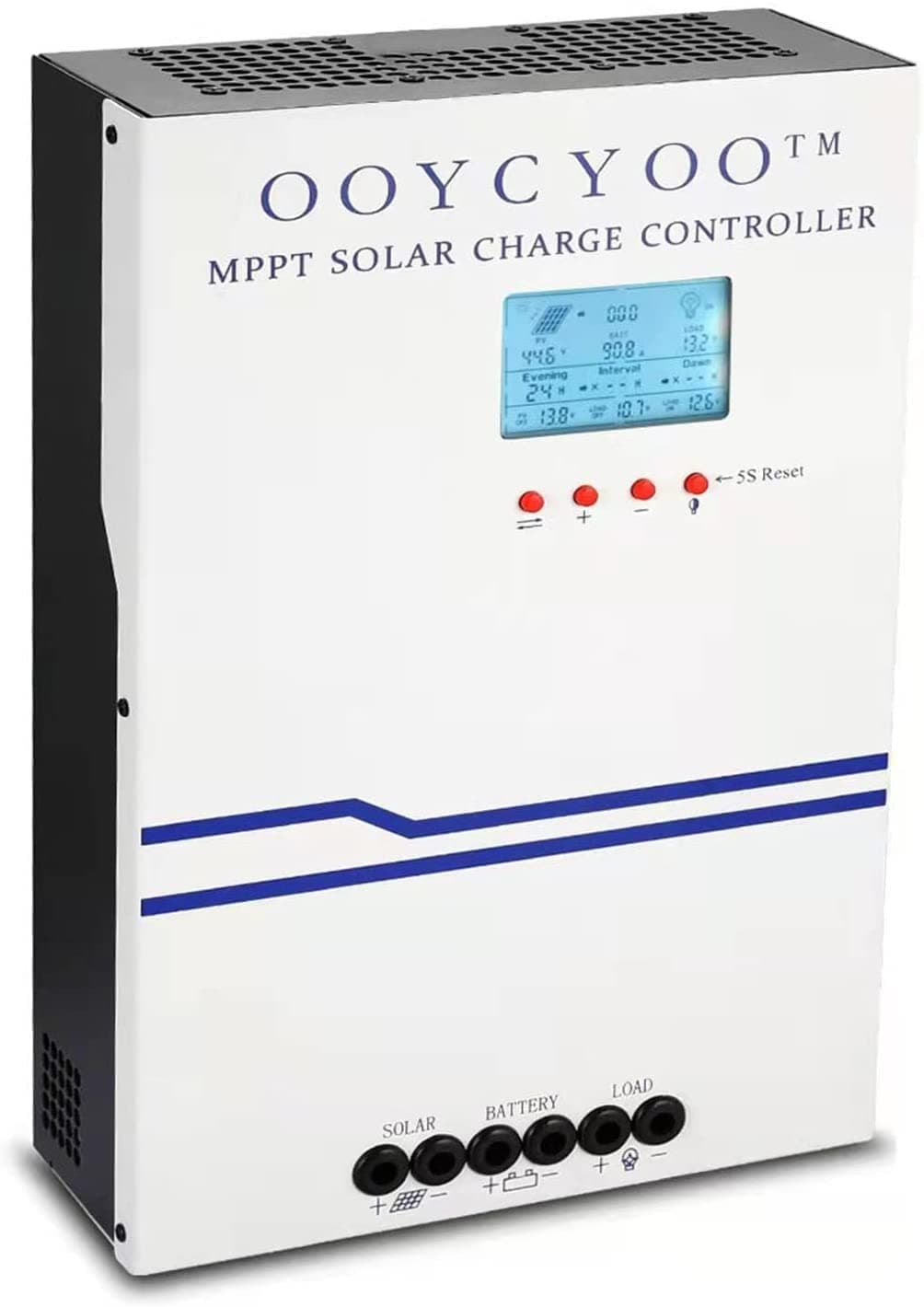
What This Calculator Does
This MPPT charge controller calculator tells you which charge controller can safely sit between your solar panels and your battery.
A charge controller is the gatekeeper of your battery. It takes whatever the panels send and feeds the battery just the right amount.
Scientists call the smart kind "MPPT", short for maximum power point tracking. That's just a fancy way of saying it keeps adjusting to squeeze the most power out of your panels.
How To Use This Calculator
- In Panel count, type the total number of panels.
- In Panel max power, type the watts on one panel's datasheet.
- In Panel Voc (open-circuit voltage), type the Voc from the datasheet. It's the panel's highest voltage, with nothing connected.
- In Panel Imp (max-power current) and Panel Isc (short-circuit current), type the Imp and Isc from the datasheet. Can't find the datasheet? The sticker on the back of the panel usually lists all of them.
- In Panels in series per string, type how many panels are chained one after another. In Strings in parallel, type how many of those chains sit side by side. The two multiplied should equal your panel count, or the tool warns you.
- In Battery system voltage, pick 12, 24 or 48 V.
- In Lowest expected temperature, type the coldest clear morning you expect at your site, in °C. A lower number is the safe side.
- In Voc temperature coefficient, type the number from the datasheet, often written as β(Voc). It's negative, like -0.29 %/°C. Modern panels mostly sit between about -0.23 and -0.30.
- Read the result card. The big number is the input voltage class your controller needs. Below it you see the string voltage on that cold morning, the charge current, the array power and current, and a suggested model.
The Formula, In Plain Words
Panels make a higher voltage when they're cold. Datasheet values hold at 25 °C. For every degree colder, Voc rises by the temperature coefficient.
So the calculator takes the degrees below 25 °C, times the coefficient, and adds that to 1. It multiplies the panels per string times Voc by that number. That's the string voltage on a frosty sunny morning.
The US electrical code (NEC 690.7) does it the same way.
It rounds this up to the next controller class: 75, 100, 150 or 250 V.
For current, it divides the total panel watts by the battery's charge voltage. That's 14.4 V for a 12 V battery, 28.8 V for 24 V and 57.6 V for 48 V. The answer is the charge current at full panel power.
Then it picks the smallest Victron SmartSolar model that covers three things: the cold voltage, your panel watts, and the array's short-circuit current. That last one is Isc times the strings in parallel. For the watts it uses Victron's own datasheet figure, the "nominal PV power" each model handles at your battery voltage.
A Worked Example
Take the starting values: 6 panels of 400 W, Voc 49 V, Imp 11 A, Isc 11.6 A, wired as 3 strings of 2, on a 48 V battery. The coldest morning is -10 °C and the coefficient is -0.29 %/°C.
That's 35 degrees below 25 °C, so Voc rises 35 × 0.29 = 10.15%. String voltage is 2 × 49 × 1.1015 = about 107.9 V, so you need a 150 V controller.
Charge current is 2,400 ÷ 57.6 = about 41.7 A. Array short-circuit current is 3 × 11.6 = 34.8 A.
The 150/35 handles 2,000 W of panels at 48 V, too little. The suggested model is the 150/45: 150 V, 2,600 W of panels at 48 V, 45 A, and up to 50 A of panel short-circuit current.
What To Watch Out For
Voltage is the dangerous number. If a cold morning pushes the string above the controller's limit, the controller can break. So always use the cold voltage, never the label voltage alone.
Victron's panel-watt figure is not a hard limit either.
A smaller MPPT doesn't break when the panels give more: it caps its output and wastes the extra. Want room to add panels later? Pick the next model up.
The panel voltage also has to stay above the battery. An MPPT only starts charging when the panels give about 5 V more than the battery's charge voltage. The tool warns you if a string is too short.
PWM controllers only fit a small panel made for your battery voltage, like a "12 V" panel with a Voc around 22 V on a 12 V battery. Read more about charge controllers, then size the wire with the DC cable size calculator.
Hard Words
| Term | What it means |
|---|---|
| Charge controller | The box between solar panels and battery that feeds the battery safely. |
| MPPT | Maximum power point tracking. A smart controller that keeps adjusting to get the most power from the panels. |
| Voc | Open-circuit voltage. The highest voltage a panel makes, with nothing connected. |
| Imp | The current a panel delivers when it is working at its best. |
| Isc | Short-circuit current. The most current a panel gives, with plus and minus connected. |
| Temperature coefficient | How much a panel's voltage changes per degree, in % per °C. |
| String | A chain of panels wired one after another, so their voltages add up. |
| Parallel | Strings wired side by side, so their currents add up. |
Common Questions
What size charge controller do I need?
You need three numbers. The controller's input voltage must be higher than your string's voltage on the coldest day. Its rated panel watts at your battery voltage should cover your array. And its PV short-circuit limit must cover your array's Isc. For 2,400 W on a 48 V battery, that is about 41.7 A of charge current, so a 150/45 model fits.
Why does cold weather matter for a charge controller?
Solar panels make a higher voltage when they are cold. On a frosty, sunny morning a string can go well above its label voltage. If that exceeds the controller's maximum input, the controller can be damaged. At -10 °C, a typical modern panel gives about 10% more than its label voltage.
What is the difference between MPPT and PWM?
A PWM controller works like a simple switch and only suits small panels that match the battery voltage. An MPPT controller converts higher panel voltage down to battery voltage and keeps finding the best working point. MPPT gets more energy out of the same panels and is the normal choice for homes.
Should I wire solar panels in series or parallel?
Series adds voltage, parallel adds current. Series strings need thinner cable and work better over long distances, but must stay below the controller's voltage limit on cold days. Parallel keeps the voltage low but raises current. Most systems mix both, which is what the strings settings in this calculator describe.
Can I use a bigger charge controller than I need?
Yes. A controller rated higher than your array needs is safe and leaves room to add panels later. It mainly costs more. The opposite is the risk: a controller that is too small on voltage can break, and one that is too small on current wastes some of your solar power.