

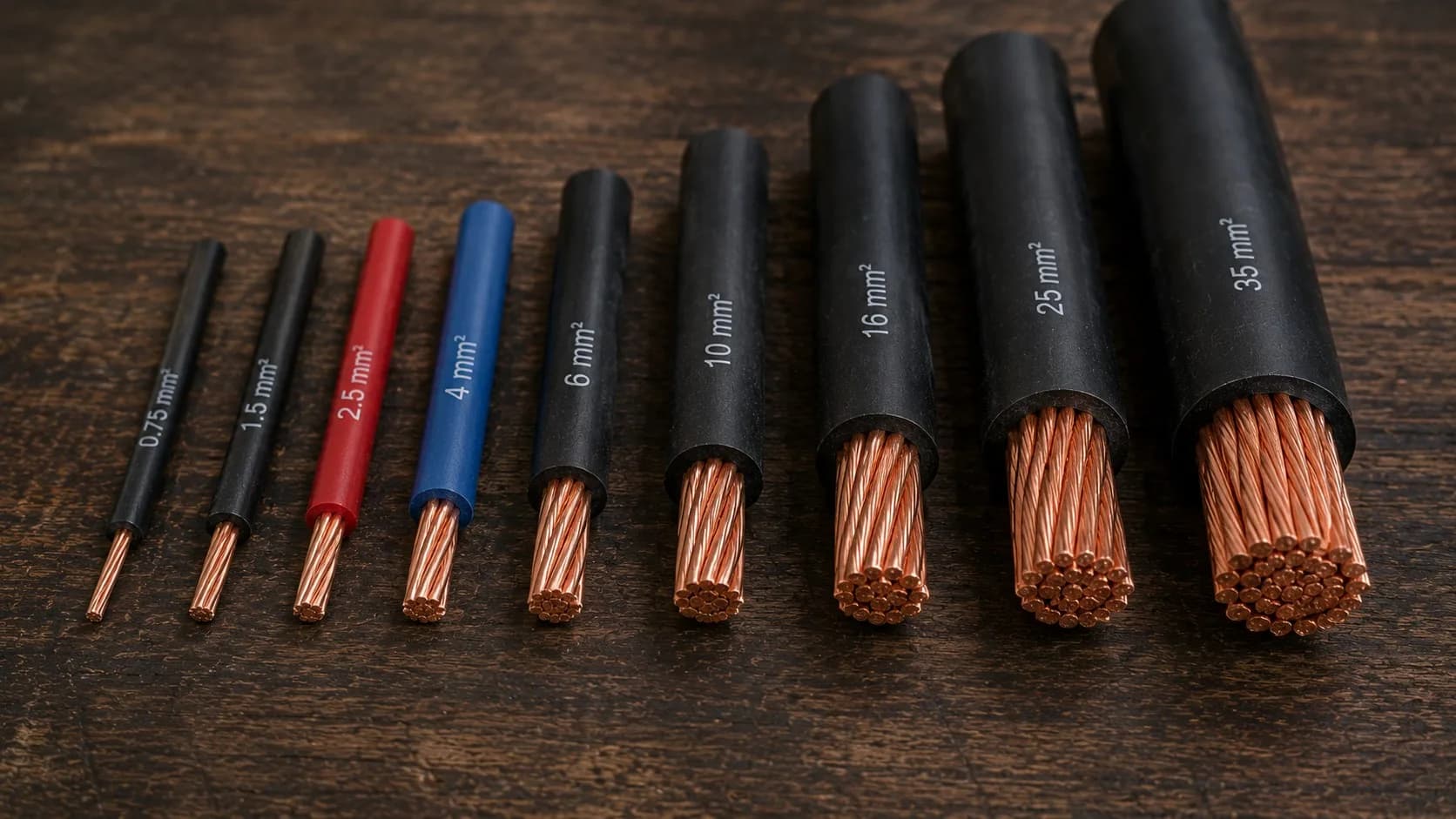
What This Chart Does
This AWG to mm² chart translates between two ways of measuring wire.
The US sells wire by "AWG", short for American Wire Gauge. Most of the world sells it by mm², the area of the copper you'd see if you cut the wire straight through. Plans, YouTube videos and shops often use different systems, so you need a translator.
The odd part is that AWG counts backwards. A bigger number means a thinner wire. 20 AWG is thinner than a spaghetti strand, while 4/0 AWG is thicker than a pencil.
How To Use This Chart
- Get the size you need first. For a battery cable, the DC cable size calculator gives it to you in mm².
- Type it in Metric size to convert. The result card shows the smallest AWG with at least that much copper.
- Prefer the table? Go down the mm² column and stop at the smallest number that is equal to or bigger than your size. Never pick a smaller one, even if it's close. The AWG on that row is the gauge to ask for.
- Going the other way? Find your gauge in the AWG column and read the mm² next to it.
- The other columns are extra facts: the diameter in inches and mm, the area in kcmil (another US unit), the resistance per metre, and the safe current in three Max A columns, one per insulation rating.
How The Numbers Fit Together
The conversion is a lookup in a fixed table, from 4/0 down to 20 AWG.
The numbers still follow a neat pattern. Every 3 steps in AWG roughly halves the copper area. 10 AWG has 5.26 mm², and 13 AWG has 2.62 mm².
Half the copper means about double the resistance. Scientists call resistance the "push-back" a wire gives against the flow of electricity. More push-back means more heat and more lost power.
A Worked Example
Say the cable calculator tells you to use 16 mm².
Going down the mm² column, 13.3 mm² (6 AWG) is too small. The next row is 16.8 mm², which is 5 AWG, so that's your answer.
If your shop doesn't sell 5 AWG, go to the next thicker size: 4 AWG, with 21.2 mm².
What To Watch Out For
Always round toward the thicker wire. A slightly too-thin cable gets warm and wastes power.
The Max A columns come from the same table as the cable and fuse calculators: ISO 10133 (2000 edition), for one copper wire in 30 °C air. That standard lists metric sizes and lets you fill in the sizes between, which is how each AWG gets its number. 10 AWG, for example, carries 41 A with 70 °C insulation and 54 A with 105 °C insulation.
The hotter the insulation may get, the more amps the same copper can carry. Hot spaces and bundled wires carry less. The thinnest gauges, 19 and 20 AWG, are below the standard's smallest size, so they get no number.
Metric and AWG sizes never line up exactly, so a "6 mm² equals 10 AWG" style rule is only a rough guess. Wiring up a battery? See wiring the system.
Hard Words
| Term | What it means |
|---|---|
| AWG | American Wire Gauge, the US system for wire sizes. A lower number means a thicker wire. |
| mm² | Square millimetres, the metric size of a wire: the area of copper across its cut end. |
| 4/0 | Said "four aught". A very thick wire, four steps thicker than 1 AWG. |
| kcmil | A US unit for the area of thick wires, one thousand circular mils. |
| Resistance | How much a wire pushes back against the flow of electricity. More resistance means more heat. |
| mΩ/m | Milliohms per metre: the resistance of one metre of the wire. |
Common Questions
How do I convert AWG to mm²?
Look up the gauge in a conversion chart and read the area next to it. For example, 10 AWG is 5.26 mm² and 4 AWG is 21.2 mm². AWG and metric sizes never match exactly, so when you go from mm² to AWG, always pick the next thicker wire rather than the closest one.
Why does a higher AWG number mean a thinner wire?
The numbers come from the old way of making wire, by pulling it through smaller and smaller holes. Each pull made the wire thinner and added one to the count. So 20 AWG went through many more steps than 4 AWG, and ended up much thinner.
What AWG is 16 mm²?
16 mm² falls between 6 AWG, at 13.3 mm², and 5 AWG, at 16.8 mm². To be safe you round toward the thicker wire, so 16 mm² becomes 5 AWG. If 5 AWG is hard to find, 4 AWG at 21.2 mm² is the next thicker choice.
How many amps can 10 AWG wire carry?
It depends on the insulation and how warm the space is. Charts disagree because they use different assumptions. This chart uses the ISO 10133 table for one wire in 30 °C air: 41 A with 70 °C insulation, 46 A at 85 to 90 °C and 54 A at 105 °C. The US house wiring table (NEC 310.16), for up to three wires together in a pipe or cable, gives less: 30 to 40 A. Some old charts say 15 A, which is a very cautious rule for long power lines. For a real install, follow the cable maker's rating and your local electrical rules.
Should I round up or down when picking a wire size?
Always round up to the thicker wire. A wire that is slightly too thin heats up and loses more power, and in the worst case it can become a fire risk. A wire that is slightly too thick only costs a bit more and is a little harder to bend.
Sources
- ISO 10133:2000, Small craft, extra-low-voltage DC installations. Values based on ISO 10133:2000, since replaced by ISO 13297:2020.
- ISO 13297:2020, Small craft, AC and DC installations
- Cerrowire, Ampacity chart (NEC 310.16)
- US eCFR, 33 CFR 183.425, allowable amperage of conductors and bundling factors
- Wikipedia, American wire gauge