

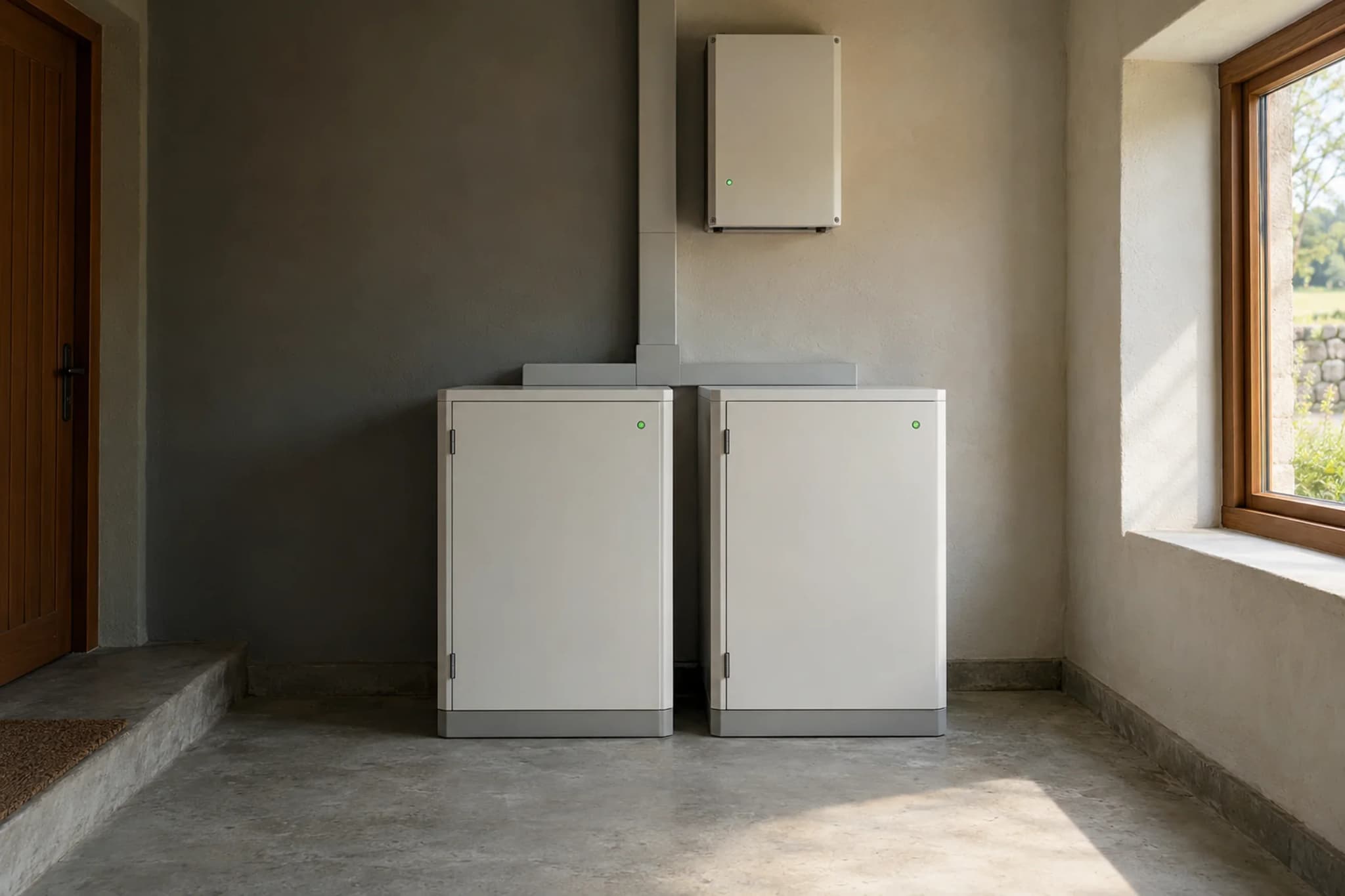
This is the step where everything finally talks to each other.
In Step 1 you worked out how much energy you use, in Step 2 you picked a battery, and in Step 3 you chose the box that charges it. Now comes the off grid solar wiring: the cables, fuses and switches that turn a pile of components into one working energy system.
Get it right and your solar system runs quietly and reliably for years, through all kinds of weather. Get it wrong and the cables get hot, which is how fires start. So we take the installation slowly, one piece at a time.
The Off Grid Solar System Wiring Diagram, In Words
Most wiring diagrams look like a plate of spaghetti. Underneath, though, almost every off grid solar system follows the same simple path, from roof to fridge.
- Solar panels catch sunlight and make DC power. Scientists call this kind "direct current": it flows one way only, like water in a hose.
- The charge controller (also called a solar charger) takes that power and feeds the battery the right amount, so it doesn't get overcharged.
- The battery is your energy storage. It holds power for the night and backup for cloudy days. How many days it can carry you is called "autonomy", and you picked that number in Step 1.
- The inverter is a kind of translator box. It turns the battery's DC into the AC power your house sockets use.
- Your house panel sends that AC power to your lights and appliances.
Think of it like a water hose with a few boxes on the way, each one with its own safety tap. Each box only knows how to do one job. Skip a box or wire one the wrong way round, and things break or catch fire.
If you want to see every piece of equipment in this chain on its own, including what each one costs, our guide to off grid solar system components walks through them one by one.
In What Order Do You Connect The Charge Controller And Battery?
Here's the part that surprises people. The path the power takes is not the order you plug things in.
Most solar chargers need the battery first. Once it's connected, the charger checks the voltage and sets itself up for it. Connect the solar side first, and it can set itself up for the wrong voltage.
Victron's manual for its SmartSolar MPPT 100/30 and 100/50, for example, says: connect the battery, wait, check the voltage, then connect the panels. It only allows panels first if you set the battery voltage by hand beforehand.
Inverters have their own rules too. They hold big capacitors that pull a huge rush of current when the battery is first connected, so some systems "pre-charge" them slowly before the main battery switch closes.
Every brand is different. Read the installation part of each manual and stick to its order, both for switching on and for switching off. This sounds boring, but it's the cheapest protection against a broken controller you'll ever get.
How Do You Wire Solar Panels Together For The Best Power?
All your panels together are called an "array". You can link them in two ways, depending on the voltage you need.
In series (one after the other, plus to minus), the voltages add up. Two 12V panels make 24V.
In parallel (side by side, plus to plus and minus to minus), the currents add up. Two 12V ones stay at 12V but give twice the current.
Larger off-grid systems often use a mix of both to land at a voltage the solar charger likes. Higher voltage means less current for the same power, so thinner cable can carry it.
But there's a catch, and it's a sneaky one. Every solar charger has a maximum input voltage. The SmartSolar MPPT 100/30, for example, allows up to 100V from the panels.
Want to know the strange part? Solar cells make a higher voltage when they're cold. Victron warns that in low temperatures the open circuit voltage of a string can rise above the charger's limit, and that you then have to put fewer of them in series. So size your strings for the coldest winter morning, not a mild spring day. Those cold, bright conditions are exactly when the voltage can reach its peak. The controller size calculator helps you calculate your numbers before buying, so you can select a charge controller with room to spare. Mounting is a separate job; the solar section covers it.
Wiring The Battery Bank For Backup Energy, And The Inverter
The battery bank. If you have more than one battery, you connect them into a "bank". Same rules as before: series for more voltage, parallel for more capacity, or a mix. The guide to choosing a solar battery explains which batteries you can combine.
In a parallel bank, the cables matter more than people expect. Victron says that for a balanced system you need the same cable type, thickness and length to every battery. Otherwise the batteries don't share the work evenly, so one wears out faster than expected. That's bad for the lifespan of the whole bank, and for your backup on cloudy days.
The inverter. Thick cables run from the battery bank to the inverter's input. The inverter's output goes to your regular electrical panel, or straight to AC appliances in a tiny setup. Selecting the right off grid inverter comes before this step, because its voltage has to match your bank.
Keep the bank, the solar charger and the inverter close together. Victron puts it simply: the closer the batteries, the shorter the cable, and the thinner the cable can be.
DC Loads Can Skip The Inverter
Some things in an off-grid home don't need the inverter at all. LED strip lights, 12V water pumps and USB chargers run on DC, the same kind of power the battery stores.
It's often smarter to wire these straight to the bank, each with its own fuse. That skips the inverter, which always loses a little energy when it converts. Even a good one, like Victron's MultiPlus-II, tops out at about 93 to 96% efficiency, depending on the model. Skip that step and the efficiency of those DC appliances goes up.
It's like walking straight to your friend's house instead of taking a bus that stops twice on the way.
How Do You Protect Your System? Select Fuses, Switches And Cables
This is the most important section, because good safety is part of the process, not an extra at the end. Stored energy is a lot of energy, and a short circuit lets it all out at once. Victron points out that lithium batteries (the most common kind in new home storage) can deliver very high short-circuit currents, which is why a fuse that can actually stop that current is required, not optional. Here are the safety hazards to plan for, and the fix for each.
Fuses on the plus side. A fuse is a weak link on purpose. If too much current flows, it melts and breaks the circuit before the cable can overheat. It's your main protection against fire, and it's important that it's fully rated for the voltage of your system. Victron's wiring guide puts the fuse in the positive cable, gives every load on the battery its own fuse, and adds one between the array and the solar charger. Our page on what fuse do I need explains how to pick one, and the fuse calculator gives you a size.
A battery switch. A big switch on the battery lets you cut everything off for repairs or in an emergency. Victron recommends that if you isolate the battery, you only switch the positive cable. Our guide to the battery disconnect switch shows how it works and which kind to buy for your electrical system.
The right cable thickness. Thin cable can't carry much current. Victron says a cable that is too thin hurts your system's performance, and that cables heat up when current passes through them. Force too much through a thin one and the plastic can melt. The cable calculator tells you what thickness you need, and the AWG conversion chart translates between the American AWG numbers and square millimetres.
Tight connections. A loose screw on a terminal looks harmless, but it can cause big trouble. Victron warns that poor contact leads to overheating and to connections that work themselves loose over time. Tighten every connection properly, to the torque the manual gives, to prevent that.
Insulation and labels. Wrap every bare end and cover the terminals. Then label every cable so that you (or someone else) can figure out what does what in two years. It's a small job that provides a big payoff the first time something stops working.
Where Does The Battery Monitor Go?
The monitor's sensor goes on the battery's minus wire, with nothing else connected to that side. Scientists call this sensor a "shunt".
A shunt is a small metal bar that every bit of current has to pass through, like a toll gate that counts every car. That lets a battery monitor tell you how full your storage is and how your system's performance holds up over time.
Victron's SmartShunt manual says the battery minus connects to one side, and everything else (loads, inverters, chargers, solar chargers) to the other side. Our page on the battery shunt shows the wiring in more detail.
When Should A Professional Check Your Solar Installation?
Wiring up an off grid solar system isn't rocket science, but it isn't building with Lego either. Many people do the DC side themselves, with care and the manuals open. Good technology helps you ensure it's right: many solar chargers and monitors show live numbers in an app, so you can check your work.
The AC side is different. From the inverter to your house panel, it's the same kind of power as a wall socket, and mistakes there can kill. If you don't have experience with mains wiring, get a qualified electrician or another professional to do it, or to check your work before you switch anything on.
Rules also depend on where you live. Some places need a permit or an inspection, even for a solar system that never touches the grid. Take that into account before you buy equipment. Our page on off grid solar permits tells you what to check before you start the electrical installation.
Quick Recap
- Power flows from the panels to the charge controller, the battery, the inverter and your house.
- Connect in the order the manuals say, which usually means battery first, panels last.
- Size your strings for cold weather, so the voltage stays under the charger's limit.
- Fuses go on the plus side: one per load, one between the solar panels and the charger.
- Use thick enough cable, keep it short and keep every connection tight.
- The shunt goes on the battery minus, alone.
- Have a pro check the AC side.
Want the whole build in one place, from Step 1 to here? Read how to build a home battery.
Sources
- Victron Energy, SmartSolar MPPT 100/30 and 100/50 manual
- Victron Energy, SmartSolar MPPT 100/30 and 100/50 technical specifications
- Victron Energy, EasySolar-II GX manual, PV array design
- Victron Energy, Wiring Unlimited, DC wiring
- Victron Energy, MultiPlus-II inverter/charger datasheet
- Victron Energy, SmartShunt manual, installation
- Victron Energy, Lynx Smart BMS manual, built-in pre-charge circuit
Hard Words
| Term | What it means |
|---|---|
| Series | Wiring devices end-to-end so their voltages add up. Two 12V panels in series make 24V. |
| Parallel | Wiring devices side-by-side so their currents add up. Two 12V panels in parallel make 12V at double the current. |
| Array | All your solar panels wired together as one group. |
| Open circuit voltage | The voltage a panel makes when nothing is connected. It rises when the panel is cold. |
| Battery bank | Multiple batteries wired together as a single unit. Combines series and parallel wiring to hit the right voltage and capacity. |
| Cable thickness | How fat the wire is. Thin cables cannot carry much current without overheating. Use a calculator to pick the right size. |
| Fuse near the battery | A safety fuse placed within a short distance of the battery's terminal. Protects the cable that follows it. |
| Insulation | The plastic coating around a wire. Stops accidental shorts when two cables touch. |
| Label | A sticker on each cable. Tells future-you which cable does what. |
| DC loads | Devices that run on DC directly (LED strips, 12V pumps, USB chargers). Can be wired straight to the battery, skipping the inverter. |
| Shunt | The metal bar between battery negative and everything else. Lets a monitor count every electron that flows in or out. |
| Mains-level wiring | Standard household AC wiring on the inverter output side. Higher voltage than the DC side; if you have not done it before, get a pro. |
Common Questions
What is the order of off grid solar wiring?
Power flows from the solar panels to the charge controller, to the battery, to the inverter, to your house. But that is not the order you connect them. Most need the battery connected first and the solar input last, so follow each device's manual.
How do I wire panels together?
Series adds voltages (one after the other). Parallel adds currents (side by side). Larger solar systems use a mix to land at a voltage the charger accepts, with room to spare for cold days when the voltage goes up.
How do I wire batteries together?
Same rules as solar panels: series for more voltage, parallel for more capacity, or both. In a parallel bank, give each one the same cable type, thickness and length so they share the work evenly.
Can I skip the inverter for some loads?
Yes. LED strip lights, 12V water pumps and USB chargers run on DC directly. Wire them straight to the bank with their own fuse and you skip the few percent the inverter loses in conversion.
Why does every battery connection need a fuse?
Because a short in any cable can dump a huge current at once. The fuse blows first and breaks the circuit before the cable melts or starts a fire.
How do I pick the right cable thickness?
Use the cable calculator on this site. You enter the inverter power, the battery voltage, the length of the run and how much voltage drop you accept, and it gives you a size in mm2. The AWG chart translates that to AWG. Round up if you land between two sizes.
Should I label every cable?
Yes. It sounds silly until you are hunting for a problem in two years and have no idea which cable is which. A label that says BATTERY+ or INVERTER OUT saves hours.
Should I do the wiring myself?
The DC side often yes, with care. The AC side from the inverter to the house panel is mains-level wiring; if you have never done it before, get a qualified electrician to check or do that part.