

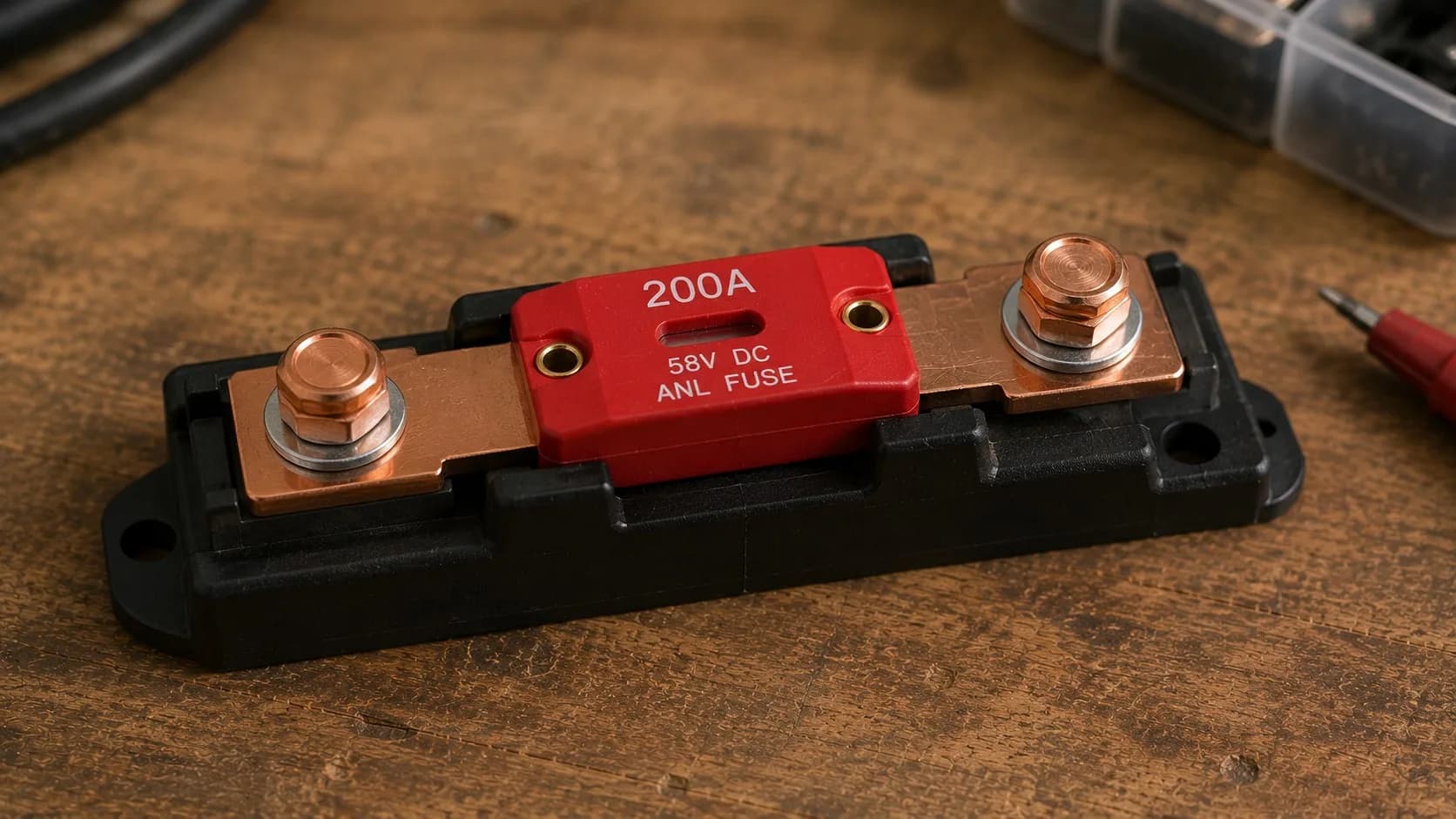
What This Calculator Does
This DC fuse size calculator works out which fuse belongs on the cable between your battery and your inverter.
A fuse is a tiny weak spot on purpose. If something goes wrong and far too much current flows, the thin metal strip inside melts and cuts the power. Better a melted fuse than a melted cable or a fire.
How To Use This Calculator
- In Inverter AC power, type the continuous watts from your inverter's datasheet. Not the surge, and not the VA number: a 3,000 VA Victron gives 2,400 W.
- In Inverter efficiency, keep 90 unless your datasheet says otherwise.
- In Battery voltage, type your battery bank voltage, like 12, 24 or 48.
- In Safety factor, pick 125% (typical) or 150% (conservative). If you don't know, start with 125%.
- In Cable insulation rating, pick what's printed on your cable. Not sure? Keep 70 °C.
- Read the result card. The small line shows the Continuous DC current and the minimum fuse. The big number is the standard fuse size. Below it you see the thinnest cable that fuse can protect. If your watts match the continuous watts of a Victron MultiPlus-II, like 2,400 W for the 3000 VA model, a box shows the fuse and cable its manual asks for.
The Formula, In Plain Words
The calculator divides the inverter watts by the battery voltage times the efficiency. The inverter loses some power as heat, so the battery has to send a bit more. That's the current flowing in the cable when the inverter runs at full power.
Then it multiplies by the safety factor, 1.25 or 1.5, and rounds up to the next standard fuse size. Last, it looks up the thinnest cable that can carry that fuse rating, using the same ISO 10133 table as the DC cable size calculator.
Scientists call that margin "headroom". It's there so the fuse doesn't blow just because the inverter works hard for a while. A fuse that pops every time you boil water is no fun.
A Worked Example
Say you have a 2,000 W inverter at 90% efficiency on a 24 V battery and choose 125%.
The current is 2,000 ÷ (24 × 0.9) = about 92.6 A. Times 1.25 gives about 115.7 A. The next standard size is a 125 A fuse.
A 125 A fuse needs a cable that carries at least 125 A: 35 mm² with standard 70 °C insulation, or 25 mm² with 85 to 90 °C insulation.
What To Watch Out For
A fuse protects the cable, not the inverter, so it must never be bigger than what the cable can carry. That's why the calculator shows the cable too. That cable size is a starting point, not a final spec: it comes from the ISO 10133 table for a single copper cable in free air at 30 °C. Cables bundled together, in a hot space or over a long run need to be thicker, so check the cable calculator as well. If your cable is thinner, use a thicker cable, never a smaller fuse that blows in normal use.
Inverters also draw a big burst for a few seconds when a motor starts. A fuse sized on continuous power alone can blow on that burst, so inverter makers ask for bigger fuses.
Victron's manual asks for 125 A on a MultiPlus-II 48/3000, where the formula for its 2,400 W gives 70 A. With that fuse, use the manual's cable, never thinner: 35 mm² for a run up to 5 m, 70 mm² for 5 to 10 m. When your inverter's manual names a fuse, use it and size the cable for it.
The fuse steps are Class T sizes. ANL and MEGA fuses skip some, like 90 A. If your fuse type lacks the size, the next one up needs the cable checked again.
Check the fuse's voltage rating too. Standard MEGA fuses are made for 32 V, so a 48 V battery needs a 58 or 80 V MEGA, an 80 V ANL or a 125 V Class T.
Fuses also differ in how much current they can safely cut. Lithium batteries can dump huge currents in a short circuit, so the fuse type matters as much as the number. This is called the breaking capacity or interrupting rating (AIC): it must be higher than the short-circuit current your battery maker lists.
Our guide to what fuse you need explains the difference. Your inverter's manual usually lists the right fuse, and that comes first.
Hard Words
| Term | What it means |
|---|---|
| Fuse | A part with a thin metal strip that melts and cuts the power when too much current flows. |
| Current (A) | How much electricity flows, measured in amps. |
| Safety factor | Extra margin above the normal current, so the fuse doesn't blow during normal use. |
| Efficiency | How much of the battery power comes out of the inverter. 90% means 10% turns into heat. |
| Continuous rating | The power an inverter can deliver for hours, as opposed to a short surge. |
| Short circuit | When plus and minus touch through almost nothing, so a huge current flows at once. |
Common Questions
What size fuse do I need between battery and inverter?
Divide the inverter's continuous watts by the battery voltage and the efficiency, then multiply by 1.25 and round up to a standard size. A 2,000 W inverter at 90% on 24 V draws about 93 A, so you need a 125 A fuse. The fuse must never be larger than what your cable can carry.
Why is a fuse sized at 125 percent?
The extra 25% stops the fuse from blowing during normal heavy use. Fuses can trip when they run close to their rating for a long time. Electrical codes like the US NEC use 125% for loads that run for hours. 150% gives extra room, but then the cable has to be thicker too. Check your inverter manual.
Should the fuse match the cable or the inverter?
The fuse protects the cable, so it must be no bigger than the cable's safe current. The inverter sets how big the fuse needs to be to avoid nuisance trips. If the fuse you need is bigger than your cable can carry, choose a thicker cable rather than a smaller fuse.
Where should the battery fuse go?
As close to the battery's positive terminal as you can. The fuse only protects the cable after it, so a fuse far from the battery leaves an unprotected stretch of cable that can still short. Many battery makers and inverter manuals give a maximum distance, so check them for your setup.
What type of fuse is best for a lithium battery?
Lithium batteries can deliver huge currents in a short circuit, so the fuse must be able to safely break that much current. That's why fuse types with a high breaking capacity, like Class T, are often used. Check the battery maker's advice, since the rating in amps is only half the story.