

Why You Want One
You're working on your off-grid setup. You drop a metal screwdriver. It lands right across the battery's two terminals.
Without a safety switch, that battery dumps all its power into the screwdriver in a heartbeat. Sparks. Smoke. Maybe a fire.
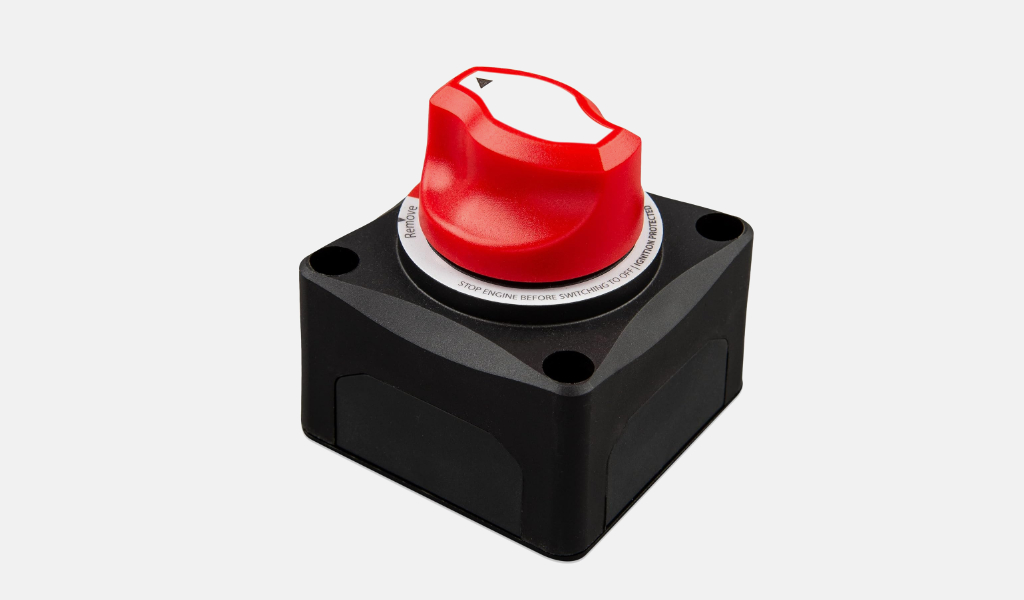
A safety switch sits between your battery and everything else. Flip it off, and the battery is isolated from the rest of the system. You can work safely. You can fix things. You can leave for the winter without worrying.
It's the off button for your whole house.
Two Jobs
A safety switch does two things.
The on/off job. A big handle you can flip to disconnect everything. Useful for maintenance. Useful in an emergency.
The fault job. Some switches also watch the current. If something goes really wrong (a short circuit, a wire chewed by a mouse, water in a connection), the switch trips itself. Power off, in a fraction of a second. Faster than you could react.
The Two Main Kinds
Non-Fusible
The simpler kind. It's just a switch. Flip it, power goes off. Flip it back, power comes on.
This kind doesn't detect faults on its own. You pair it with a fuse, and the fuse handles the auto-shutoff job.
Fusible
This kind has the switch and a fuse built into the same box. One thing to install, one thing to find when something goes wrong. Best for most home setups.
How The Fault Detection Works
If you've got the smart kind, it constantly watches how much current is flowing.
If a normal amount is flowing, it's happy.
If suddenly way too much is flowing (say, a short circuit), it knows something is wrong. It snaps open in milliseconds. Faster than the wire can heat up. Faster than anything can catch fire.
That speed is the whole point. The fault doesn't get a chance to do damage.
Where To Put It
Right next to the battery. The cable run from the battery to the switch should be as short as you can make it.
The reason: anything before the switch can't be turned off. If your switch is across the room, all the cable between the battery and the switch is "always live". One short there, and the switch can't help you.
Battery, switch, then everything else. In that order.
Label Everything
Sounds dumb. Matters in an emergency.
When something goes wrong, you don't want to be guessing which switch does what. Put a label on every switch. "MAIN BATTERY", "SOLAR INPUT", "INVERTER". Future-you will thank past-you.