



The job
Three Victron Multiplus 5 kVA inverters need to land on three separate phases. The inverters live in the shed. The grid connection lives in the meter box. The cables between them have to be sized, fused, and labelled in a way that lets Robbert work on the system later without anyone accidentally flipping a switch on him.
This video covers the wiring side of the build: meter box extension, cable runs, busbars, and the small habits that keep three-phase work boring instead of dangerous.
Extending the meter box
The existing meter box has room, but not much room for future additions. Rather than cramming everything in, Robbert mounts a second small consumer unit next to the original and cuts a side opening so the two cabinets share a single feed-through.
The reason is straightforward. He wants the option to add more circuits later without ripping the whole thing apart. Building in headroom now is cheaper than rebuilding later.
A small mistake shows up immediately. Robbert flips the breaker for the group he is working on, except he flips the wrong one and gets a live circuit at his fingertips. He says it on camera: turning the group off was not such a good idea. Lesson: kill the main, not the group, when you are unsure.
The cable run
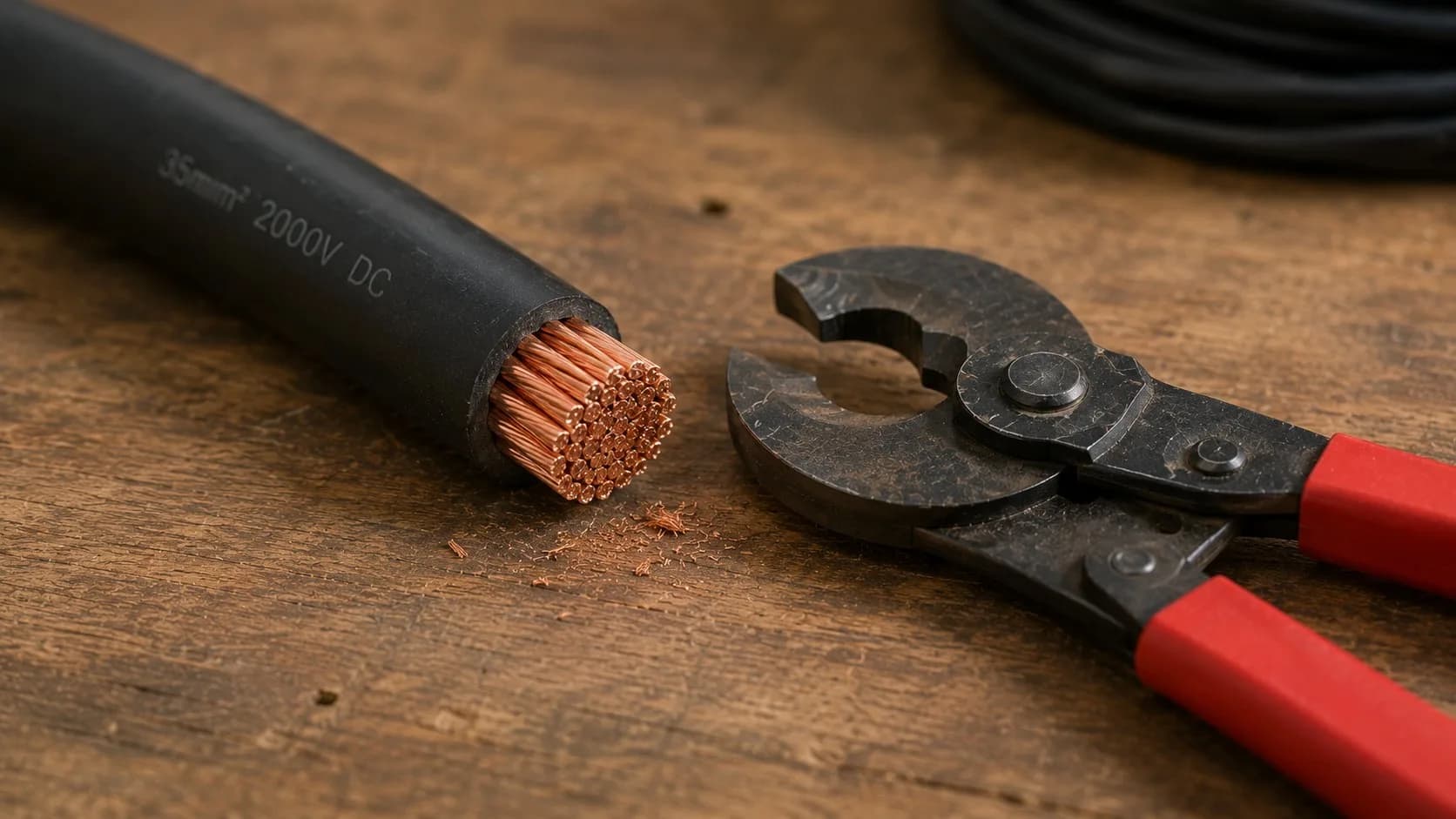
Two 5-conductor, 6 mm² cables run between the meter box and the shed: one feeding power out to the inverters, one bringing it back to feed the existing groups.
| Cable segment | Conductor | Purpose |
|---|---|---|
| Meter box → shed | 5x6 mm² | Grid feed to the Multiplus units |
| Shed → meter box | 5x6 mm² | Inverter output back to groups |
The 6 mm² rating is sized for the load with margin. Robbert notes the spec sheet allows 25 A through 6 mm² over 70 metres, and his run is roughly 5 metres. Loss is not an issue at that distance.
Protecting both directions
Both cables get their own fuse. The feed to the shed runs from the main switch in the meter box through a residual-current breaker, then out to the shed. Inside the shed, a 40 A main switch sits at the wall plate. The return cable from the shed back to the meter box is protected by a 25 A breaker.
The shed-side main switch is the safety lever. When Robbert works on the inverters, he can kill that switch and keep eyes on it. No one else can switch it back on without him seeing.
Every breaker gets a sticker from the labelling sheet that ships with the consumer unit. Most builders skip this. Robbert insists on it. With three Multiplus units, a main, multiple residuals, and incoming and outgoing breakers, the labels are the difference between an organised panel and a puzzle.
Wiring the Multiplus units
Victron recommends flexible cable for the Multiplus connections, not solid copper. Robbert uses 6 mm² flexible stripped from a spare 5-conductor power cable he had on the shelf.
Each Multiplus gets one phase. Brown to unit one, black to unit two, grey to unit three. Neutrals are jumpered along the bottom of the panel from the main switch. AC outputs run upward to the return breaker, again keeping colours matched to phases.
The warning is real. Crossing a neutral and a phase gives a normal 230 V reading on a multimeter. Crossing two phases gives 400 V. Equipment dies. People get hurt. The rule on the bench is to check every termination twice before energising.
The earth is the last cable in. All three Multiplus earths come together at a small collection block at the top of the panel.
3D-printed covers and the asterisks
Officially, all cables between the wall trunking and the Multiplus units should be double-insulated. In practice, Robbert leaves a short exposed section and notes he will add a PVC sleeve later. He also prints a custom housing for the RCD and breaker section, sprayed in Victron blue. Function-wise it changes nothing. Aesthetically and finger-safety-wise it covers what would otherwise be exposed terminals.
Takeaways
- Add a second small consumer unit instead of cramming new circuits into the existing meter box. Headroom is cheaper now than later.
- Fuse both directions of a cable run, not just the outgoing side. A 25 A breaker on the return cable protects everything downstream.
- Match wire colour to phase end-to-end. Brown stays brown. Grey stays grey. Future troubleshooting depends on it.
- A wall-mounted safety switch in eyeshot of the workbench is not optional on a system you actively maintain.
- Three-phase mis-wiring shows up as 400 V where 230 V belongs. Check, then check again.