


The premise
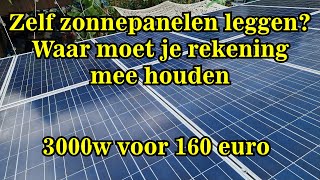
Most solar advice points one direction: buy new, high-efficiency panels, accept the price tag, wait years to break even. Robbert wanted to test the other direction. Cheap second-hand panels, a homemade frame, the absolute minimum spend. How fast can a budget setup pay itself back?
What it cost
| Item | Cost |
|---|---|
| 6 used panels (Marktplaats, €10 each) | €60 |
| 6 wooden frame beams | €50 |
| Solar inverter (used) | €30 |
| Solar cables | €25 |
| Total | €165 |
Six panels, roughly 1.5 kW peak on paper. Mounted on a flat wooden frame on top of an existing back-veranda, where the panels lie horizontal instead of tilted toward the sun.
Why this isn't ideal (and why he did it anyway)
The panels lie flat. They are rotated 90 degrees off the ideal orientation. They are second-hand, so per-panel output is lower than a new spec sheet predicts. None of this is optimal.
What the spot did offer was unused roof space, already in front of the sun all day. Robbert's main array is on a different part of the property. This was about extracting some value from a leftover surface for as little money as possible, not maxing out generation.
Real-world output
Robbert logged a handful of random days at the end of April and start of May. Mostly cloudy with a few clear days mixed in. Six panels, leftover veranda, flat orientation.
| Day | Energy generated | Daily yield |
|---|---|---|
| Random day 1 | 6.1 kWh | €0.92 |
| Random day 2 | 6.6 kWh | €0.58 |
| Random day 3 | 4.6 kWh | €0.98 |
| Random day 4 | 3.8 kWh | €0.92 |
| Random day 5 | 6.7 kWh | €0.70 |
Daily revenue lands roughly between €0.70 and €1.00. Production peaks around 1024 W, well below the 1.5 kW the panel labels suggest. That gap is partly the flat orientation, partly second-hand wear.
Payback math
At €0.70 a day, the €165 spend breaks even in roughly 235 sunny days. At €1.00 a day, it drops to 165 sunny days. Either way, the recovery window is measured in months, not years. Closer to the "good summer" end of the range, this setup pays for itself before winter.
For comparison: new panels with proper tilt and modern efficiency push that timeline out to seven or eight years on most setups, and longer once net-metering rules get rolled back.
Where the trick actually is
The big asterisk on those numbers is what you do with the power. Selling 6.7 kWh back to the grid at midday, when half the country is also exporting solar, fetches a low spot price. The economics only really work when production lines up with consumption, or when stored energy can be released later at a higher tariff.
That is why Robbert wired this into a home battery setup instead of straight grid feed-in. The same six panels routed into a battery can release that energy in the evening when prices are €0.40 per kWh or higher, doubling the per-kWh value on most days. A €0.70 day at the spot price becomes a €2 day with smart timing.
Takeaways
- Used panels are not a dead end. They are a fast, low-risk way to fill awkward roof space.
- A flat wooden frame, no tilt, no fancy mounting works for marginal surfaces. Compromised output, fine economics.
- Payback math collapses to under a year when the spend is low and the panels aren't doing nothing.
- The piece that makes the numbers actually work is timing: store and release, don't feed back at midday.
Not every house has a leftover slab of roof and an existing main array to extend. For households that do, this kind of budget extension is one of the highest-return spots on the property.