

The Island That Drinks Off Its Roofs
 Illustrative image
Bermuda is a small island in the Atlantic Ocean with no fresh water springs and no lakes. For hundreds of years, its people had one main source of water: the sky.
That's rainwater harvesting. You capture the rain that lands on your roof, keep it in a storage tank, and use it later.
In Bermuda it's not a hobby, it's the law. Every house has to collect 80 percent of the rain that falls on its roof. That's why the roofs there are white and built like little stone staircases, so the rain runs down them into a tank under the house.
The rules even set the tank size. For every square foot of roof, about the size of a big floor tile, a house needs room for eight gallons. That's about 30 litres, or two buckets, for every single tile of roof.
Your roof does the same thing every time it rains. The rain just runs off into the drain and disappears.
How Much Rainwater Can You Harvest From A Roof?
 Illustrative image
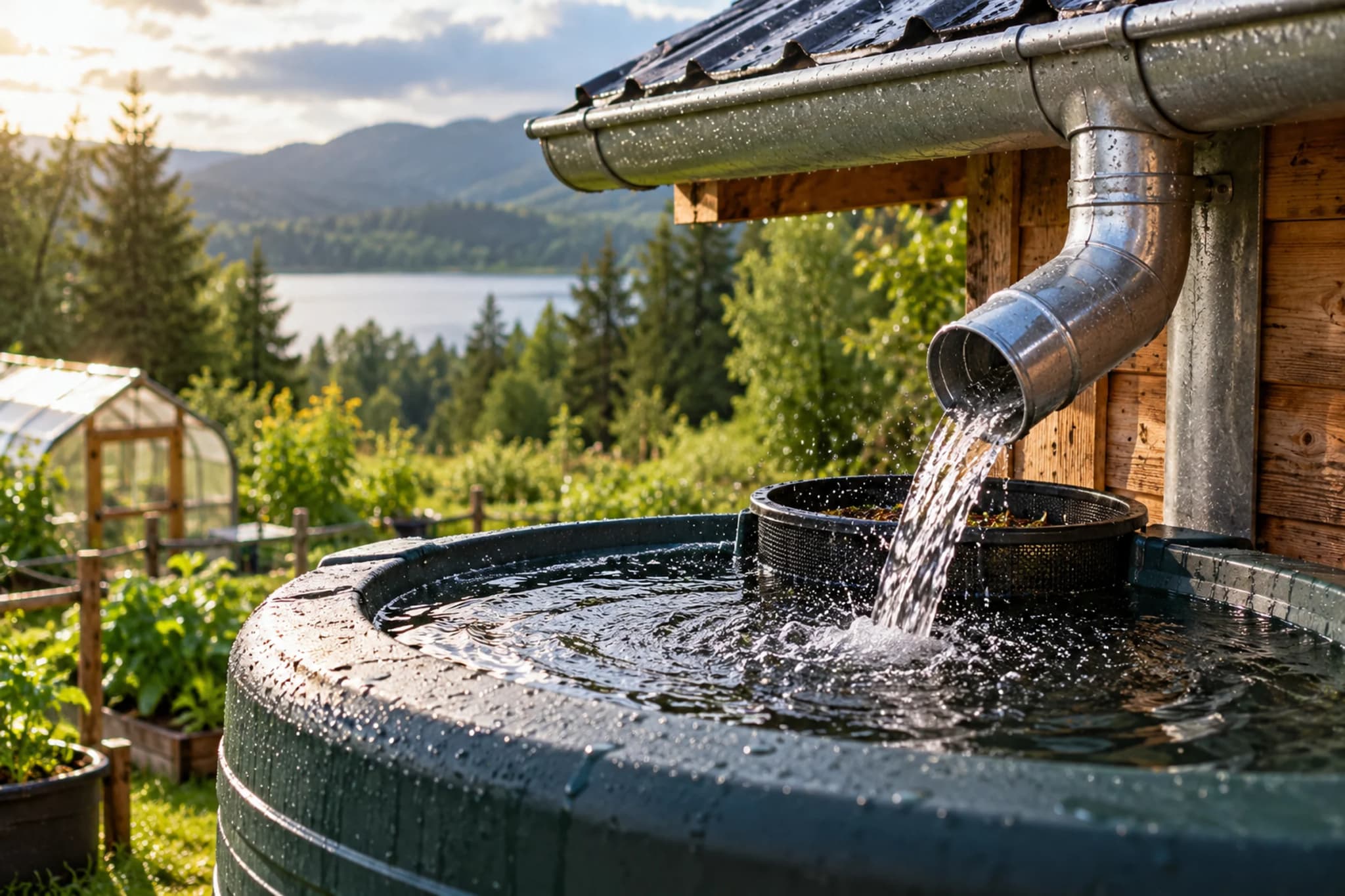
A lot more than most people guess. The amount depends on two things: how much rain falls, and how big the roof surface is.
There is a handy rule in metric.
One millimetre of rain on one square metre of roof gives you one litre of water. So a 100 square metre roof, about the floor of a small house, catches 100 litres from just one millimetre of rain. That's roughly a bathtub.
In feet and inches, the rule says one inch of rain on 1,000 square feet of roof gives about 623 gallons. University extension services in Texas and Arizona use that same number.
Now stretch it over a whole year. Say you live somewhere with 600 millimetres of rainfall a year, which is on the dry side for much of Europe. That same 100 square metre roof could catch around 60,000 litres.
You never get all of it, though. Some rain splashes over the edge in big storms, some dries off the roof, and some goes to cleaning. Most installers count on catching 75 to 90 percent.
That still leaves about 45,000 to 54,000 litres. A typical American uses 300 to 380 litres a day at home, so that roof could supply one such person for around five months. Careful off-gridders use far less than that.
But a yearly total hides the real problem: rainfall is not spread evenly. In many places most of it comes in winter, and summer is dry. So do the sum month by month:
rain that month (mm) × roof (m²) × 0.8 for losses − the amount you use that month = what goes into or out of the tank
Here is an example. The numbers are assumptions, not a real place: the same 600 mm a year, but 85 mm a month from October to March and only 15 mm a month from April to September. The roof is 100 m², you catch 80%, and you use 120 litres a day (3,600 litres a month).
| Months | Rain caught each month | Used each month | Tank each month |
|---|---|---|---|
| October to March (wet) | 85 × 100 × 0.8 = 6,800 L | 3,600 L | +3,200 L |
| April to September (dry) | 15 × 100 × 0.8 = 1,200 L | 3,600 L | −2,400 L |
Over the whole year you catch 48,000 litres and use 43,200, so on paper it fits. But six dry months in a row take 6 × 2,400 = 14,400 litres out of the tank. So you need a tank of at least about 15,000 litres, full by April, plus some spare for a drier year than usual. A 5,000 litre tank would run dry by early June.
For your own plan, use the monthly rainfall figures from your national weather service, the driest year you can find, and your real daily use.
How Rainwater Harvesting Systems Work, From Roof To Tap
 Illustrative image
Think of the whole collection system like a giant funnel with a bucket underneath.
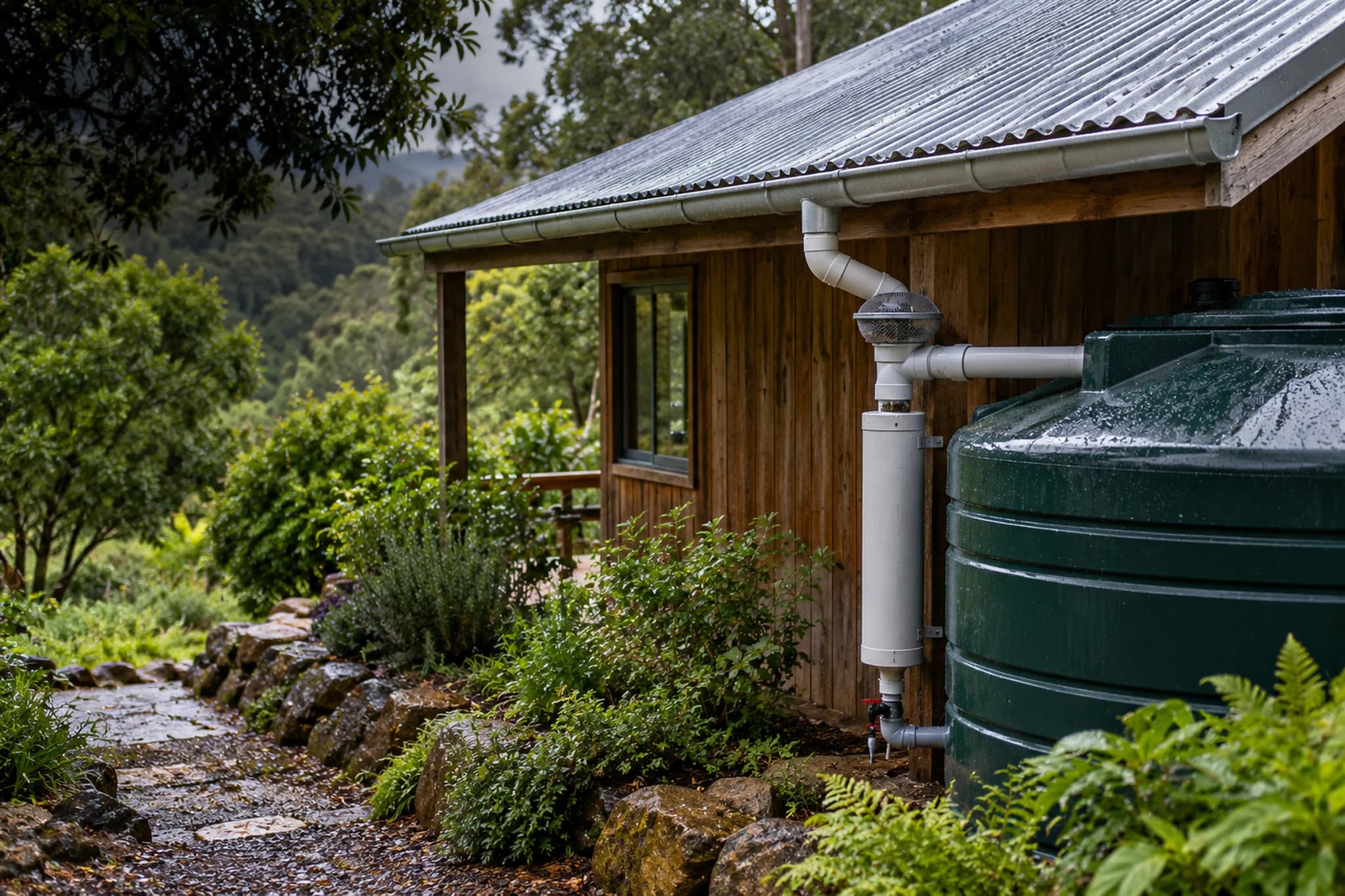
The roof is the wide part of the funnel. The rain runs down it into gutters, which carry it sideways to a pipe going down the wall. People call that pipe a "downspout" or "downpipe".
Before the rain reaches the tank, it passes a few cleaning stops.
Leaf screen. A simple mesh that catches leaves, twigs and the odd tennis ball.
First flush diverter. The first rain of a storm washes all the dust, bird poop and pollen off the roof. A first flush diverter catches that dirty first splash in a side pipe and sends it away. That allows only the cleaner rain to flow on. One Texas guide suggests diverting at least 10 gallons for every 1,000 square feet of roof. For a 100 square metre roof that's about 40 litres.
The storage tank. This is where the water waits. Tanks are also called "cisterns", which is just an old word for a big water tank. A good one is dark inside and lets no light through, to prevent green slime (algae) from growing.
The overflow. When the tank is full, extra water has to go somewhere safe, away from the house walls. A pipe near the top takes care of that.
The pump. Water in a tank just sits there. To provide real pressure at a tap or a shower, most systems use a small electric pump. Plenty of off-grid homes run it from solar power.
Rain Barrel, Big Tank, Or Underground Cistern?
 Illustrative image
Rainwater harvesting comes in three main sizes, a bit like a bike, a car and a school bus.
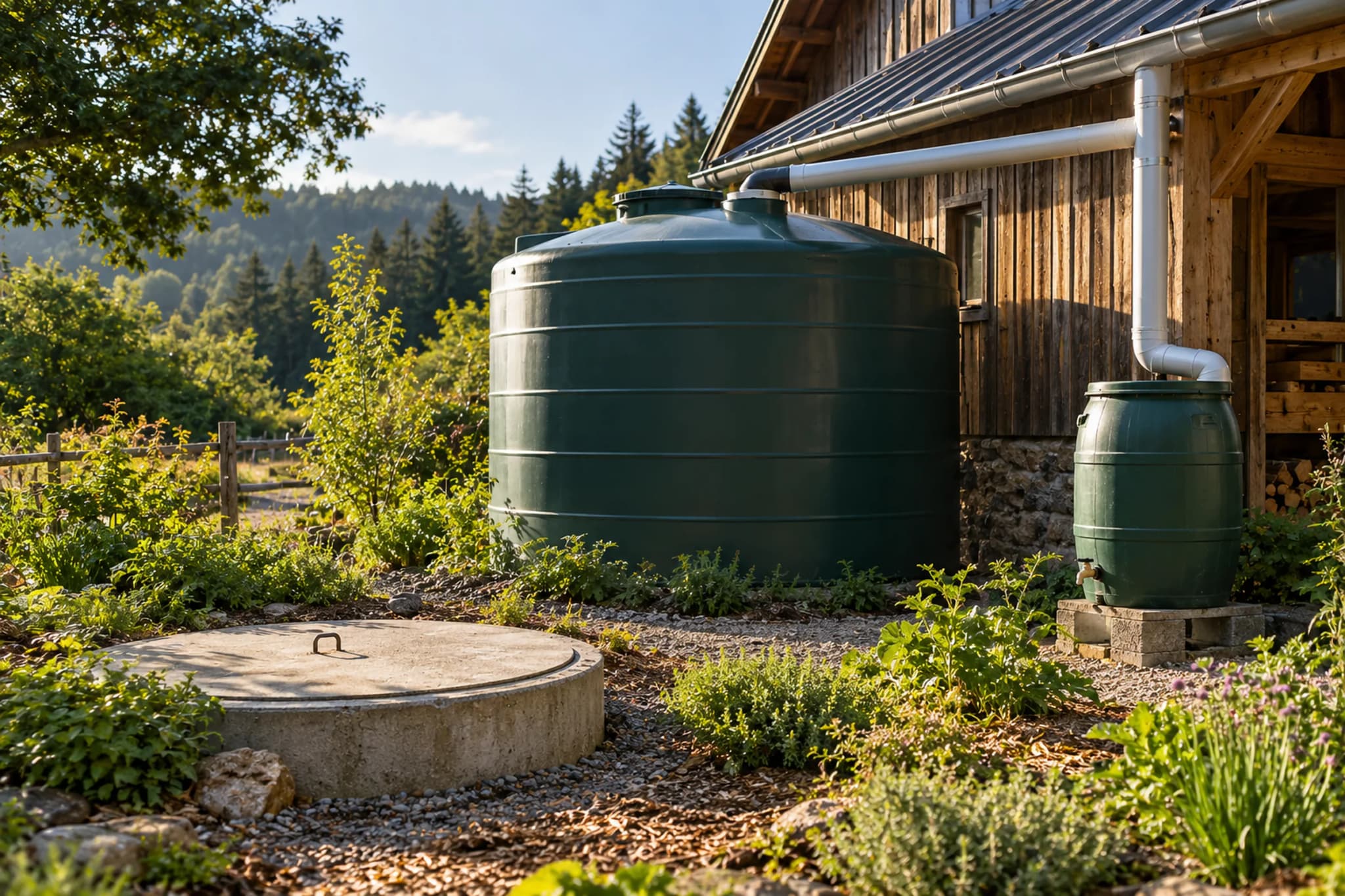
A rain barrel is the bike. It sits under one downspout and often holds around 200 litres. It's cheap, easy and great for the garden, but it fills up in one good storm.
An above-ground storage tank is the car. These hold anything from 1,000 litres to tens of thousands of litres. You'll see them next to cabins, farms and tiny homes, and many small off-grid places start with one. One tiny cabin setup runs on a 1,000 litre tank, topped up by a truck in dry summers.
An underground cistern is the school bus. It's big, hidden and stays cool, which keeps the water fresher. But it costs much more, because somebody has to dig a big hole first.
What you plan to use the water for matters even more than the size. Plants and toilets are easy. Water you drink takes more work, and we'll get to that.
In Australia, about one in four households outside the big cities drank mainly tank water in 2013.
What A Rainwater Collection System Costs
 Illustrative image
Prices change a lot by country, so take these as a rough guide from the United States.
A plastic tank of 1,000 gallons, about 3,800 litres, sells for roughly 1,300 to 1,650 dollars on its own. The University of Washington puts smaller tanks at about half a dollar to one dollar for every gallon they hold.
Installed systems cost more. One big US cost guide puts an above-ground cistern at 1,500 to 4,500 dollars, while underground ones start around 5,000.
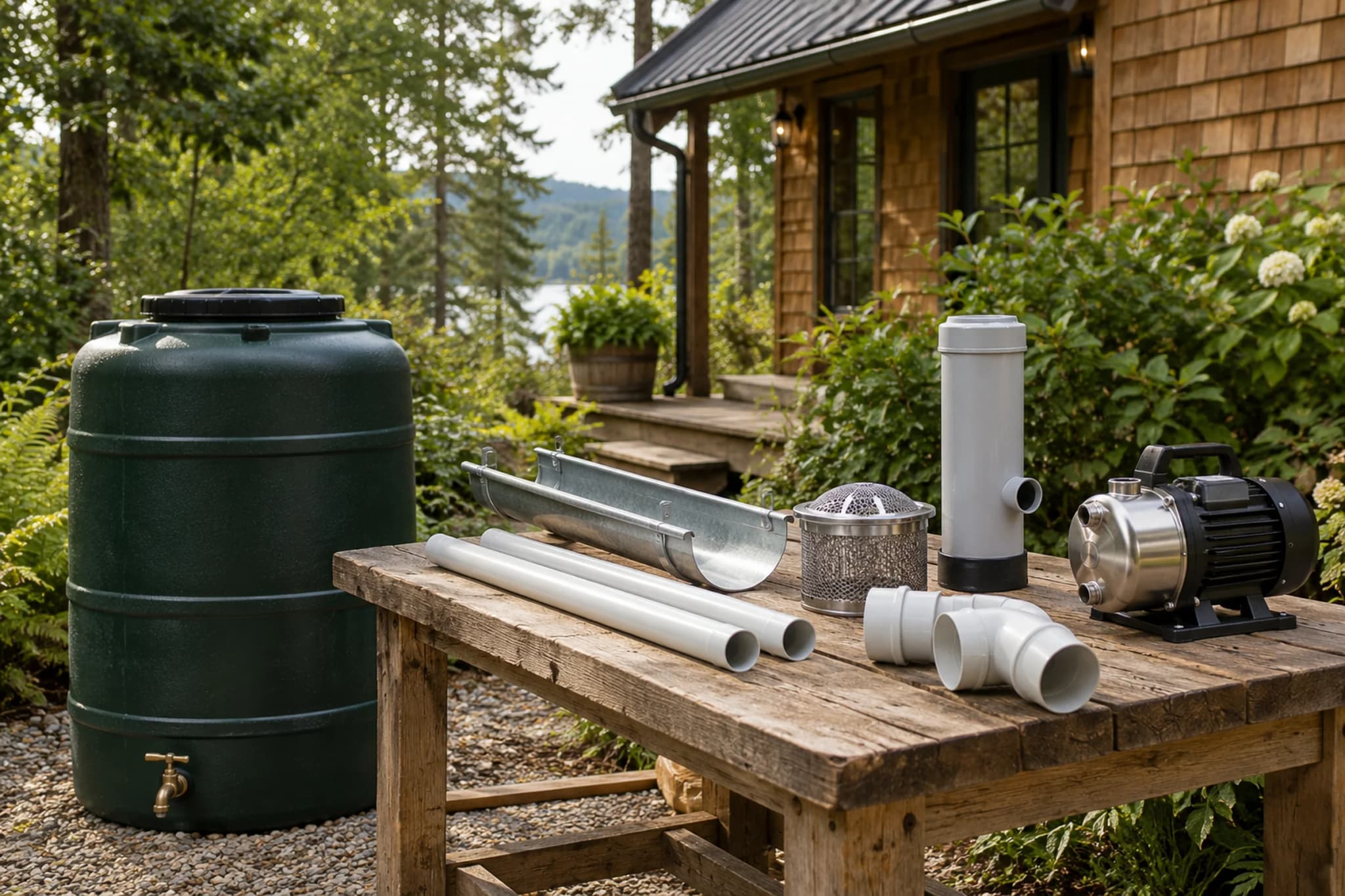
In addition, there are the extras: screens, a first flush diverter, a pump, and filters if you want to drink the water. A garden-only system can be cheap, while a whole-house supply is a real project.
Is Rainwater Safe To Drink?
 Illustrative image
Not straight off the roof. Rain starts out pretty clean, but it falls through the air and lands on your roof, and that's where things get messy.
On the way down it can pick up dust and smoke. On the roof it meets bird droppings, leaves and whatever the roof is made of. The US Centers for Disease Control (CDC) warns that roofs, gutters and pipes can add things like lead, copper or asbestos.
That's why roof material matters. Metal roofs are the usual favourite if you want potable water, which just means water that is safe to drink. Treated wood, copper and old lead paint are on the "avoid" list from US extension services. Asphalt shingles are argued about, so testing is the safe way to know.
Here's the part almost nobody expects.
A 2022 study from Stockholm University found tiny traces of "forever chemicals" in rain all over the world, even in Antarctica. Scientists call them PFAS. That's just a short name for man-made chemicals that barely break down.
The levels were above the newest US safety advice, which is strict. It doesn't mean one sip of rain makes you sick, but it does mean "rain is pure" isn't true anymore.
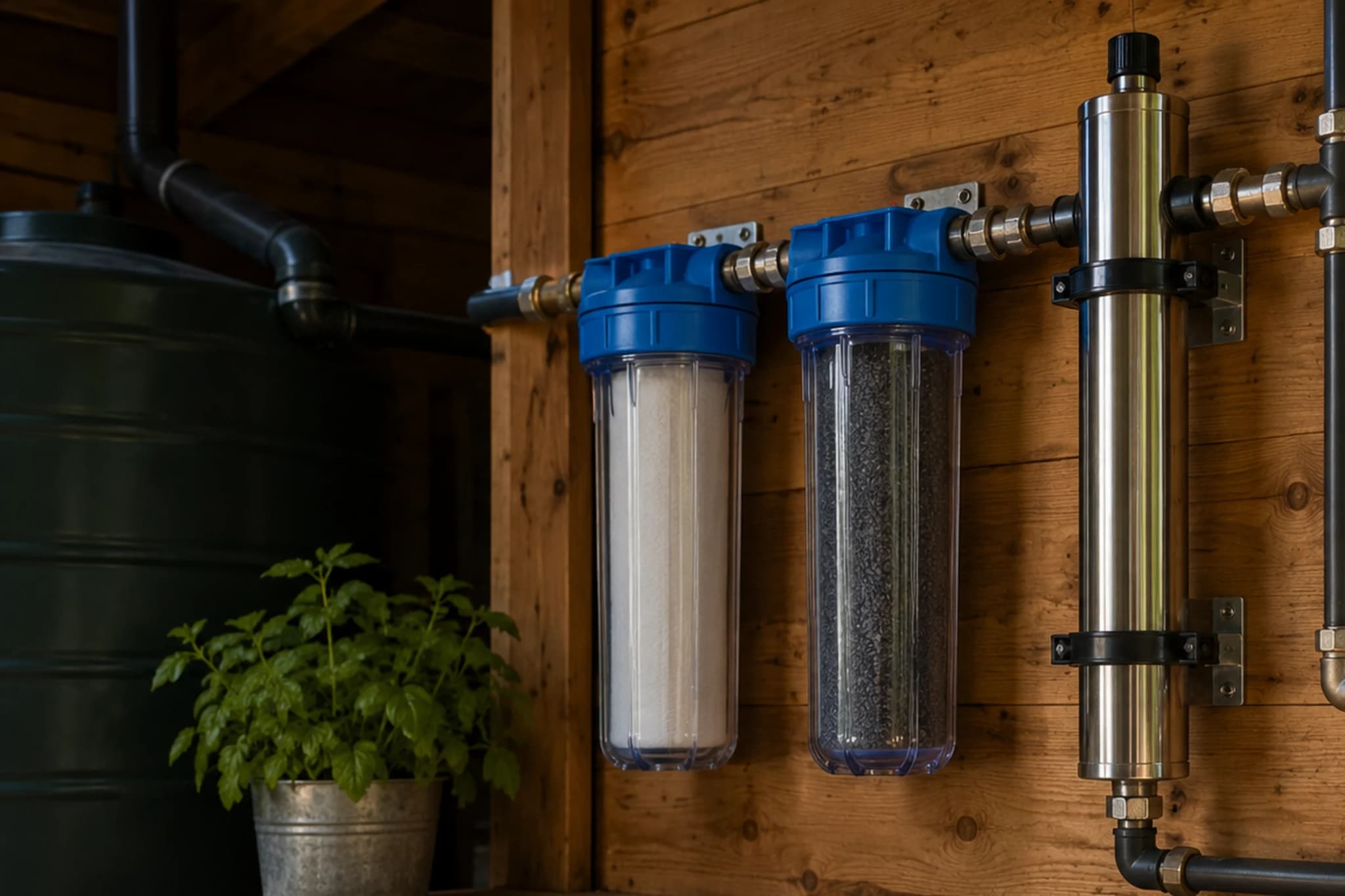
So rainwater harvesting systems that feed a tap clean the water in steps. A popular setup in Texas is two cartridge filters, which work like very fine coffee filters, followed by an ultraviolet (UV) lamp. UV light is the same invisible light that gives you sunburn, and it breaks germs so they can't make you sick.
Even with all that, the CDC says you should test it regularly to check its quality. Ask your local health department which tests to do and how often, and use a certified lab. If you have a weak immune system or a baby at home, talk to them first.
Two more safety rules come straight from the CDC. Keep rainwater pipes completely separate from any municipal water pipes, and put a screen on every opening so mosquitoes can't lay eggs in your tank.
The Bonus: Less Stormwater Runoff
When rain hits a roof, a road or a car park, it can't soak into the ground. It runs off instead. That stormwater runoff picks up trash, chemicals, oil and dirt, and the US Environmental Protection Agency (EPA) says this pollution can harm rivers, streams, lakes and the sea.
A tank catches part of that rain before it ever leaves your roof. The EPA puts it simply: catching roof runoff reduces the amount of water that flows off your property, and they give you free water for your landscape, which means your garden, lawn and trees.
So the benefits reach past your own tap. It's a small environmental win that comes with every storm.
Is It Legal To Harvest Rainwater Where You Live?
 Illustrative image
Usually yes, but the rules vary a lot, so it isn't a silly question.
In some places, water that falls from the sky legally belongs to everyone downstream, so the rules limit how much you can keep. In Colorado, for example, a normal home may only use two rain barrels with 110 gallons in total, and only for outdoor use.
Other places push in the opposite direction. Texas removes sales tax from rainwater harvesting equipment. The Indian state of Tamil Nadu made the practice compulsory for buildings back in 2003, and Bermuda still requires it on every house.
On top of that, many places have building or plumbing rules for tanks, overflows and potable systems. So check with your local council, water authority or health department before you build. The rules can change from one town to the next.
Is Rainwater Harvesting Right For You?
 Illustrative image
Harvesting rainwater shines when it rains often and your roof is big. It can offer a whole home its main source of water, or just provide for the garden. It's quiet, needs no drilling, and every full tank is one less bill or truck delivery.
The hard part is the dry spells. Your tank has to be big enough to last through the longest stretch without rain, not just an average month. In hot, dry places, that can mean a much larger tank or a backup well.
It also asks for a bit of care. Gutters need clearing, the first flush pipe needs emptying, and the water you drink needs testing. Our guide to how a home gets its own water off the grid shows where the tank fits next to wells, pumps and filters.
But think about what you get back. Every storm that rolls over your house stops being something to wait out. It becomes water in the bank.
Sources
- CDC, Collecting Rainwater and Your Health: An Overview
- Texas Water Development Board, Texas Manual, 3rd edition
- University of Arizona Cooperative Extension, Harvesting Rain in Cochise County
- University of Arizona Water Wise, Worksheet
- Texas A&M AgriLife Today, roof catchment numbers
- USGS, Water Use Questions and Answers
- Amusing Planet, How Bermuda's chronic water shortage shaped its architecture
- 99% Invisible, Stepping Up: Bermuda roofs rebuff hurricanes, collect water and cool homes
- Bernews, BBC highlight Bermuda's roof water system
- Australian Bureau of Statistics, Environmental Issues: Water Use and Conservation, March 2013
- Baytec Containers, 1,000 gallon rain harvest tank
- Store More Store, 1,000 gallon rainwater collection tank
- University of Washington, Cost
- HomeAdvisor, Rainwater collection system cost
- New Mexico Office of the State Engineer, Roof-Reliant Landscaping, chapter 7
- Purdue Extension, WQ-40
- Solar Daily, Rainwater unsafe to drink due to chemicals: study
- US EPA, NPDES Stormwater Program
- US EPA, Soak Up the Rain: Rain Barrels
- Colorado State University Extension, Rainwater collection in Colorado
- Colorado Division of Water Resources, Rainwater, storm water and graywater
- Centre for Science and Environment, Legislation
Hard Words
| Term | What it means |
|---|---|
| Rainwater harvesting | Catching rain off a roof and storing it in a tank to use later. |
| Downspout | The pipe that carries water from the gutter down the wall. Also called a downpipe. |
| First flush diverter | A side pipe that catches the dirty first rain off the roof and keeps it out of the tank. |
| Cistern | A big water tank, above or below the ground. |
| Overflow | A pipe near the top of the tank that safely gets rid of extra water when the tank is full. |
| Algae | Tiny green plant life that grows in water when light gets in. The reason tanks should be dark inside. |
| Cartridge filter | A swap-out filter, like a very fine coffee filter, that catches dirt and small particles. |
| UV lamp | A lamp that shines ultraviolet light through the water to break germs so they can't make you sick. |
| PFAS | Man-made "forever chemicals" that barely break down. Traces now show up in rain worldwide. |
| Potable | Safe to drink. |
| Stormwater runoff | Rain that runs off roofs and roads instead of soaking into the ground. |
Common Questions
How much water can I collect from my roof?
About one litre for every millimetre of rain on every square metre of roof. In US units, one inch of rain on 1,000 square feet gives about 623 gallons. Plan on catching 75 to 90 percent of that.
Is rainwater safe to drink?
Not straight from the roof. To make it potable you need a first flush diverter, filters and usually UV treatment, plus regular lab tests.
Is it legal to collect rainwater?
Usually yes, but rules vary. Colorado caps a home at 110 gallons for outdoor use, while Bermuda requires collection. Check with your local water authority first.
What is a first flush diverter?
A pipe that catches the first, dirtiest rain of a storm. Once it fills, cleaner water flows into the tank.
How big should a rainwater tank be?
Big enough to last through your longest dry spell. Multiply your daily use by the longest stretch without rain, or do the month by month sum above.
Why should a rainwater tank be dark inside?
Because sunlight makes algae grow, and algae makes water smell, taste bad and clog filters. A tight lid and screens also keep out mosquitoes and leaves.
What roof is best for rainwater harvesting?
Metal roofs are the usual favourite. Avoid treated wood, copper and lead paint if you plan to drink the water, and test it either way.