

AWG conversion chart
 Illustrative image
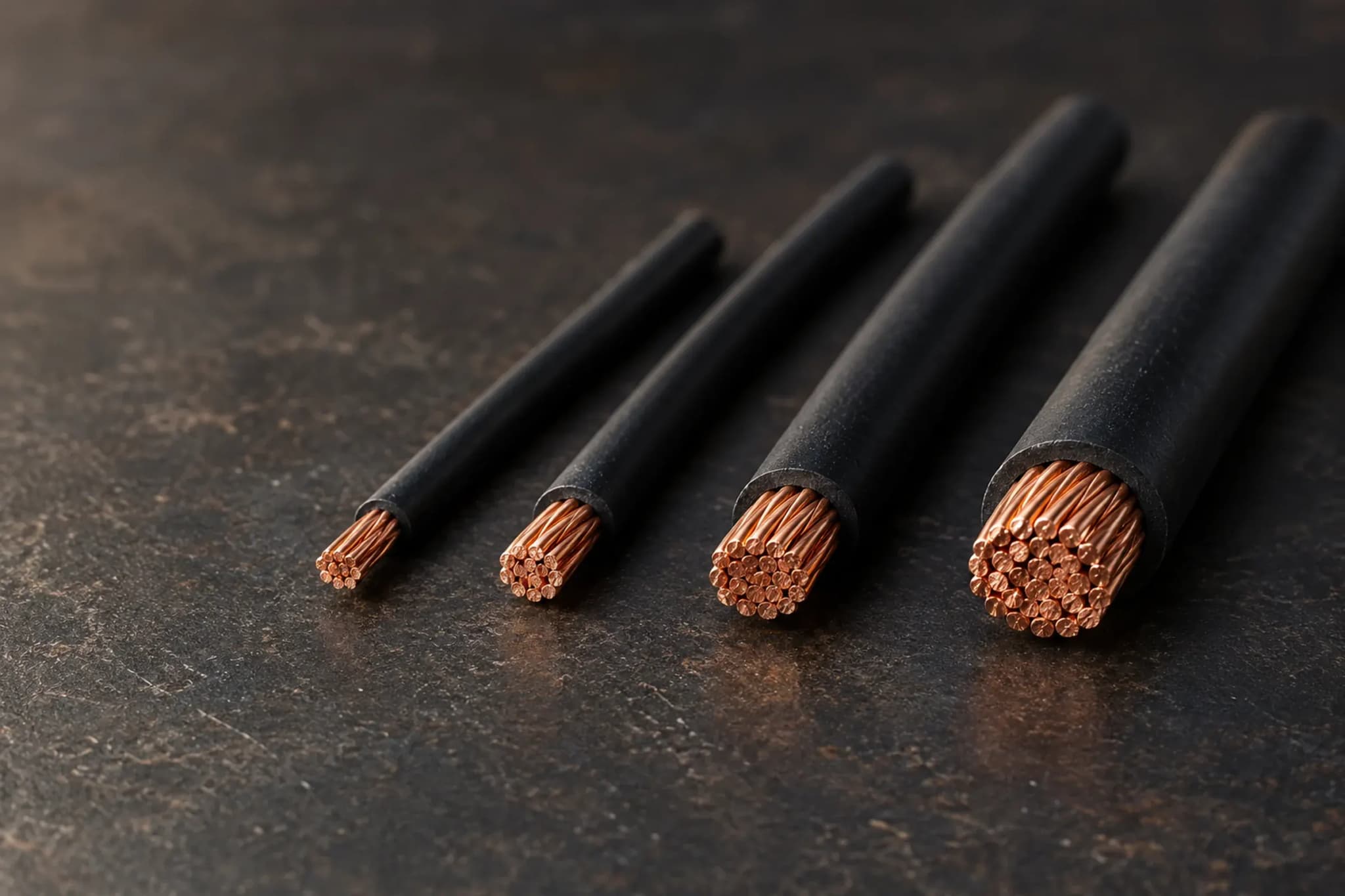
American wire gauge (AWG) is the US standard for wire sizes, and it counts backwards: the lower the gauge number, the thicker the wire. A 4 AWG battery cable is approximately 5.2 mm across, eight times wider than a 22 AWG wire at 0.64 mm.
Why backwards? The gauge started as a count of how many times the metal was pulled through smaller and smaller holes to make it thin. More pulls, thinner wire, higher gauge.
The thickest sizes are written with zeros: 0000 is also written 4/0, and electricians refer to 2/0 as "two-aught".
The table below gives every AWG wire from 4/0 down to 40 with its diameter in inches and mm, its cross-sectional area in mm², its resistance and the amps it can carry. Need just one size? Our AWG calculator does the AWG to mm² conversion both ways.
| AWG | Diameter | Area | Resistance | Max Current* | Max Frequency | |||
|---|---|---|---|---|---|---|---|---|
| [inch] | [mm] | [kcmil] | [mm2] | [mΩ/m] | [mΩ/ft] | [A, 70 °C insulation] | for 100% skin depth | |
| 0000 (4/0) | 0.4600 | 11.684 | 212 | 107 | 0.1608 | 0.04901 | 334 | 125 Hz |
| 000 (3/0) | 0.4096 | 10.405 | 168 | 85.0 | 0.2028 | 0.06180 | 292 | 160 Hz |
| 00 (2/0) | 0.3648 | 9.266 | 133 | 67.4 | 0.2557 | 0.07793 | 257 | 200 Hz |
| 0 (1/0) | 0.3249 | 8.251 | 106 | 53.5 | 0.3224 | 0.09827 | 219 | 250 Hz |
| 1 | 0.2893 | 7.348 | 83.7 | 42.4 | 0.4066 | 0.1239 | 184 | 325 Hz |
| 2 | 0.2576 | 6.544 | 66.4 | 33.6 | 0.5127 | 0.1563 | 154 | 410 Hz |
| 3 | 0.2294 | 5.827 | 52.6 | 26.7 | 0.6465 | 0.1970 | 126 | 500 Hz |
| 4 | 0.2043 | 5.189 | 41.7 | 21.2 | 0.8152 | 0.2485 | 107 | 650 Hz |
| 5 | 0.1819 | 4.621 | 33.1 | 16.8 | 1.028 | 0.3133 | 92 | 810 Hz |
| 6 | 0.1620 | 4.115 | 26.3 | 13.3 | 1.296 | 0.3951 | 78 | 1100 Hz |
| 7 | 0.1443 | 3.665 | 20.8 | 10.5 | 1.634 | 0.4982 | 67 | 1300 Hz |
| 8 | 0.1285 | 3.264 | 16.5 | 8.37 | 2.061 | 0.6282 | 56 | 1650 Hz |
| 9 | 0.1144 | 2.906 | 13.1 | 6.63 | 2.599 | 0.7921 | 48 | 2050 Hz |
| 10 | 0.1019 | 2.588 | 10.4 | 5.26 | 3.277 | 0.9989 | 41 | 2600 Hz |
| 11 | 0.0907 | 2.305 | 8.23 | 4.17 | 4.132 | 1.260 | 35 | 3200 Hz |
| 12 | 0.0808 | 2.053 | 6.53 | 3.31 | 5.211 | 1.588 | 30 | 4150 Hz |
| 13 | 0.0720 | 1.828 | 5.18 | 2.62 | 6.571 | 2.003 | 25 | 5300 Hz |
| 14 | 0.0641 | 1.628 | 4.11 | 2.08 | 8.286 | 2.525 | 22 | 6700 Hz |
| 15 | 0.0571 | 1.450 | 3.26 | 1.65 | 10.45 | 3.184 | 19 | 8250 Hz |
| 16 | 0.0508 | 1.291 | 2.58 | 1.31 | 13.17 | 4.016 | 16 | 11 K Hz |
| 17 | 0.0453 | 1.150 | 2.05 | 1.04 | 16.61 | 5.064 | 14 | 13 K Hz |
| 18 | 0.0403 | 1.024 | 1.62 | 0.823 | 20.95 | 6.385 | 11 | 17 K Hz |
| 19 | 0.0359 | 0.912 | 1.29 | 0.653 | 26.42 | 8.051 | - | 21 K Hz |
| 20 | 0.0320 | 0.812 | 1.02 | 0.518 | 33.31 | 10.15 | - | 27 K Hz |
| 21 | 0.0285 | 0.723 | 0.810 | 0.410 | 42.00 | 12.80 | - | 33 K Hz |
| 22 | 0.0253 | 0.644 | 0.642 | 0.326 | 52.96 | 16.14 | - | 42 K Hz |
| 23 | 0.0226 | 0.573 | 0.509 | 0.258 | 66.79 | 20.36 | - | 53 K Hz |
| 24 | 0.0201 | 0.511 | 0.404 | 0.205 | 84.22 | 25.67 | - | 68 K Hz |
| 25 | 0.0179 | 0.455 | 0.320 | 0.162 | 106.2 | 32.37 | - | 85 K Hz |
| 26 | 0.0159 | 0.405 | 0.254 | 0.129 | 133.9 | 40.81 | - | 107 K Hz |
| 27 | 0.0142 | 0.361 | 0.202 | 0.102 | 168.9 | 51.47 | - | 130 K Hz |
| 28 | 0.0126 | 0.321 | 0.160 | 0.0810 | 212.9 | 64.90 | - | 170 K Hz |
| 29 | 0.0113 | 0.286 | 0.127 | 0.0642 | 268.5 | 81.84 | - | 210 K Hz |
| 30 | 0.0100 | 0.255 | 0.101 | 0.0509 | 338.6 | 103.2 | - | 270 K Hz |
| 31 | 0.00893 | 0.227 | 0.0797 | 0.0404 | 426.9 | 130.1 | - | 340 K Hz |
| 32 | 0.00795 | 0.202 | 0.0632 | 0.0320 | 538.3 | 164.1 | - | 430 K Hz |
| 33 | 0.00708 | 0.180 | 0.0501 | 0.0254 | 678.8 | 206.9 | - | 540 K Hz |
| 34 | 0.00630 | 0.160 | 0.0398 | 0.0201 | 856.0 | 260.9 | - | 690 K Hz |
| 35 | 0.00561 | 0.143 | 0.0315 | 0.0160 | 1079 | 329 | - | 870 K Hz |
| 36 | 0.00500 | 0.127 | 0.0250 | 0.0127 | 1361 | 414.8 | - | 1100 K Hz |
| 37 | 0.00445 | 0.113 | 0.0198 | 0.0100 | 1716 | 523.1 | - | 1350 K Hz |
| 38 | 0.00397 | 0.101 | 0.0157 | 0.00797 | 2164 | 659.6 | - | 1750 K Hz |
| 39 | 0.00353 | 0.0897 | 0.0125 | 0.00632 | 2729 | 831.8 | - | 2250 K Hz |
| 40 | 0.00314 | 0.0799 | 0.00989 | 0.00501 | 3441 | 1049 | - | 2900 K Hz |
How do you read the American wire gauge size chart?
 Illustrative image
Each row is one AWG size. Read across and you get that gauge size in two systems: US inches and kcmil, or mm and mm².
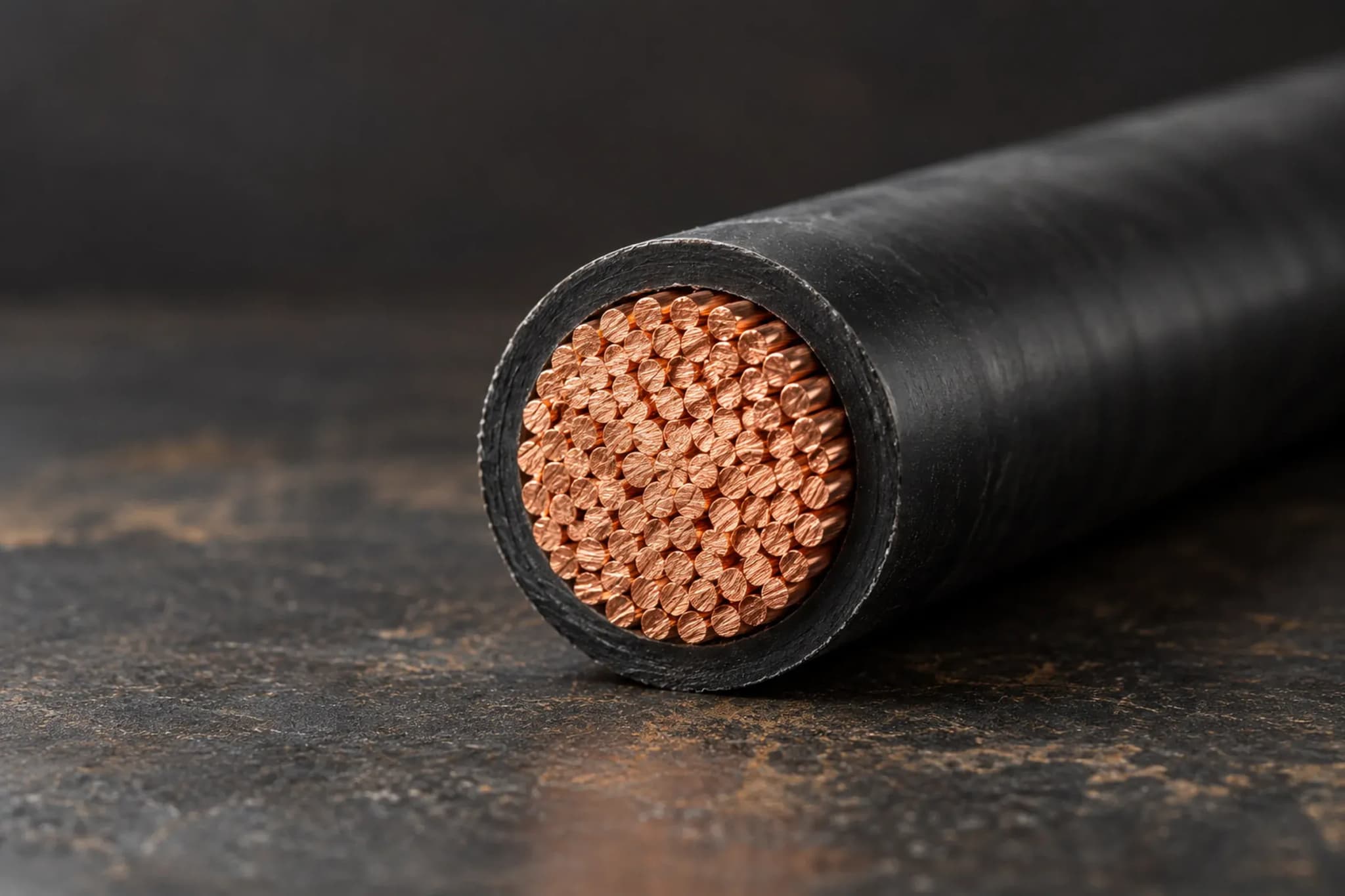
The cross-sectional area is the column that matters most. Slice the wire like a sausage and look at the flat end: that little circle of copper is what the power flows through. A kcmil is a thousand circular mils, and a circular mil is the area of a wire one thousandth of an inch across. Most of the world simply uses mm² instead.
Solid and stranded wire
 Illustrative image
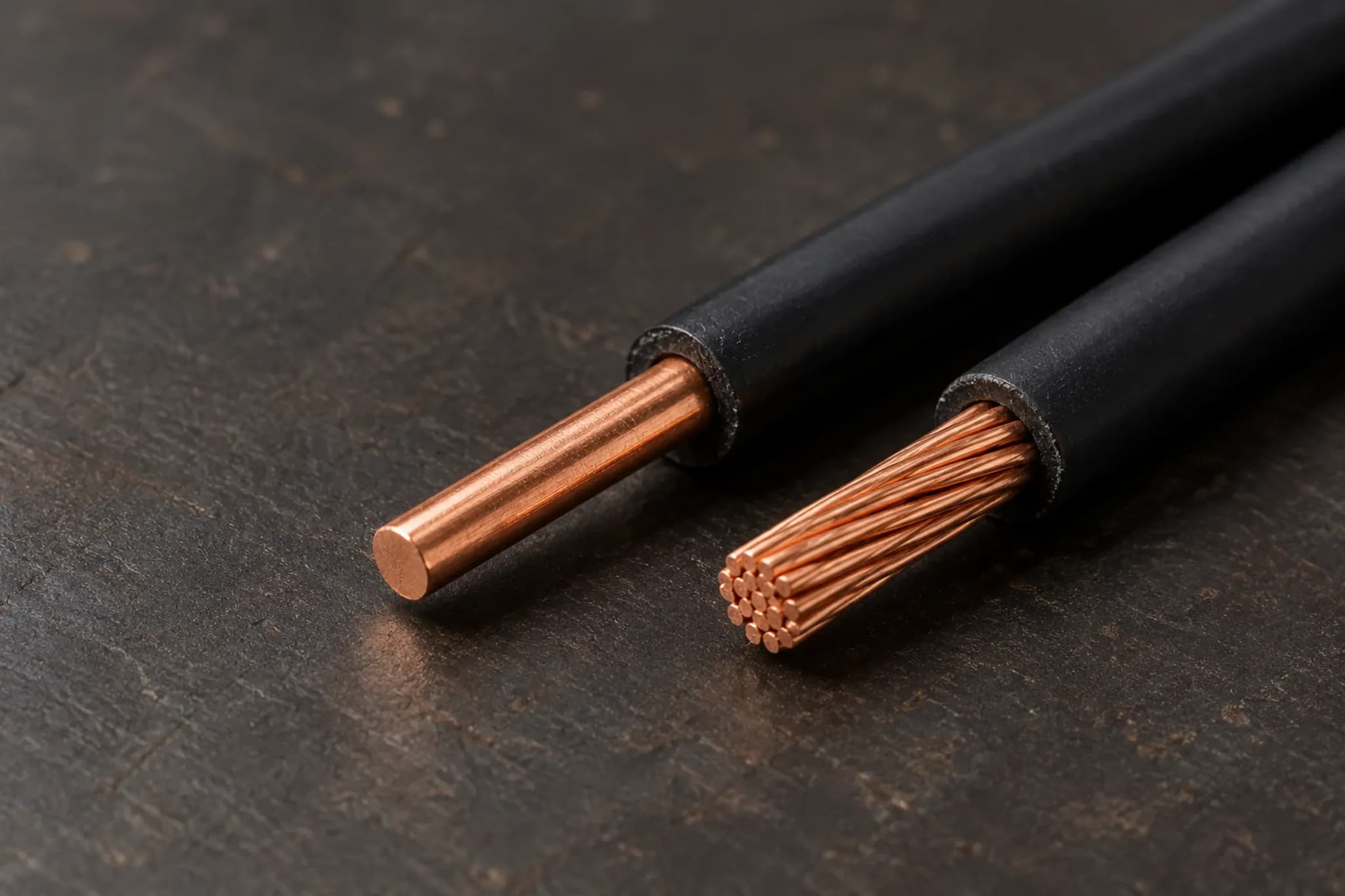
The values are for one solid copper conductor at 20 °C. Stranded wire with the same AWG number has the same metal area, but it looks slightly larger because of the tiny gaps between the strands.
A handy rule when determining sizes: every 3 steps down the gauge doubles the cross-sectional area. Check it in the table: 10 AWG is 5.26 mm², 13 AWG is 2.62 mm².
* Where the Max Current values come from. They match our AWG to mm² tool and cable size calculator: ISO 10133, the rule book for low-voltage DC wiring on small boats. They are for one wire on its own in 30 °C air, with insulation rated for 70 °C (normal PVC), filled in between its sizes the way ISO 10133 allows. Wires bundled together, inside a wall or in a hot space carry less. Sizes thinner than 18 AWG are under the standard's smallest size, so they get no value.
Other tables give other amps because they measure something else. The US tables for house electrical wiring, from the National Electrical Code, give 10 AWG 30 to 40 A, depending on the insulation. Older versions of this page said 15 A: that is a very cautious "power transmission" rule of thumb, not the most a wire can safely carry.
Choosing a metric size: always round up
 Illustrative image
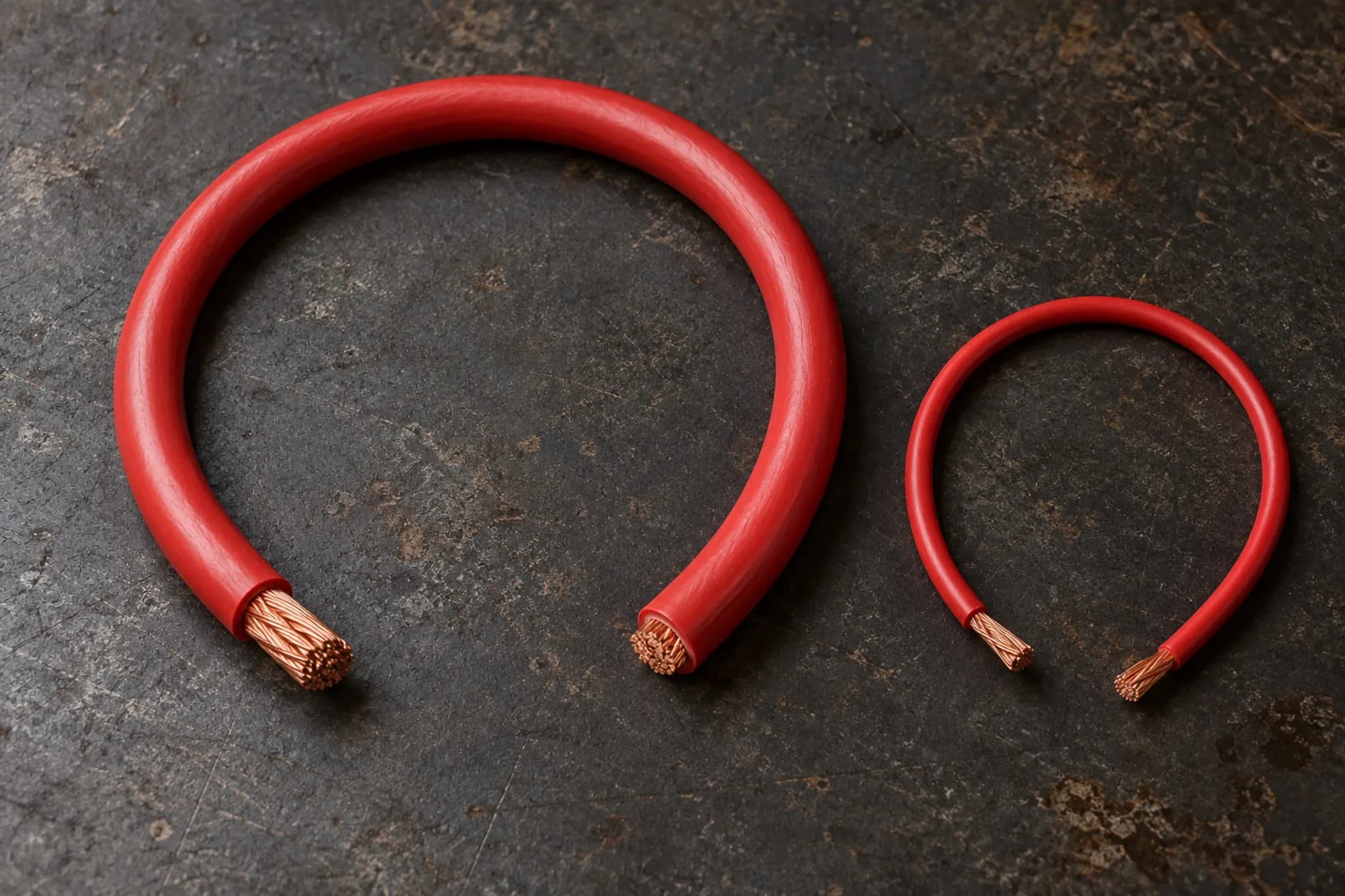
AWG and metric sizes never line up exactly. So when you convert, pick the next thicker wire, never the closest thinner one. A 16 mm² cable from a European data sheet becomes 5 AWG (16.8 mm²), not 6 AWG (13.3 mm²).
A wire one size too thick costs a bit more. A wire one size too thin gets hot under load, and it wastes power as heat on long runs. That is why the fuse and the wire are picked together: the fuse calculator finds the fuse that protects your wire, and wiring the system shows where each cable goes.
This page is a guide, not a guarantee. For the real install, follow the cable maker's specification and recommended rating and your local wiring rules, and ask a qualified electrician for assistance on bigger setups.
Sources
- Wikipedia, American wire gauge
- ISO 10133:2000, Small craft, extra-low-voltage DC installations. Values based on ISO 10133:2000, since replaced by ISO 13297:2020.
- ISO 13297:2020, Small craft, AC and DC installations
- Cerrowire, Ampacity charts
- eCFR, 33 CFR 183.425 Conductors: General
- PowerStream, American Wire Gauge table
Hard Words
| Term | What it means |
|---|---|
| AWG | American Wire Gauge. The way the US sizes wires. A lower gauge means a thicker wire. |
| mm2 | Square millimeters. How most of the world measures how thick a wire is. |
| Cross-sectional area | The size of the metal circle you see when you cut the wire straight across. |
| Diameter | How wide the wire is across, in mm or inches. |
| kcmil | The US unit for the area of very thick wires, counted in thousands. |
| Resistance | How much a wire pushes back against the power flowing through it. Measured in milliohms per meter. |
| Max current | The most amps a wire can safely carry without overheating. |
| Stranded wire | A wire made of many thin wires twisted together, so it bends more easily than solid wire. |
| Voltage drop | The power lost as heat when electricity travels through a wire. Thinner wire over long distances drops more voltage. |
Common Questions
What is AWG?
The US standard for sizing wires. A lower gauge means a thicker wire, so AWG 4 is much thicker than AWG 14.
Why convert AWG to square millimeters?
Because most of the world, and most European equipment, uses mm² for wires. If you mix US and European parts, you need to know which mm² a given AWG matches.
What is 12 AWG in mm²?
12 AWG is 3.31 mm², with a diameter of 2.053 mm. The nearest common size in mm² that is not thinner is 4 mm².
What is 1 mm² in AWG?
1 mm² is approximately 17 AWG, which is 1.04 mm². Pick the thicker size like this and the wire is never thinner than required.
Why does wire size matter so much?
Too thin a wire heats up under load, which can start a fire, and over long runs it wastes power as heat in the wire itself.
What's voltage drop?
The power lost as heat when electricity travels through any wire. Longer and thinner wires drop more voltage, so long off-grid cable runs often need a thicker wire than the amps alone ask for.
When should I use this table vs an electrician?
Use it for planning and rough estimates. For the actual install, especially on bigger setups, get a qualified electrician to double-check, because local codes vary.