

The Problem With Off-Grid
When you live on solar, your house runs on whatever's in the battery right now.
You can't just trust it. You need to know.
How full is the battery? Is it charging? Are the panels working today, or is one of them dusty and producing nothing?
Without something watching, you'd find out the bad way. Lights start flickering at midnight. Fridge stops humming. By then it's too late.
A monitoring system is the box that keeps an eye on all of it for you.
What A Monitoring System Actually Tells You
Three things, mostly.
How full your battery is. Like a gas gauge on a car. You glance at the screen, see 73%, you know what you've got.
How much power your panels are making right now. On a sunny day you might see 2000 watts coming in. On a cloudy day, 200. That's useful to know before you decide to run the washing machine.
How much power your house is using. Right now, this second. Turn on a kettle, watch the number jump. It's actually a fun little game once you have it.
You can usually see all of this on your phone. So you can be at work and check on your battery at home.
The Tiny Thing That Makes It All Work
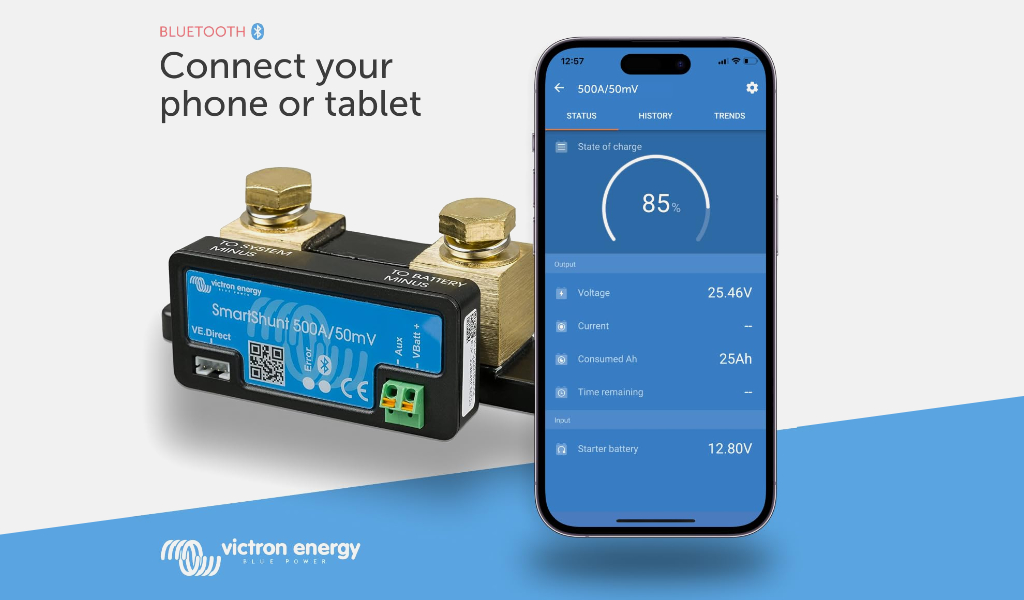
The thing doing the actual measuring is called a shunt. Scientists call it that. It's just a small bar of metal that the current flows through, with a sensor on it.
The shunt sits between your battery and everything else. Every electron that goes in or out passes through it. That's how the monitor knows exactly how much power moved.
It's a small part. The shunt itself can be cheap, but a full shunt-and-monitor kit (think Victron SmartShunt) usually runs closer to a hundred euros. Either way, it's the difference between guessing and knowing.
Do You Really Need One?
For a tiny setup (a solar light, a phone charger, a single panel on a shed), no. You can skip it.
For anything bigger? Yes.
A house-sized off-grid battery is the most expensive part of your whole setup. Treating it badly (running it flat over and over, overcharging it) kills it years early. A monitor stops that from happening.
It pays for itself the first time it saves your battery from a bad day.
Where The Monitor Goes
The shunt sits right next to the battery, between the battery's minus terminal and everything else.
The screen (or the part that talks to your phone) can go anywhere you want to look at it. Most people put it near where they hang out, so they can glance at it without thinking.
→ Read more about choosing a battery