


This page shows how to read a solar panel label and its datasheet, one number at a time. Find a number on your own panel, look up its name below, and you'll see what it means, what values are normal and which planning step uses it.
The label on the back of a panel, and the datasheet that goes with it, can look like a wall of letters: Voc, Isc, Vmp, Imp, NOCT. It's friendlier than it looks. The heart of it is five numbers, the test they were measured in, and a few lines about heat, cold and safety.
What A Solar Panel Label Looks Like
 Illustrative image
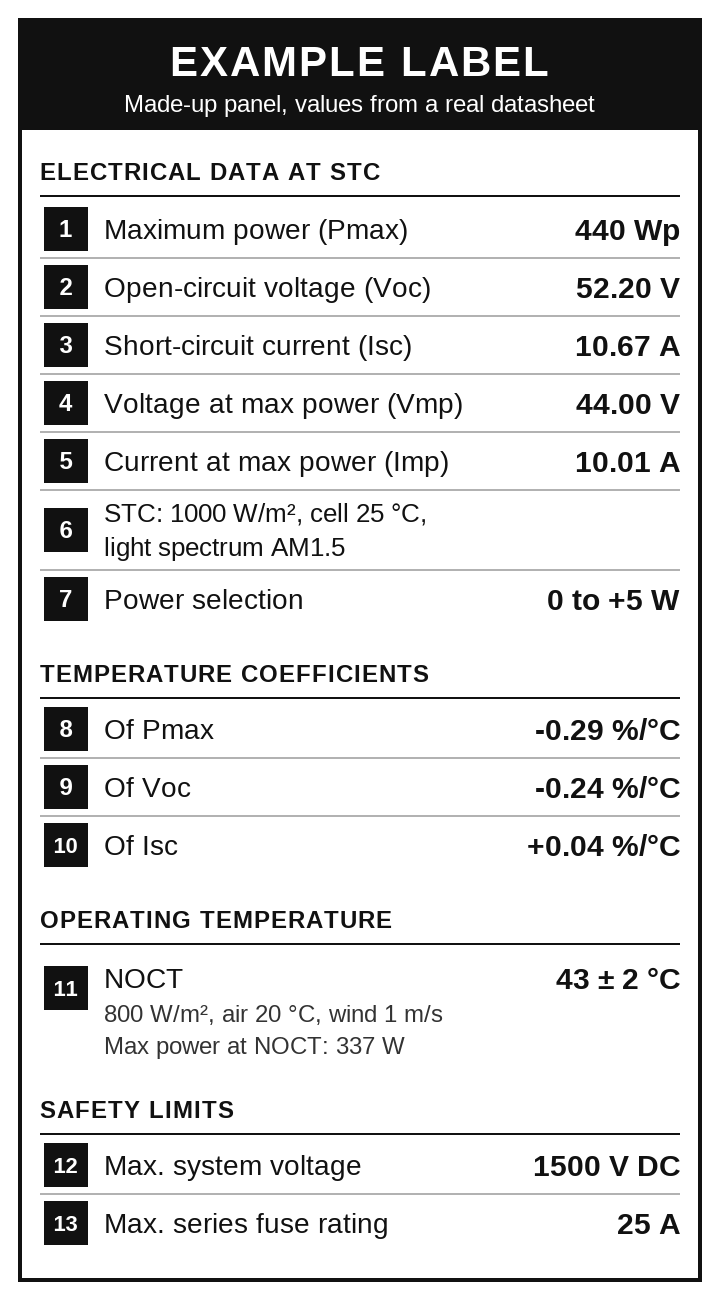
Example label, made up for this page. The values come from the Trina Solar Vertex S+ 440 W datasheet (TSM-NEG9R.28, 2025 edition). Real labels and datasheets lay things out their own way, and some leave fields out.
Here is what each numbered field is. The sections below explain them one by one.
- Pmax, the maximum power, in Wp
- Voc, the open-circuit voltage
- Isc, the short-circuit current
- Vmp, the voltage at maximum power
- Imp, the current at maximum power
- STC, the test conditions behind numbers 1 to 5
- Power tolerance (Trina's sheet calls this line "power selection")
- Temperature coefficient of Pmax
- Temperature coefficient of Voc
- Temperature coefficient of Isc
- NOCT, the cell temperature in a second test
- Maximum system voltage
- Maximum series fuse rating
First, The Test Behind The Numbers (STC)
The main numbers on a label come from one lab test that the whole industry uses. Engineers call it STC, short for "standard test conditions" (number 6).
STC means three things at once. The light is 1000 watts on every square metre of panel, the cells are at 25 °C, and the light has a fixed mix of colours called AM1.5. That colour recipe is written down in a standard (IEC 60904-3), so every lab tests with the same kind of light.
It works like timing every runner on the same track. The times can be compared, even if each runner is faster or slower on a windy day.
On a real roof, the light and the cell temperature change all day. So the label is a starting point for planning, not a promise for every hour. Many datasheets also print a second set of numbers from a different test, which comes up further down.
Solar Panel Specifications Explained: The Five Main Numbers
Two words first. Voltage is how hard the electricity pushes, and current is how much of it flows, a bit like the pressure and the amount of water in a garden hose. Power, in watts, is the two multiplied together.
The typical values below come from four makers' datasheets dated 2023 to 2025: Trina, Jinko, LONGi and Canadian Solar. All are modern rooftop panels of 420 to 460 W, about 1.7 by 1.1 metres. That's a sample, not a survey of every panel sold.
They come in two layouts, and the layout changes the volts and amps a lot. Panels with 108 half-cells give about 39 volts open-circuit, while Trina's 144 half-cell panel gives about 52 volts.
Pmax: The Panel's Watts (Number 1)
Pmax is the most power the panel makes at STC. The European standard for panel labels and datasheets (EN 50380) calls it "maximum power at STC condition".
Makers write its unit as Wp, short for "watt-peak". That's how makers write it (we found no definition of Wp in the label standard), and it simply means watts at STC. Trina prints "PMAX(Wp)" and Jinko prints "Pmax [Wp]".
Typical: 420 to 460 W on the four datasheets.
Used for: counting panels. The solar panel calculator takes your panel's watts and your region's solar yield and works out how many panels you need.
Voc: Open-Circuit Voltage (Number 2)
Voc is the voltage when nothing is connected, so no current flows. Think of a garden hose with your thumb pressed hard over the end. The push is at its biggest, but no water comes out.
Typical: 38.6 to 40.17 V on the 108-cell panels, and 52.20 to 53.80 V on Trina's 144-cell range.
The label Voc is the highest voltage only at STC. On a cold morning it climbs higher, which is why it gets its own section below.
Used for: checking that a row of panels can't push more volts than the charge controller can take.
Isc: Short-Circuit Current (Number 3)
Isc is the current when the plus and minus wires are joined straight together, with nothing in between. In the hose picture, it's the hose wide open: the most water, but no pressure left. It's a lab measurement, not something to try with real panel wires.
Typical: 13.58 to 14.45 A on the 108-cell panels, and 10.67 A on Trina's 440 W panel.
Like Voc, it's the highest value only at STC. Sunlight can be stronger than 1000 W/m², and then the current goes up too.
Used for: the charge controller's limit for panel short-circuit current, and the fuse and wire between the panels and the controller.
Vmp And Imp: The Sweet Spot (Numbers 4 And 5)
Somewhere between "no flow" and "no push" is the point where the panel gives the most power. Scientists call it the maximum power point. Vmp is the voltage there and Imp is the current, like holding your thumb halfway over the hose so the water squirts the farthest.
Sheets spell them differently: Vmpp and Impp, or VPmax and IPmax in the standard. They all mean the same two numbers.
Typical: Vmp 31.6 to 33.64 V and Imp 13.13 to 13.69 A on the 108-cell panels. On Trina's 440 W panel, Vmp is 44.00 V and Imp is 10.01 A.
Here's a quick check that you read the label right. Multiply them: 44.00 V × 10.01 A = 440.4 W, which is Pmax. On all four datasheets this check lands within 0.2% of Pmax.
Used for: an MPPT charge controller, a box that keeps hunting for this sweet spot. The panels' voltage must also stay high enough for the controller on hot days. Victron, for example, says the panel voltage must be more than 5 V above the battery voltage before its controller starts.
Power Tolerance: How Close To The Label? (Number 7)
No factory makes every panel exactly the same. Power tolerance is the spread the maker allows at STC.
Sheets write it in two ways. Jinko prints 0 to +3%, so a panel never tests below its label. LONGi and Canadian Solar print ±5 W, which on a 430 W panel is about ±1.2%.
Trina's sheet calls its line "power selection" and prints "0 ~ +5 W" in the table and "up to +3%" in a footnote.
A separate line on three of the four sheets says ±3%. That's the measurement uncertainty: how exactly the lab can measure, not how much the panels differ.
Used for: comparing makers or checking a delivered panel. It doesn't change your panel count.
Temperature Coefficients: What Heat And Cold Do (Numbers 8 To 10)
A temperature coefficient tells you how much a number changes for every degree the cells sit above or below 25 °C. It's written in % per °C, as a share of the STC value.
- Pmax (number 8) is negative, so power drops as cells heat up. All four datasheets print -0.29% per °C. In the 2024 scorecard of the US test lab PVEL, the averages were -0.30 for TOPCon and -0.32 for PERC panels, and -0.26 for a smaller group of HJT panels. (TOPCon, PERC and HJT are three ways of building a cell.)
- Voc (number 9) is also negative, so voltage rises when cells get cold. The four datasheets print -0.23 to -0.25% per °C.
- Isc (number 10) is small and positive: +0.04 to +0.05% per °C. You'll mostly see it in detailed computer models.
Older figures sit further from zero. A 2017 report from the IEA's solar power programme (IEA-PVPS) gave -0.3 to -0.5% per °C as typical rates for cells back then.
A hot day shows what that means. If the cells of the 440 W Trina panel reach 60 °C, that's 35 degrees above the test. 35 × 0.29 = 10.15%, so in STC-strength light it makes about 395 W instead of 440 W.
If you live somewhere hot, a Pmax coefficient closer to zero loses less. Why heat costs power at all is part of how solar cells work.
One trap: don't use the Pmax coefficient for voltage. The Voc coefficient is the one for the cold check, and a coefficient for Vmp or Imp only counts if the sheet prints one.
The Cold Morning Rule For Voc
Cold makes voltage climb. Victron, who make charge controllers, say: "The colder it is, the higher the open circuit voltage on a PV array will be." So you plan with the coldest temperature you expect.
This is the sum for the Trina panel on the drawing, with its cells at -10 °C:
- Count the degrees below 25 °C. From 25 °C down to -10 °C is 35 degrees.
- Multiply by the Voc coefficient without its minus sign: 35 × 0.24 = 8.4%.
- Add that to the label Voc: 52.20 V × 1.084 = 56.6 V.
With the coefficients on the four sheets (-0.23 to -0.25% per °C), Voc ends up about 8 to 8.75% above the label at a cell temperature of -10 °C. At -20 °C, with -0.25% per °C, it's about 11% above.
Panels wired in a row, called a series string, add up their voltages. Two of these panels in that cold give about 113 V.
A Victron SmartSolar MPPT 150/70 is rated for 145 V when starting and running, and 150 V as the absolute maximum in the coldest conditions. So two panels in a row fit, and three (about 170 V) do not. The charge controller calculator does this sum for your own panels.
- 145 V: MPPT 150/70, start and run
- 150 V: its absolute max, in the coldest conditions
The European label standard also gives a quick safety margin. It has makers tell installers to multiply the label's Isc and Voc by 1.25 when choosing parts, because sunlight is often stronger than 1000 W/m² and cold raises Voc. That 25% is more than any of the cold rises above, and the standard says a designer may change it using the site's lowest temperature and the Voc coefficient.
STC, NOCT And NMOT: The Second Set Of Numbers (Number 11)
Many datasheets add a second test with weaker light and real air around the panel.
The older one is NOCT, short for "nominal operating cell temperature". The panel sits in 800 W/m² of light, the air is 20 °C, a breeze blows at 1 m/s and nothing is connected. NOCT is the temperature the cells settle at: 43 ± 2 °C on the Trina sheet, and 45 ± 2 °C on the Jinko and LONGi ones.
Newer sheets may print NMOT, "nominal module operating temperature", as defined in the 2017 edition of EN 50380. The light, air and wind are the same, but the panel is mounted on an open rack, tilted at 37.5°, and working near its maximum power point. Canadian Solar prints NMOT 41 ± 3 °C.
Next to that temperature, the sheet lists Pmax, Voc, Isc, Vmp and Imp for that test. Trina's 440 W panel makes 337 W there, and on the four sheets that print this test it's 75 to 77% of the label watts.
Two warnings. NOCT and NMOT are different tests, so don't compare an NOCT number on one sheet with an NMOT number on another. And some newer sheets print neither: one of the Jinko sheets used here lists only STC values.
Used for: estimating how hot your cells run. None of the main sizing steps need it.
Two Safety Limits: System Voltage And Series Fuse (Numbers 12 And 13)
These last two aren't about how much power you get. They're limits, like the weight limit on a trampoline.
Maximum system voltage is the most voltage the panel's insulation is built for when it's part of a string. The four sheets print 1000 or 1500 V DC. A string's cold Voc must stay under it, but in a small off-grid system the controller's own limit (like 150 V or 250 V) is much lower, so that one comes first.
Maximum series fuse rating is the biggest fuse or breaker allowed to protect a string of these panels. All four sheets say 25 A. It's a ceiling, not the size to buy, so it's a check for your installer. Our guide to which fuse goes where covers the fuse between panels and controller.
How To Read A Solar Panel Label At A Glance
| On the label | What it tells you | Typical on the 2023 to 2025 sheets | Used for |
|---|---|---|---|
| Pmax (Wp) | Most power at STC | 420 to 460 W | Counting panels |
| Voc | Voltage with nothing connected | 38.6 to 40.17 V (108 cells), 52.20 to 53.80 V (144 cells) | Cold-voltage check on the controller |
| Isc | Current with plus and minus joined | 13.58 to 14.45 A (108 cells), 10.67 A (144 cells, 440 W) | Controller current limit, panel fuse and wire |
| Vmp and Imp | Volts and amps at the sweet spot | 31.6 to 33.64 V and 13.13 to 13.69 A (108 cells) | Vmp × Imp = Pmax check, MPPT voltage on hot days |
| Power tolerance | Factory spread at STC | 0 to +3%, or ±5 W | Comparing makers |
| Pmax coefficient | Power change per °C | -0.29% per °C | Comparing panels for hot places |
| Voc coefficient | Voltage change per °C | -0.23 to -0.25% per °C | Cold-voltage check |
| Isc coefficient | Current change per °C | +0.04 to +0.05% per °C | Detailed models |
| NOCT or NMOT | Cell temperature in the 800 W/m² test | 41 to 45 °C | Estimating cell heat |
| Max system voltage | Insulation limit for a string | 1000 or 1500 V DC | Upper limit for string voltage |
| Max series fuse | Biggest fuse allowed | 25 A | Installer check |
Stuck on a word? The off-grid solar glossary explains every datasheet term in a line or two.
Sources
- CENELEC EN 50380:2017, Marking and documentation requirements for photovoltaic modules (sample pages)
- EN 50380:2003, Datasheet and nameplate information for photovoltaic modules (sample pages)
- IEC 60904-3:2019, Measurement principles for terrestrial PV devices with reference spectral irradiance data
- Sandia National Laboratories, Photovoltaic Array Performance Model (SAND2004-3535)
- IEA-PVPS T13-06:2017, PV Performance Modeling Methods and Practices
- Trina Solar, Vertex S+ TSM-NEG9R.28 440-470 W datasheet (2025)
- JinkoSolar, Tiger Neo 54HL4R-(V) 435-460 W datasheet
- JinkoSolar, Tiger Neo 54HL4R-B 425-445 W datasheet (2023)
- LONGi, Hi-MO 6 LR5-54HTH 440-450M datasheet (2023)
- Canadian Solar, TOPHiKu6 CS6R-420 to 440T datasheet
- PVEL, 2024 PV Module Reliability Scorecard, PAN performance
- Victron Energy, Matching solar modules to MPPT charge controllers (2014)
- Victron Energy, SmartSolar MPPT 150/70 to 250/100 manual, technical specifications
Hard Words
| Term | What it means |
|---|---|
| STC | Standard test conditions: the lab test behind a label's main numbers. 1000 W/m² of light, cells at 25 °C and the AM1.5 sunlight spectrum. |
| Wp (watt-peak) | The unit makers print for Pmax. It means watts at STC. |
| Voltage | How hard electricity pushes, like the pressure in a garden hose. Measured in volts (V). |
| Current | How much electricity flows, like the amount of water in a hose. Measured in amps (A). |
| Open circuit | Nothing connected to the panel, so no current flows. Voc is measured this way. |
| Short circuit | Plus and minus joined straight together. Isc is measured this way, in a lab. |
| Maximum power point | The mix of voltage and current where a panel gives the most power. Vmp and Imp are its two numbers. |
| MPPT charge controller | A box between panels and battery that keeps finding the maximum power point. |
| Temperature coefficient | How much a label number changes for each degree the cells sit above or below 25 °C, in % per °C. |
| NOCT and NMOT | Two tests at 800 W/m², 20 °C air and a 1 m/s breeze. The number printed is the temperature the cells settle at. |
Common Questions
What do Voc, Isc, Vmp and Imp mean on a solar panel?
Voc is the voltage with nothing connected and Isc is the current with plus and minus joined, both measured at standard test conditions. Vmp and Imp are the voltage and current at the point where the panel gives the most power. Multiply Vmp by Imp and you get the panel's watts, Pmax.
What does Wp mean on a solar panel?
Wp means watt-peak. Makers use it as the unit for Pmax, the panel's maximum power at standard test conditions: 1000 W/m² of light, cells at 25 °C and the AM1.5 sunlight spectrum. It is how makers write it (we found no definition of Wp in the label standard), and on a real roof the light and heat change all day.
What are standard test conditions (STC) for solar panels?
STC is the lab test behind a panel's main label numbers: 1000 watts of light per square metre, a cell temperature of 25 °C and a standard sunlight spectrum called AM1.5. Because every maker uses the same test, labels can be compared. Many datasheets also print a second set of values at NOCT or NMOT.
How much does a solar panel's Voc go up in the cold?
It depends on the panel's Voc temperature coefficient. The four rooftop panel datasheets from 2023 to 2025 used on this page print -0.23 to -0.25% per °C, which puts Voc about 8 to 8.75% above the label at a cell temperature of -10 °C, and about 11% above at -20 °C. Panels in a row add up these higher voltages.
What is the difference between NOCT and NMOT?
Both are cell temperatures measured in 800 W/m² of light, 20 °C air and a 1 m/s breeze. NOCT, the older test, leaves the panel unconnected. NMOT, as defined in the 2017 European label standard, mounts the panel on an open rack at 37.5° and lets it work near maximum power. Don't compare one with the other.
What is a good temperature coefficient for a solar panel?
Closer to zero is better, because the panel loses less power on hot days. Four rooftop panel datasheets from 2023 to 2025 all print -0.29% per °C for power. PVEL's 2024 scorecard, from an independent test lab, averaged -0.30 for TOPCon and -0.32 for PERC panels. A 2017 review gave -0.3 to -0.5% for typical cells back then.
What does power tolerance mean on a solar panel?
It is how far a panel may differ from its label watts when it leaves the factory, measured at STC. Some makers print 0 to +3%, so the panel never tests below its label, and others print ±5 W. It is a different line from measurement uncertainty, which is how exactly the lab can measure.