

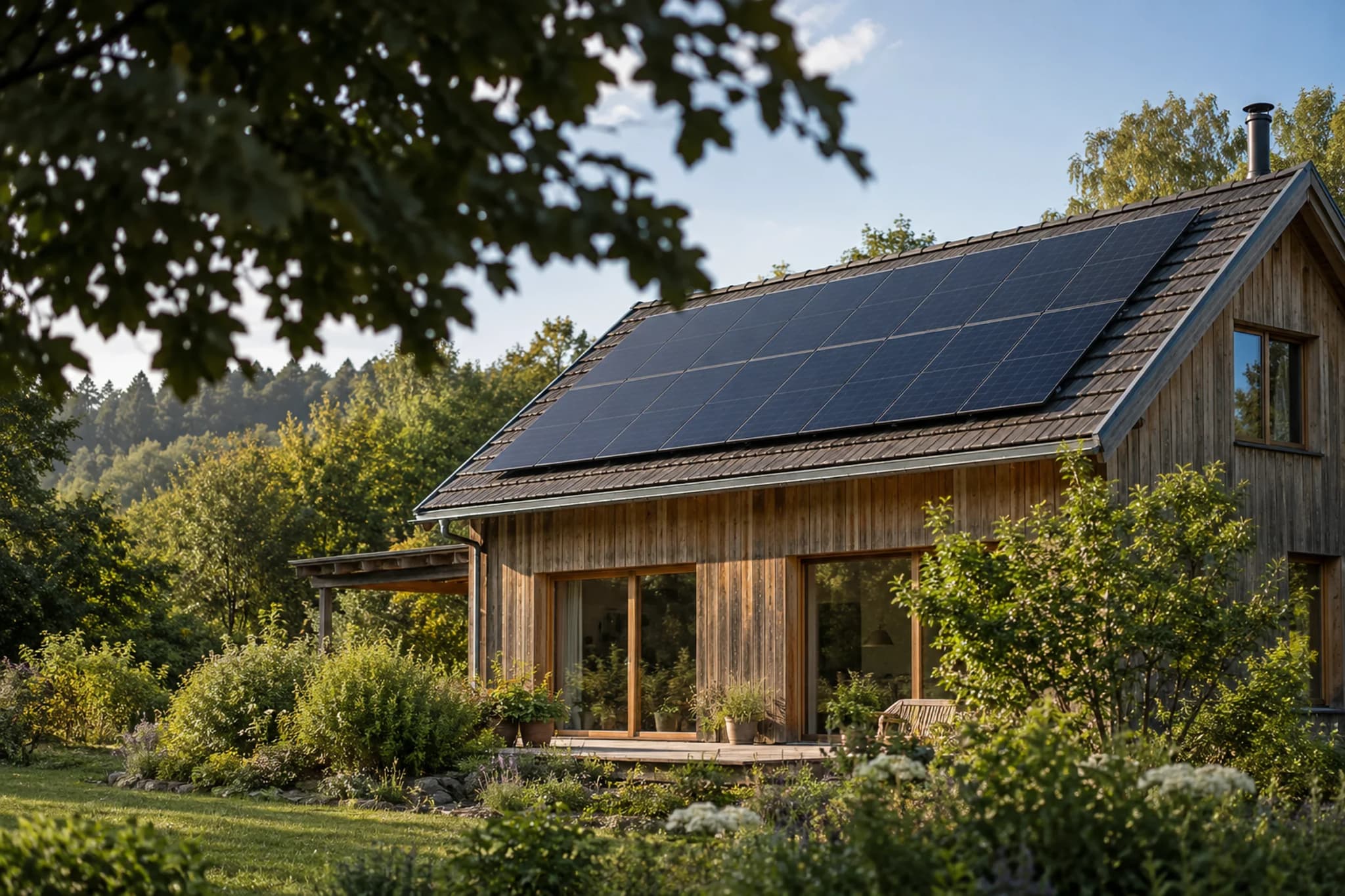
This off-grid solar glossary explains the words you meet when you plan your own solar power: panels, batteries, inverters, wires and the sums that tie them together. Find a word under its first letter, read the short meaning, and follow the "Read more" link when you want the whole story.
Some words mean different things in different places. "Hybrid" and "peak" are the big ones. Those words get one line per meaning, so you can pick the one that fits what you were reading.
Words that start with a number come first, then A to Z.
Numbers
12-volt system. A DC system that is common in vans and boats. Many devices run straight from the battery, with no conversion needed. Read more: Are solar panels AC or DC? How DC and AC power work in an off-grid solar system
16S BMS. A BMS built for 16 cells in series, the usual 48 V pack. Read more: Battery Management System: How To Choose The Right BMS
18650. A round lithium cell, about 18 mm wide and 65 mm long. Read more: Lithium-Ion Batteries: How They Work, Last and Stay Safe
4/0. Said "four aught". A very thick wire, four steps thicker than 1 AWG. Read more: AWG to mm2: Wire Gauge Chart With Amps and Diameter
A
Absorption. The second stage of charging, when the battery is topped up from about 80% to 100%. See also bulk and float. Read more: Off-Grid Solar Troubleshooting: Why It Stopped Working
AC (alternating current). Electricity that goes back and forth many times a second: 60 times in the US and 50 in most of Europe. Wall sockets give AC. Read more: Are solar panels AC or DC? How DC and AC power work in an off-grid solar system
AC coupling. The panel power is turned into AC first, and a second box turns it back into DC to fill the battery. That is two translations instead of one. Read more: Are solar panels AC or DC? How DC and AC power work in an off-grid solar system
AC wiring. The standard house wiring that runs from the inverter to your electrical panel. Also called mains wiring. Read more: Electronic parts
Active balancing. A way for a BMS to keep its cells even: it moves the extra charge from a full cell to a low one. Read more: Battery Management System: How To Choose The Right BMS
Adjustable mount. A mount that lets you change the tilt of the panels by season. A bit more work, and a bit more output in the dark months. Read more: Roof Orientation For Solar Panels: Direction And Angle
AGM (absorbent glass mat). A sealed lead-acid battery with the acid soaked into a fibreglass mat, like juice in a sponge. Nothing to top up. Read more: Lead Acid Batteries: How They Work, Types and Care
Agrivoltaics. Solar panels standing over crops, so one field grows food and makes power at the same time. Read more: The Future of Solar Panels: Tandem Cells, New Tech and Trends
Alternator. The engine's built-in generator in a van or boat. It charges the batteries while the engine runs. Read more: Van, Camper And Boat Electrical System: Solar, Alternator And Shore Power
Aluminum frame. The strong, light metal frame around the edge of a solar panel. It gives the mounting parts something to grip. Read more: Inside A Solar Panel: The 6 Parts And What Each One Does
Always live. The cable between the battery and the disconnect switch. It can never be shut off. Read more: Battery Disconnect Switch: How It Cuts The Power Safely
Amorphous silicon (a-Si). Silicon with no neat crystal pattern, used in the bendy kind of thin-film panel. Cheap, but only about 7 to 9 percent efficient. Read more: Thin Film Solar Panels: How They Work and Where They Win
Amp (A). The unit of current: how much electricity flows right now. Wires and fuses are sized by amps: a 100 A fuse is made to carry 100 amps all day, and it blows when a lot more than that flows for long enough. Read more: What Fuse Do I Need? Sizing Fuses For Off-Grid Batteries
Amp-hour (Ah). One amp flowing for one hour, the unit many batteries are sold in. It only means something together with a voltage: watt-hours = amp-hours × volts, so 100 Ah at 12 V is 1,200 Wh. Read more: Off-Grid Battery Calculator: Size Your Solar Battery Bank
Ampacity. How many amps a cable can carry before it gets too hot. Read more: Metric DC Cable Size Calculator
Annual energy consumption. All the electricity your home uses in one year, in kWh. Read more: Solar Panel Calculator: Panel Count From Your Yearly kWh
Anode. The negative side of a battery cell. In a lithium-ion cell it is usually graphite. Read more: Lithium-Ion Batteries: How They Work, Last and Stay Safe
Anti-islanding. What a grid-tied inverter does when the grid goes down: it notices and disconnects, so it does not push power into "dead" wires where line workers may be busy. Read more: Off-Grid vs Grid-Tied Solar System: Costs and Blackouts
Anti-reflective coating. A super-thin film on the panel glass that helps more light get through. Damaging it lowers the panel's output for good. Read more: Solar Panel Maintenance: Safe Solar Panel Cleaning and Checks
Array (solar array). Several solar panels joined together into one group. Its size is given in kilowatts. Read more: Step 4. Off Grid Solar Wiring: How Your System Connects
Array size. The total kilowatts of solar panels you need, worked out from how many kWh you use a day and how much sun your place gets. Read more: Peak Sun Hours: How Much Sunlight Your Solar Panels Get
Autonomy (days of autonomy, backup days). How long the battery can run everything with no help from the sun at all. You choose the number of days when you size the battery. Read more: Off-Grid Battery Calculator: Size Your Solar Battery Bank
AWG (American Wire Gauge). The way the US sizes wires. A lower number means a thicker wire. Read more: AWG Conversion Chart: Wire Gauge to mm² and Inches
Azimuth. The compass direction a panel faces. Read more: Roof Orientation For Solar Panels: Direction And Angle
B
Back sheet. The thin plastic sheet on the back of a solar panel. It seals out moisture and insulates the wiring. Read more: Inside A Solar Panel: The 6 Parts And What Each One Does
Backup. Power from the battery during a grid power cut, often only for chosen circuits. Read more: High Voltage Battery Systems Explained: Stacks, Inverters And Going Off-Grid
Backup generator. A small petrol or diesel generator kept for very long dark spells, like the worst winter weeks. Cheap to buy, expensive to run. Read more: Things To Consider Before Going Off Grid With Solar
Balance of system. Everything in a solar system that is not a panel, a battery or a box with a screen: cables, fuses, switches, mounts and a monitor. Read more: Electronic parts
Ballast. Weight that holds a solar frame down on a flat roof instead of screws. It has to be heavy enough that the wind can't lift the panels. Read more: Solar Panel Mounting: Roof, Ground, Pole And Tracker Mounts
Ballasted tilt frame. A metal frame that props panels up at an angle on a flat roof. Heavy concrete blocks hold it down, so no holes have to be drilled. Read more: Roof Orientation For Solar Panels: Direction And Angle
Bank voltage. The volts of your batteries together, usually 12, 24 or 48. Read more: Solar Charge Controller Guide: PWM vs MPPT, Sizing, Setup
Battery bank. One battery, or a group of them wired together. Off the grid it is your whole night-time supply. Read more: Step 2. How To Choose A Solar Battery For Your Off-Grid Home
Battery disconnect switch. A switch that cuts the battery off from the rest of the system, for repairs and emergencies. The battery itself stays live. Read more: Battery Disconnect Switch: How It Cuts The Power Safely
Battery minus (battery negative). The minus terminal on the battery. Only the shunt connects here. Read more: Battery Shunt: How To Know How Full Your Battery Really Is
Battery module (module). One building block of a high-voltage battery: a box of battery cells in its own case, with its own kWh and voltage. Several modules joined in series make a stack. Read more: High Voltage Battery Systems Explained: Stacks, Inverters And Going Off-Grid
Battery monitor. A device that counts the amps going in and out of the battery to show how full it is. It works with a shunt. Read more: Battery Shunt: How To Know How Full Your Battery Really Is
Battery size. The total kWh your battery bank holds. You get it from your daily use and the number of days without sun, plus room for the part you keep in reserve and the losses. Read more: How To Build A Home Battery Backup System, Step By Step
Battery stack (stack). The modules of a high-voltage battery joined in series, so their voltages add up to hundreds of volts. The number of modules sets both the kWh and the voltage. Read more: High Voltage Battery Systems Explained: Stacks, Inverters And Going Off-Grid
Bifacial panel. A panel that catches light on both sides. The front takes the direct sun, and the back picks up light bouncing off the ground. Read more: Types of Solar Panels and Which One Is Right for Your Roof
Bird droppings. Bird poop on a panel. You can't see through it, so it blocks light: a small spot costs a few percent, and one over a whole cell can cost about a third of a common 60-cell panel's output. Read more: Solar Panel Maintenance: Safe Solar Panel Cleaning and Checks
Black start. Waking the battery and inverter when there is no grid and no sun to start them. Read more: High Voltage Battery Systems Explained: Stacks, Inverters And Going Off-Grid
Blade fuse. A small plastic fuse with two flat legs, like the ones in cars. Fine for small branch circuits. Read more: What Fuse Do I Need? Sizing Fuses For Off-Grid Batteries
BMS (battery management system). A small electronic brain inside or next to a lithium battery. It watches every cell's voltage, the temperature and the current, and cuts the power before trouble starts. Read more: Battery Management System: How To Choose The Right BMS
Bonding. Joining metal parts with a solid electrical connection, so they act as one piece. Read more: Solar Panel Grounding And Surge Protection For Off-Grid
Branch circuit. A separate run from the battery to one device or group of devices. Each branch gets its own fuse. Read more: What Fuse Do I Need? Sizing Fuses For Off-Grid Batteries
Break-even. The moment your total savings equal the price you paid for the system. Read more: Solar Payback and ROI Calculator: Years to Break Even
Breaker (circuit breaker). A switch that trips when too much current flows. Instead of melting like a fuse, it can be switched back on. Read more: What Fuse Do I Need? Sizing Fuses For Off-Grid Batteries
Built-in charge controller. A charge controller built into a portable power station, so a solar panel can plug straight in. Read more: Portable Solar Power Stations: What They Run and How to Choose
Built-in inverter. An inverter that comes inside a portable power station. It turns the battery's DC into AC for the sockets. Read more: Portable Solar Power Stations: What They Run and How to Choose
Bulk. The first stage of charging, when the battery fills to about 80%. Read more: Off-Grid Solar Troubleshooting: Why It Stopped Working
Burn rate. How much fuel a generator uses per hour. Read more: Generator Backup Runtime Calculator
Bypass diode. A tiny one-way gate inside a panel's junction box. When one group of cells goes dark, it lets the current skip around that group, so the rest of the panel keeps working. Read more: Solar Panel Shading: Why One Leaf Can Cost A Third
C
Cable sizing (cable thickness). Picking a wire thick enough to carry the current without overheating. Thin cables can't carry much current without getting hot. Read more: Metric DC Cable Size Calculator
Cadmium telluride (CdTe). The most common thin-film material, used in big solar farms. It contains toxic cadmium, but more than 90% of a module can be recycled. Read more: Thin Film Solar Panels: How They Work and Where They Win
Cathode. The positive side of a battery cell. In a lithium-ion cell it is a metal compound that holds the lithium. Read more: Lithium-Ion Batteries: How They Work, Last and Stay Safe
Cell. Two different things, depending on whether you are talking about panels or batteries.
- Solar cell: a thin slice of silicon that turns light into electricity. A typical panel holds dozens of them, joined in a chain. Read more: Inside A Solar Panel: The 6 Parts And What Each One Does
- Battery cell: one of the smaller batteries inside a battery pack. A 48 V LiFePO4 pack usually has 16. Read more: Battery Management System: How To Choose The Right BMS
Cell balance. Keeping every cell in a battery at the same charge level. Read more: Battery Management System: How To Choose The Right BMS
Cell chain. Solar cells wired in a line, where the current flows from one to the next. Read more: Solar Panel Shading: Why One Leaf Can Cost A Third
Cell imbalance. When one cell in a battery fills or empties faster than the others. Read more: Off-Grid Solar Troubleshooting: Why It Stopped Working
Charge controller. The small box between the panels and the battery. It lets in only as much as the battery can safely take. Also called a solar regulator or charge regulator. Read more: Solar Charge Controller Guide: PWM vs MPPT, Sizing, Setup
Christmas-light effect. One dead bulb darkening a whole string of old lights. A dark cell in a chain of solar cells does the same thing. Read more: Solar Panel Shading: Why One Leaf Can Cost A Third
CIGS (copper indium gallium selenide). A thin-film material that bends well. The best modules reach about 19 percent efficiency. Read more: Thin Film Solar Panels: How They Work and Where They Win
Circular solar industry. A future where old solar panels are recycled into new ones. Read more: The Future of Solar Panels: Tandem Cells, New Tech and Trends
Clamping zone. The part of a panel's frame where its maker allows clamps. Clamping outside it lowers the load the panel is rated to carry. Read more: Solar Panel Mounting: Roof, Ground, Pole And Tracker Mounts
Class T fuse. A fuse with a very high interrupt rating, used as the main fuse on big lithium batteries. Read more: What Fuse Do I Need? Sizing Fuses For Off-Grid Batteries
Cold factor. The number you multiply a string's label voltage by to get its voltage on the coldest morning: 1 + (coldest morning minus 25) × temperature coefficient ÷ 100. Cold panels make a higher voltage than the label says. Read more: MPPT Charge Controller Calculator: Size It for Your Solar Panels
Combiner box. The box where several strings of solar panels join before one cable runs on to the inverter. Read more: Solar Panel Grounding And Surge Protection For Off-Grid
Conductor. The metal core of a cable that carries the flow, usually copper. Read more: Metric DC Cable Size Calculator
Continuous load. Everything that can run at the same time for minutes or longer. It is not your daily average: it is the total watts of every device that can be on together. Read more: Inverter Size Calculator
Continuous rating. What an inverter or a generator can deliver for hours, not just for a short burst. Read more: Generator Backup Runtime Calculator
Cranking rating. The short burst of current a disconnect switch can carry while a starter motor turns an engine. Read more: Battery Disconnect Switch: How It Cuts The Power Safely
Critter guard (rodent mesh). A strip of metal mesh along the edges of the array that keeps animals from nesting under the panels and chewing the cables. Read more: Solar Panel Maintenance: Safe Solar Panel Cleaning and Checks
Cross-sectional area. The size of the metal circle you see when you cut a wire straight across. Read more: AWG Conversion Chart: Wire Gauge to mm² and Inches
Crystal edges. The borders between the small grains inside a polycrystalline cell. They cause the speckled look and slow the electrons down. Read more: Polycrystalline Panels: How These Solar Panels Work vs Mono
Crystalline. Atoms lined up in a neat pattern, like in mono and poly silicon. Read more: Thin Film Solar Panels: How They Work and Where They Win
Current. How much electricity is flowing. It is measured in amps. Read more: War Of The Currents: Edison vs Tesla And AC vs DC Power
Current rating. How many amps a BMS can safely pass. Read more: Battery Management System: How To Choose The Right BMS
Cycle (battery cycle). One full empty-and-refill of a battery. Batteries wear out one cycle at a time. Read more: How Do Home Batteries Work? Types, Lifespan And Picking One
Cycle life. How many charge-and-discharge cycles a battery survives before its capacity drops to about 80%. Read more: Step 2. How To Choose A Solar Battery For Your Off-Grid Home
Czochralski method. The factory way to grow one big silicon crystal: dip a seed into melted silicon, spin it and pull it up slowly. Read more: Monocrystalline Solar Panels: How They Work and Why They Won
D
Daily power use. The total kWh your house uses in a day. It is the starting point for sizing the rest of the system. Read more: How To Build A Home Battery Backup System, Step By Step
Daily yield. How many kWh 1 kW of panels really delivers per day, averaged over a whole year, after losses. It is the yearly figure divided by 365. Also called effective sun hours or daily yield per kWp. Read more: Solar Yield By Region: What 1 kW Of Panels Makes In 70 Places
DC (direct current). Electricity that flows one way only, like water down a hose. Solar panels make DC, and batteries store DC. Read more: Are solar panels AC or DC? How DC and AC power work in an off-grid solar system
DC coupled. The path where panels go to the charge controller and then to the battery, DC the whole way. Read more: Are solar panels AC or DC? How DC and AC power work in an off-grid solar system
DC fuse. A fuse built and tested for direct current. DC arcs differently from AC, so the fuse needs a DC voltage rating. Read more: What Fuse Do I Need? Sizing Fuses For Off-Grid Batteries
DC loads. Devices that run on DC directly, like LED strips, 12 V pumps and USB chargers. They can be wired straight to the battery, skipping the inverter. Read more: Step 4. Off Grid Solar Wiring: How Your System Connects
DC ripple. A wobble in the battery voltage, often from loose connections or cables that are too thin. Read more: Off-Grid Solar Troubleshooting: Why It Stopped Working
DC-DC charger. A box that charges a van's or boat's house battery from the alternator and limits the current it takes. Read more: Van, Camper And Boat Electrical System: Solar, Alternator And Shore Power
DC-DC converter. A small box that turns one DC voltage into another, for example 24 V into 12 V. Read more: Van, Camper And Boat Electrical System: Solar, Alternator And Shore Power
Deep-cycle. A battery built to be drained low and recharged many times. Read more: Lead Acid Batteries: How They Work, Types and Care
Degradation. Solar panels slowly making less power as they age. Read more: Solar Payback and ROI Calculator: Years to Break Even
Depth of discharge (DoD). How much of the battery you use before you charge it again. A DoD of 80% means you use 80% and leave 20% inside. LiFePO4 is often planned at 80% and lead-acid at about 50%. Read more: Off-Grid Battery Calculator: Size Your Solar Battery Bank
Derating. Taking a bit off a generator's rated power for high altitude or heat, where the engine gets less air. Read more: Generator Backup Runtime Calculator
Diameter. How wide a wire is across, in mm or inches. Read more: AWG Conversion Chart: Wire Gauge to mm² and Inches
Diode. A one-way valve for electricity. Read more: Inside A Solar Panel: The 6 Parts And What Each One Does
Disconnect switch (safety switch). An off switch that cuts one part of the system loose, for repairs and emergencies. A DC safety switch cuts the DC side, for example the circuit from the panels. Read more: Battery Disconnect Switch: How It Cuts The Power Safely
Distilled water. Pure water with no minerals in it, used to top up flooded lead-acid batteries. Read more: Lead Acid Batteries: How They Work, Types and Care
Dust buildup. A chalky layer of fine dust that slowly cakes on panel glass in dry, sunny places. It acts like sunscreen on the cells underneath. Read more: Solar Panel Maintenance: Safe Solar Panel Cleaning and Checks
E
East-west split. Half the panels face east and half face west, so the electricity is spread across the day instead of peaking at noon. Read more: Roof Orientation For Solar Panels: Direction And Angle
Effective sun hours. Another name for daily yield: peak sun hours after the normal losses from heat, dirt, cables and the inverter. Lower than peak sun hours, and more realistic. Read more: Peak Sun Hours: How Much Sunlight Your Solar Panels Get
Efficiency. The share of energy that gets through a step. The word is used in two main ways.
- Panel efficiency: how much of the sunlight hitting a panel turns into electricity. Higher efficiency means more watts from the same size of panel. Read more: Types of Solar Panels and Which One Is Right for Your Roof
- Efficiency of a step in the system: the share of the energy that actually gets through, for example through an inverter. In battery sums it is written η ("eta"): 0.9 through an inverter means 10% turns into heat, and 1.0 is used for straight DC loads. Read more: Off-Grid Battery Calculator: Size Your Solar Battery Bank
ELCI. A safety switch on a boat's shore power line that cuts the power when current leaks out. Read more: Van, Camper And Boat Electrical System: Solar, Alternator And Shore Power
Electric field. The invisible one-way slide where the two layers of a solar cell meet. It pushes freed electrons to one side. Read more: How Do Solar Cells Work? Inside the Photovoltaic Effect
Electrode. One of the two ends inside a battery: the plus side (cathode) or the minus side (anode). Read more: How Do Home Batteries Work? Types, Lifespan And Picking One
Electrolyte. The liquid or paste between the two ends of a battery that carries the charge from one side to the other. In a saltwater battery it is water-based. Read more: How Do Home Batteries Work? Types, Lifespan And Picking One
Electron. A tiny particle that can flow through wires. A flow of electrons is what we call electricity. Read more: How Do Solar Cells Work? Inside the Photovoltaic Effect
Encapsulant. The clear, sticky layer above and below the cells, usually EVA. It holds the cells in place and keeps moisture out. Read more: Inside A Solar Panel: The 6 Parts And What Each One Does
EPS (Emergency Power Supply). A backup output on some hybrid systems, wired to the circuits you want to keep on in a blackout. Read more: Off-Grid vs Grid-Tied Solar System: Costs and Blackouts
Equalising. A deliberate extra-high charge that only flooded lead-acid batteries get. For lithium, Victron says equalisation must be off. Read more: Off-Grid Solar Troubleshooting: Why It Stopped Working
Equator-facing. Pointing toward the equator: south for places north of it, and north for places south of it. That is the best direction for solar panels. Read more: Solar Yield By Region: What 1 kW Of Panels Makes In 70 Places
Equipment grounding conductor. The wire that joins all the metal you can touch (frames, racking, cases), so a fault blows a fuse. Read more: Solar Panel Grounding And Surge Protection For Off-Grid
Expansion battery. An extra battery pack that plugs into some bigger portable power stations to add capacity. Read more: Portable Solar Power Stations: What They Run and How to Choose
Export. Energy you send out to the grid because you can't use it right then. Read more: Solar Self-Consumption Calculator: What You Keep at Home
F
Feed-in payment. What your supplier pays for each kWh you send to the grid, minus any feed-in costs. Read more: Solar Payback and ROI Calculator: Years to Break Even
Fixed-angle mount. A mount that holds the panel at one tilt for good. The cheapest and most common kind. Read more: Roof Orientation For Solar Panels: Direction And Angle
Flashing. A flat plate that slides under the shingles and keeps rain out of the hole a roof screw makes. Read more: Solar Panel Mounting: Roof, Ground, Pole And Tracker Mounts
Float. The last stage of charging, which holds the battery at full. Victron says the battery should reach float every day. Read more: Off-Grid Solar Troubleshooting: Why It Stopped Working
Floating system. A system where no current-carrying wire is tied to the ground. Read more: Solar Panel Grounding And Surge Protection For Off-Grid
Flooded (wet cell). A lead-acid battery with liquid acid you can see under the caps. It needs topping up with distilled water now and then, and fresh air while charging. Read more: Lead Acid Batteries: How They Work, Types and Care
Flow battery. A battery that keeps its chemistry in big tanks of liquid and pumps it through a reaction unit. Built for big jobs, not homes. Read more: Home Battery Storage: Energy Storage For Off-Grid Homes
Folding solar panel. A panel made of two or three hinged sections that fold up small. Read more: Portable Solar Power Stations: What They Run and How to Choose
Frost heave. Freezing soil swelling and pushing posts upward. Read more: Solar Panel Mounting: Roof, Ground, Pole And Tracker Mounts
Frost line. How deep the ground freezes in winter. Footings for a ground mount go below it. Read more: Solar Panel Mounting: Roof, Ground, Pole And Tracker Mounts
Fuse. A thin metal strip, often in a small tube, that melts and breaks the circuit when too much current flows. The simplest fire-safety part. Read more: What Fuse Do I Need? Sizing Fuses For Off-Grid Batteries
Fuse holder. The plastic and metal housing that holds a fuse. Quality matters, because cheap holders corrode and heat up. Read more: What Fuse Do I Need? Sizing Fuses For Off-Grid Batteries
Fuse sizing. Picking a fuse that blows before the wire overheats. A fuse that is too big lets the wire get dangerously hot, and one that is too small blows when nothing is wrong. Read more: Fuse Size Calculator For DC Fuses And Breakers
Fusible switch. A disconnect switch with a fuse built in. Both jobs in one box. Read more: Battery Disconnect Switch: How It Cuts The Power Safely
G
Galvanic corrosion. Two different metals touching with water between them, so one of them slowly corrodes. Read more: Solar Panel Mounting: Roof, Ground, Pole And Tracker Mounts
Gap (December gap). The part of a day's load the panels do not cover in your darkest month: daily load minus panel kW × the darkest month's daily yield. Read more: How Many Solar Panels Do I Need? Off-Grid Math and Calculator
Gel battery. A sealed lead-acid battery with the acid turned into a jelly. Read more: Lead Acid Batteries: How They Work, Types and Care
Grid-following. What a grid-tied inverter does: it listens to the grid's rhythm and matches it. With no grid, it has nothing to copy. Read more: Off Grid Inverter Guide: Solar Inverter Types and Sizing
Grid-forming. What an off-grid inverter has to be: it makes the rhythm of the AC power itself, because there is no grid to copy. Read more: Off Grid Inverter Guide: Solar Inverter Types and Sizing
Grid-tie inverter. An inverter that keeps in step with the grid and shuts off in a power cut. Read more: Off-Grid vs Grid-Tied Solar System: Costs and Blackouts
Grid-tied. A solar system that keeps its wire to the power company. The grid does the storing, so it needs no batteries, and it shuts off in a blackout. Read more: Off-Grid vs Grid-Tied Solar System: Costs and Blackouts
Ground loop. A second bond or second path to ground that splits the current and confuses the safety gear. Read more: Solar Panel Grounding And Surge Protection For Off-Grid
Grounding (earthing). Connecting a system to the soil, so a lightning strike or a fault has a safe road away. Read more: Solar Panel Grounding And Surge Protection For Off-Grid
Grounding wire. A wire that joins the metal parts you can touch into one ground path. If a live wire touches that metal, the current rushes along this path instead of through you, and the fuse blows. Read more: Solar Panel Grounding And Surge Protection For Off-Grid
H
Headroom. Extra room above what you need today, like a 50 amp charge controller for a 42 amp system. Read more: Solar Charge Controller Guide: PWM vs MPPT, Sizing, Setup
Heat coefficient. How much power a panel loses when it gets hot. Poly panels lose a little more than mono. See also temperature coefficient. Read more: Polycrystalline Panels: How These Solar Panels Work vs Mono
Hemisphere. One half of the Earth, above or below the equator. Panels face the equator from either half. Read more: Roof Orientation For Solar Panels: Direction And Angle
High-voltage battery. A home battery made of several modules stacked in series, so the voltages add up to hundreds of volts DC instead of 48. The range depends on the maker, and in the makers' own words a qualified installer fits it. See battery stack. Read more: High Voltage Battery Systems Explained: Stacks, Inverters And Going Off-Grid
High-voltage DC (HVDC). DC sent over long power lines at a big push. The first commercial line opened in Sweden in 1954. Read more: War Of The Currents: Edison vs Tesla And AC vs DC Power
HJT cell (heterojunction cell). A normal silicon cell coated on both sides with very thin layers of a different kind of silicon. Together with TOPCon it is replacing PERC. Read more: The Future of Solar Panels: Tandem Cells, New Tech and Trends
Hole. The empty spot an electron leaves behind when light knocks it loose. Read more: How Do Solar Cells Work? Inside the Photovoltaic Effect
Hot spot. A blocked solar cell that heats up because power gets stuck in it. Read more: Solar Panel Shading: Why One Leaf Can Cost A Third
House battery. The battery that runs the living space in a van or boat, kept separate from the engine's starter battery. Read more: Van, Camper And Boat Electrical System: Solar, Alternator And Shore Power
Hybrid. This word has three meanings in solar, so ask which one is meant.
- Hybrid system (grid plus battery): grid-tied solar that also has a battery. Read more: Off-Grid vs Grid-Tied Solar System: Costs and Blackouts
- Hybrid system (two sources): an off-grid system with two or more sources of power, like solar plus wind. Read more: Wind Solar Hybrid System: How Sun And Wind Team Up
- Hybrid inverter: one box that handles the panels, the battery and the grid together, for homes that are still connected. It names a box, not a whole system. It is also the box a high-voltage battery often comes with: the charge controller is built in, and the battery is matched to it. Some can keep chosen loads on when the grid fails, so read the manual for what it does with no grid at all. Read more: Off Grid Inverter Guide: Solar Inverter Types and Sizing
I
Idle draw. What an inverter uses just by being switched on with nothing plugged in, like a car engine running at a red light. It rises with the inverter's size. Read more: Off Grid Inverter Guide: Solar Inverter Types and Sizing
Imp. The current a panel delivers when it is working at its best point. Multiply it by the voltage at that same point and you get roughly the panel's watts. Read more: How To Read A Solar Panel Label: The Key Numbers Explained
Import. What you buy from the grid when your panels and battery can't cover your needs. Read more: Solar Self-Consumption Calculator: What You Keep at Home
Inrush current. A brief surge of current when something turns on. See also surge and locked rotor current. Read more: How Much Power Do Appliances Use? An Appliance Wattage Chart
Insulation. The plastic coating around a wire. It stops accidental shorts when two cables touch. Read more: Step 4. Off Grid Solar Wiring: How Your System Connects
Insulation rating. The highest temperature the plastic coat of a cable can take. A higher rating means the cable may carry more amps. Read more: Metric DC Cable Size Calculator
Intensity. How strong the sunlight is at one moment. Low in the morning, high at noon. Read more: Peak Sun Hours: How Much Sunlight Your Solar Panels Get
Interrupt rating (AIC). The biggest short-circuit current a fuse can safely break. Big lithium batteries need a fuse with a high one. Read more: What Fuse Do I Need? Sizing Fuses For Off-Grid Batteries
Inverter. The box that turns the battery's DC into the AC your sockets and appliances use. It is a kind of translator, and it loses a little energy as heat. Read more: Off Grid Inverter Guide: Solar Inverter Types and Sizing
Inverter loss. The energy lost when an inverter turns DC into AC. Even good ones lose a few percent. Read more: Step 1. Off Grid Load Calculation: Assess Your Solar Power Needs
Inverter sizing. Picking an inverter big enough for everything that runs at once, plus 25 percent headroom. For 1,000 W of load that means a 1,250 W inverter. Read more: Inverter Size Calculator
Inverter-charger. An inverter and a battery charger in one box. When a generator runs, it passes the power to the house and charges the battery. Read more: Off Grid Inverter Guide: Solar Inverter Types and Sizing
Isc (short-circuit current). The current a panel gives in the label test with plus and minus joined. In sunlight stronger than the test light it can go a bit higher. Read more: How To Read A Solar Panel Label: The Key Numbers Explained
J And K
Junction box. The small plastic box on the back of a panel where the wires come out. The bypass diodes sit inside it. Read more: Inside A Solar Panel: The 6 Parts And What Each One Does
kcmil. A US unit for the area of very thick wires: one thousand circular mils. Read more: AWG to mm2: Wire Gauge Chart With Amps and Diameter
Kilowatt (kW). 1,000 watts. It is used in two ways.
- For panels: panels whose labels add up to 1,000 W. Also written kWp, kilowatt peak. Read more: Solar Yield By Region: What 1 kW Of Panels Makes In 70 Places
- For a generator: the useful power it delivers. Read more: Generator Backup Runtime Calculator
Kilowatt-hour (kWh). 1,000 watt-hours, the unit on an electricity bill. One kWh lights a 100 W bulb for 10 hours. Read more: How Much Power Do Appliances Use? An Appliance Wattage Chart
kVA (kilovolt-amps). A size unit on many inverters and generators. kW is kVA times the power factor, which is often 0.8 and sometimes 1.0, so check the plate. Read more: Inverter Size Calculator
kWp (kilowatt-peak). The total watts of your panels in test sunlight, divided by 1,000. "1 kW of panels" and "1 kWp" mean the same thing. Read more: Solar Panel Output Calculator: Yearly kWh Production
L
Latitude. How far from the equator you are. A rough starting point for the tilt of your panels; the best yearly tilt is often a bit flatter. Read more: Roof Orientation For Solar Panels: Direction And Angle
Lead-acid battery. The oldest rechargeable battery still in use, invented in 1859: lead plates sitting in acid. Heavy, cheap and used in most cars. Read more: Lead Acid Batteries: How They Work, Types and Care
LFP. Short for lithium iron phosphate. See LiFePO4. Read more: Lithium-Ion Batteries: How They Work, Last and Stay Safe
LiFePO4 (lithium iron phosphate). A member of the lithium-ion family that uses iron and phosphate and no cobalt. A cell is rated at 3.2 V. It is the off-grid favourite: much less likely to catch fire than other lithium types and rated for thousands of cycles. Say "lifepo-four". Read more: Step 2. How To Choose A Solar Battery For Your Off-Grid Home
Lithium-ion (Li-ion). The battery in your phone, your laptop and electric cars, and the most common rechargeable battery today. Light and powerful, but some types can catch fire if damaged. Read more: Lithium-Ion Batteries: How They Work, Last and Stay Safe
Load. Anything that uses power: lights, fridge, pump, laptop. Read more: Step 1. Off Grid Load Calculation: Assess Your Solar Power Needs
Load calculation. The list of every device, its watts and its hours, added up to one daily kWh figure for your solar system. Read more: Step 1. Off Grid Load Calculation: Assess Your Solar Power Needs
Load level. How hard a generator works, as a percentage of its rating. Read more: Generator Backup Runtime Calculator
Locked rotor current. The electrician's name for the big gulp of current a motor takes when it starts. See surge. Read more: Step 1. Off Grid Load Calculation: Assess Your Solar Power Needs
Low-resistance precision resistor. The technical name for a shunt. Read more: Battery Shunt: How To Know How Full Your Battery Really Is
M
Mains wiring. Standard household AC wiring on the inverter's output side, the same kind of power as a wall socket. Mistakes there can kill, so if you have not done it before, get a qualified electrician to do it or to check it. Read more: Step 4. Off Grid Solar Wiring: How Your System Connects
Manganese. A common metal, used as manganese oxide in some saltwater batteries. Its dust is not something to breathe in. Read more: Saltwater Batteries: Safe, Heavy and Hard to Find
Max current. The most amps a wire can carry without overheating. See also ampacity. Read more: AWG Conversion Chart: Wire Gauge to mm² and Inches
Maximum power point. The mix of voltage and current where a panel gives the most power. Vmp and Imp are its two numbers, and an MPPT charge controller keeps finding it. Read more: How To Read A Solar Panel Label: The Key Numbers Explained
MCOV. The highest voltage a surge protection device (SPD) can handle all day without reacting. It must be at or above the highest voltage your solar system can reach. Read more: Solar Panel Grounding And Surge Protection For Off-Grid
Melt-and-pour method. How polycrystalline cells are made: melted silicon is poured into a square mould, and as it cools, many small grains form together. Read more: Polycrystalline Panels: How These Solar Panels Work vs Mono
Microinverter. A small inverter on the back of one panel that turns its DC into AC right there, so each panel works on its own. It helps with shade but does not fix it completely. Read more: Solar Panel Shading: Why One Leaf Can Cost A Third
mm² (square millimetres). The area of metal you see across a wire's cut end. How most of the world measures how thick a wire is. Often typed mm2. Read more: Metric DC Cable Size Calculator
mΩ/m (milliohms per metre). The push-back of one metre of wire. Read more: AWG to mm2: Wire Gauge Chart With Amps and Diameter
Modified sine wave. A cheaper, choppier kind of AC, shaped like stairs instead of a smooth wave. It makes motors and microwaves run hotter. See pure sine wave. Read more: Off Grid Inverter Guide: Solar Inverter Types and Sizing
Monitoring system. An app or display that shows what the panels make, what the battery holds and what your house uses, all in real time. Read more: Solar Monitoring System: What It Shows And Do You Need One?
Monocrystalline. Solar cells cut from one big, pure silicon crystal. Black, the most efficient common type, and almost every new panel today. Read more: Monocrystalline Solar Panels: How They Work and Why They Won
Mount (mounting). The rails, clamps or frames that hold the panels on a roof or on the ground at the right angle. Some turn to follow the sun. Read more: Solar Panel Mounting: Roof, Ground, Pole And Tracker Mounts
MPPT (maximum power point tracking). A charge controller that keeps hunting for the panels' sweet spot, then reshapes that power to suit the battery. High voltage and low current from the panels come out as lower voltage and more current into the battery. Read more: Solar Charge Controller Guide: PWM vs MPPT, Sizing, Setup
Multicrystalline. Another name for polycrystalline. "Multi" or "poly" means the many small crystals inside. Read more: Polycrystalline Panels: How These Solar Panels Work vs Mono
Multimeter. A handheld meter with two probes that measures volts, and with care amps. Read more: Off-Grid Solar Troubleshooting: Why It Stopped Working
N
N-type. Silicon mixed with a tiny bit of another element, which gives it extra electrons to move. Read more: Monocrystalline Solar Panels: How They Work and Why They Won
Nameplate. The sticker on a device that shows its watts, or its volts and amps, at full power. Read more: How Much Power Do Appliances Use? An Appliance Wattage Chart
Net metering. The power company credits you for the extra energy your panels feed into the grid. Read more: Off-Grid vs Grid-Tied Solar System: Costs and Blackouts
Neutral-to-ground bond. The one place where the AC neutral wire is tied to earth. An RCD needs it to work. Read more: Solar Panel Grounding And Surge Protection For Off-Grid
NMC. A high-energy type of lithium-ion battery used in many cars. Read more: Lithium-Ion Batteries: How They Work, Last and Stay Safe
NOCT and NMOT. Two label tests at 800 W/m² of light, 20 °C air and a 1 m/s breeze. The number printed is the temperature the cells settle at, which helps you guess how hot they get in use. Read more: How To Read A Solar Panel Label: The Key Numbers Explained
Nominal voltage. The round number a battery is known by. The real voltage moves up and down as it charges and empties. A "12 V" LiFePO4 battery is usually rated at 12.8 V, a "24 V" one at 25.6 V, and a "48 V" one at 51.2 V. Read more: High Voltage Battery Systems Explained: Stacks, Inverters And Going Off-Grid
Non-fusible switch. A plain on/off disconnect switch with no fuse inside. Pair it with a separate fuse. Read more: Battery Disconnect Switch: How It Cuts The Power Safely
O
Off-grid. Living without a connection to the public power grid. You make and store all your own power. Read more: Living Off the Grid on Solar Power: How Off-Grid Solar Works
Off-grid inverter. An inverter that runs without the grid, paired with batteries. It has to be grid-forming. Read more: Off Grid Inverter Guide: Solar Inverter Types and Sizing
Open-circuit voltage (Voc). A panel's voltage in the label test with nothing connected. On a cold morning it climbs higher than the label, and that cold number is what a charge controller has to survive. Read more: How To Read A Solar Panel Label: The Key Numbers Explained
Optimizer. A small box behind each panel that lets that panel work on its own. It helps with shade but does not fix it completely. Read more: Solar Panel Shading: Why One Leaf Can Cost A Third
Overcurrent protection. Anything that stops too much current, like a fuse or a breaker. Read more: What Fuse Do I Need? Sizing Fuses For Off-Grid Batteries
P
Panel rating (W). How much power a panel makes in standard test sunlight, printed on its datasheet. Read more: How To Read A Solar Panel Label: The Key Numbers Explained
Parallel. Joined side by side, plus to plus and minus to minus. The voltage stays the same and the current adds up, so two 12 V 100 Ah batteries in parallel give 12 V and 200 Ah. Read more: Step 4. Off Grid Solar Wiring: How Your System Connects
Partial shade. Part of a panel in shade, the rest in sun. It hits output far worse than people expect. Read more: Solar Panel Shading: Why One Leaf Can Cost A Third
Passive balancing. A way for a BMS to keep its cells even: it burns the extra charge of a full cell as heat. Read more: Battery Management System: How To Choose The Right BMS
Payback period. How many years it takes for your savings to add up to what the system cost. Read more: Solar Payback and ROI Calculator: Years to Break Even
Peak. A word used in several ways, and each one means something different. See also kWp.
- Peak efficiency: a maker's best efficiency figure, the best point on the efficiency curve. It is not a yearly average, and some spec sheets do not say under which test it was reached.
- Peak load: what your devices ask for in the biggest burst of a few seconds: the continuous load plus the extra kick of a motor that starts. Also called the start-up peak. It is used to size the inverter. Read more: Inverter Size Calculator
- Peak sun hour: one hour of full-strength sunlight, about 1,000 watts on every square metre. A day's weak and strong sun counted up as hours of full-strength sun. It is not the same as an hour of daylight. Read more: Peak Sun Hours: How Much Sunlight Your Solar Panels Get
- Peak watts: the most an inverter or a portable power station can give for a very short burst, for example to start a fridge compressor. It has to cover the peak load. Read more: Portable Solar Power Stations: What They Run and How to Choose
Per-watt cost. How much you pay for each watt of panel output. The fairest way to compare any two panels, new or used. Read more: Polycrystalline Panels: How These Solar Panels Work vs Mono
PERC cell. Short for "passivated emitter and rear cell". A cell with a mirror layer at the back that bounces escaped light back in. It was the standard, and TOPCon and heterojunction cells are now replacing it. Read more: The Future of Solar Panels: Tandem Cells, New Tech and Trends
Perovskite. A family of crystals that can be printed or coated like ink. Scientists are testing it in labs, often stacked on top of a normal silicon cell to catch more of the light. Read more: The Future of Solar Panels: Tandem Cells, New Tech and Trends
Phantom load (standby power). Power used by devices that look off but are on standby. In a 1997 study, the average home leaked about 50 W this way. Read more: How Much Power Do Appliances Use? An Appliance Wattage Chart
Phase. One of the lines that carry AC power. It comes in two kinds of supply.
- Single-phase: the usual home supply, one AC supply. Read more: Inverter Size Calculator
- Three-phase: three AC supplies side by side, with three live wires instead of one. Big loads such as some car chargers and heat pumps may need it. Off-grid, three stackable inverters of the same model can work together to make three-phase power. Read more: Off Grid Inverter Guide: Solar Inverter Types and Sizing
Photon. A tiny packet of light energy. Sunlight is a stream of them. Read more: How Do Solar Cells Work? Inside the Photovoltaic Effect
Photovoltaic (PV). Turning light straight into electricity. "Photo" means light, and "voltaic" means electricity. Read more: How Do Solar Cells Work? Inside the Photovoltaic Effect
Photovoltaic effect. Light hits a material and knocks electrons loose, which makes a flow of electricity. Edmond Becquerel noticed it in 1839. Read more: How Do Solar Cells Work? Inside the Photovoltaic Effect
Plug-in energy meter. A small box between the wall socket and a device that measures how much the device really uses. Read more: How Much Power Do Appliances Use? An Appliance Wattage Chart
Pmax. The most power a panel gives at STC, the big watt number on its label. Makers print it in Wp. You use it to count how many panels you need. Read more: How To Read A Solar Panel Label: The Key Numbers Explained
Polarity. Which wire is plus and which is minus. Swapping them can blow fuses or damage equipment. Read more: Off-Grid Solar Troubleshooting: Why It Stopped Working
Polycrystalline. Solar cells made from many small silicon crystals melted together. Blue and speckled, a little less efficient than mono, and hardly made anymore. Read more: Polycrystalline Panels: How These Solar Panels Work vs Mono
Portable power station. A battery, an inverter and a solar charge controller in one case, with its own fuses and BMS. You pick it up like a cooler, while the panel and the devices you plug in stay outside. Read more: Portable Solar Power Stations: What They Run and How to Choose
Power. How fast energy is used right now, measured in watts: watts = volts × amps. Read more: How Much Power Do Appliances Use? An Appliance Wattage Chart
Power factor. The number that turns VA into watts. On Victron's 3,000 VA and bigger inverters it is 0.8. On many nameplates it is written cos φ. Read more: Inverter Size Calculator
Power tolerance. The factory spread on a panel's power at STC, for example 0 to +3% or ±5 W. It helps when you compare makers. Read more: How To Read A Solar Panel Label: The Key Numbers Explained
Pre-charge. A gentle first trickle of power that fills an inverter's capacitors before full power flows. Read more: Off-Grid Solar Troubleshooting: Why It Stopped Working
Pure sine wave. Smooth AC, the same shape appliances get from the grid. See modified sine wave. Read more: Off Grid Inverter Guide: Solar Inverter Types and Sizing
PV wire. Special sun-resistant wire with a thick jacket that runs from the panels. It is built to last years of sun, rain and snow. Read more: Electronic parts
PVGIS. A free solar tool from the European Commission that works out solar yield, month by month, for almost any spot on its map. Read more: Solar Yield By Region: What 1 kW Of Panels Makes In 70 Places
PVWatts. A free US solar calculator from the National Laboratory of the Rockies (formerly NREL). Read more: Peak Sun Hours: How Much Sunlight Your Solar Panels Get
PWM (pulse width modulation). A simple kind of charge controller that works as a fast switch between the panels and the battery. Fine for small panels made for the battery voltage. Read more: Solar Charge Controller Guide: PWM vs MPPT, Sizing, Setup
R
Racking. The rails, feet and clamps that hold solar panels in place. Read more: Solar Panel Mounting: Roof, Ground, Pole And Tracker Mounts
Rafter. One of the big sloping beams under a roof that carry its weight. Roof feet for solar panels are screwed into them. Read more: Solar Panel Mounting: Roof, Ground, Pole And Tracker Mounts
RCD (residual current device). A safety switch that cuts the power when current leaks out of a circuit, for example through a person. Read more: Solar Panel Grounding And Surge Protection For Off-Grid
Rectifier. The opposite of an inverter: it turns AC into DC. The brick on a phone charger is one. Read more: War Of The Currents: Edison vs Tesla And AC vs DC Power
Reference city. The one city each region's solar figures were worked out for. Read more: Solar Yield By Region: What 1 kW Of Panels Makes In 70 Places
Residential market. Solar systems for homes, as opposed to big solar farms. Read more: Polycrystalline Panels: How These Solar Panels Work vs Mono
Resistance. How much a wire pushes back against what flows through it. A thin wire pushes back more than a thick one. Read more: Metric DC Cable Size Calculator
Resistivity. A number for how hard a metal makes it for electricity to flow. Lower is better. Read more: Metric DC Cable Size Calculator
Roof factor. The number you multiply the daily yield by when your roof is not the best case. Facing the equator at about 35° is the best case, 1.00. Read more: Solar Panel Calculator: Panel Count From Your Yearly kWh
Round-trip efficiency. The share of the energy you put into a battery that comes back out, for one full charge and discharge. The rest is lost, mostly as heat. Makers measure it in different ways, so compare only on the same terms. Read more: Step 2. How To Choose A Solar Battery For Your Off-Grid Home
S
Safety buffer. A little extra panel capacity for dust and ageing. Useful, but off-grid you size for the darkest month instead. Read more: How Many Solar Panels Do I Need? Off-Grid Math and Calculator
Safety factor. Extra room above the normal current when you pick a fuse, so the fuse never runs at its limit. Read more: Fuse Size Calculator For DC Fuses And Breakers
Saltwater battery. A battery with a water-based salty liquid inside. Very hard to set on fire, but heavy for what it stores. Read more: Saltwater Batteries: Safe, Heavy and Hard to Find
Search mode. An inverter setting that sleeps until something switches on, bringing idle draw down to a few watts. Read more: Off Grid Inverter Guide: Solar Inverter Types and Sizing
Seasonal swing. The change in sun hours between summer and winter. In the Netherlands it is about five times. Read more: Peak Sun Hours: How Much Sunlight Your Solar Panels Get
Self-consumption. The share of your solar power that you use in your own home instead of sending it to the grid. Read more: Solar Self-Consumption Calculator: What You Keep at Home
Self-discharge. The slow loss of charge while a battery just sits there. Read more: How Do Home Batteries Work? Types, Lifespan And Picking One
Self-sufficiency. The share of your home's yearly electricity that your own panels cover. Read more: Solar Self-Consumption Calculator: What You Keep at Home
Semiconductor. A material that can carry electricity, but only when something gives it a push. For a solar cell, sunlight is the push. Read more: How Do Solar Cells Work? Inside the Photovoltaic Effect
Separator. A thin film inside a battery cell that keeps the two electrodes apart. Read more: Lithium-Ion Batteries: How They Work, Last and Stay Safe
Series. Joined end to end, plus of one to minus of the next. The voltages add up and the current stays the same, so two 12 V batteries in series make a 24 V pack. Read more: Step 4. Off Grid Solar Wiring: How Your System Connects
Shading. When a tree, a chimney or a neighbour's roof throws shadow on your solar panels. Even partial shade hurts output a lot. Read more: Solar Panel Shading: Why One Leaf Can Cost A Third
Shore power. Mains power from a post at a campsite or marina, brought in by cable. Read more: Van, Camper And Boat Electrical System: Solar, Alternator And Shore Power
Short circuit. When current finds a path with almost no resistance, usually because plus and minus touch, so a huge current flows almost at once. Read more: What Fuse Do I Need? Sizing Fuses For Off-Grid Batteries
Shunt. A small metal bar on the battery's minus side that every amp passes through. A monitor reads the tiny voltage drop across it to count the amps in and out. Read more: Battery Shunt: How To Know How Full Your Battery Really Is
Silicon. Super-clean refined sand, the main material inside almost every solar cell. It is also in computer chips and phones. Read more: Inside A Solar Panel: The 6 Parts And What Each One Does
Silicon crystal. A long log of pure silicon pulled slowly out of the melt, then sliced into wafers. Read more: Monocrystalline Solar Panels: How They Work and Why They Won
Single-axis and dual-axis tracker. Mounts that turn the panels to follow the sun: east to west, or east to west and up and down. Read more: Solar Panel Mounting: Roof, Ground, Pole And Tracker Mounts
Smart shunt. A shunt with the battery monitor built in, read over Bluetooth in an app. Read more: Battery Shunt: How To Know How Full Your Battery Really Is
Solar battery. A battery that stores the extra electricity from your solar panels so it can give power at night. Read more: Step 2. How To Choose A Solar Battery For Your Off-Grid Home
Solar farm. A large field of solar panels feeding power into the grid. Read more: Polycrystalline Panels: How These Solar Panels Work vs Mono
Solar generator. A sales name for a portable power station sold together with a solar kit. Read more: Portable Solar Power Stations: What They Run and How to Choose
Solar panel. A flat black or blue rectangle that catches sunlight and turns it into electricity, with no moving parts. Read more: Types of Solar Panels and Which One Is Right for Your Roof
Solar yield. How much electricity a set of panels makes in a certain time, such as a year or a day. Read more: Solar Yield By Region: What 1 kW Of Panels Makes In 70 Places
Solid-state battery. A future battery with a solid material instead of a liquid electrolyte. Read more: Home Battery Storage: Energy Storage For Off-Grid Homes
SPD (surge protection device). A box that sends a sudden voltage spike into the ground wire before it reaches your gear. Read more: Solar Panel Grounding And Surge Protection For Off-Grid
Spectral response. How well a solar cell turns each colour of light into electricity. Silicon is best with red and near-infrared light. Read more: How Do Solar Cells Work? Inside the Photovoltaic Effect
Stackable inverter. An inverter that can be joined with more of the same model, so they work together like one bigger box, for more power or three-phase power. Read more: Off Grid Inverter Guide: Solar Inverter Types and Sizing
Standard fuse sizes. The fixed ratings fuses come in, like 100 A, 110 A, 125 A and 150 A. You round up to the next one, as long as the cable is rated for it. Read more: What Fuse Do I Need? Sizing Fuses For Off-Grid Batteries
Standby. See phantom load. Read more: How Much Power Do Appliances Use? An Appliance Wattage Chart
State of charge (SOC). How full the battery is, from 0 to 100%. Read more: Battery Shunt: How To Know How Full Your Battery Really Is
Stationary storage. A battery that stays in one place, like a basement or a shed, so it does not need to be light. Read more: Saltwater Batteries: Safe, Heavy and Hard to Find
STC (standard test conditions). The lab test behind a panel label's main numbers: 1000 W/m² of light, cells at 25 °C and the AM1.5 sunlight spectrum. Read more: How To Read A Solar Panel Label: The Key Numbers Explained
Stranded wire. Wire made of many thin threads twisted together, so it bends more easily than solid wire. Read more: AWG Conversion Chart: Wire Gauge to mm² and Inches
String. A row of panels joined in series, so their voltages add up. Read more: Step 4. Off Grid Solar Wiring: How Your System Connects
String inverter. One big inverter for a whole chain of panels. Cheaper, but sensitive to shade. Read more: Solar Panel Shading: Why One Leaf Can Cost A Third
Sulfation. A coating that hardens into crystals when a lead-acid battery sits low for weeks or months. The lost capacity usually never comes back. Read more: Lead Acid Batteries: How They Work, Types and Care
Sulfuric acid. The strong acid in a lead-acid battery that lets the charge move between the plates. Read more: Lead Acid Batteries: How They Work, Types and Care
Sun's path. The arc the sun traces across the sky. It is higher in summer and lower in winter, so the best tilt changes with the season. Read more: Roof Orientation For Solar Panels: Direction And Angle
Surge. The short burst of extra power a motor needs to get spinning, like a fridge compressor kicking on. A motor that starts straight on the supply can pull about 6 to 8 times its running current for a moment. Read more: How Much Power Do Appliances Use? An Appliance Wattage Chart
Switch-over time. How long the house is without power between the grid failing and the backup taking over. Read more: High Voltage Battery Systems Explained: Stacks, Inverters And Going Off-Grid
Synchronise. Setting a battery monitor's count back to a true 100%. It does this by itself when the battery is truly full, or you press the button in the app after installing it or after its power was cut. Read more: Battery Shunt: How To Know How Full Your Battery Really Is
System loss. Power lost between the panels and the plug. The PVGIS default of 14% covers cables, the inverter, dirt or snow on the panels, and ageing; PVGIS works out heat separately. Read more: Solar Yield By Region: What 1 kW Of Panels Makes In 70 Places
System minus. The other side of the shunt, where every load and charger connects. Read more: Battery Shunt: How To Know How Full Your Battery Really Is
T
Tandem cell. Two layers stacked on top of each other, each catching a different part of the sun's light. Read more: The Future of Solar Panels: Tandem Cells, New Tech and Trends
Temperature coefficient. How much a panel's power or voltage changes per degree away from 25 °C, in % per °C. It is a negative number. It shows up in two places.
- For power: how much power a panel loses per degree of heat above 25 °C. Read more: How To Read A Solar Panel Label: The Key Numbers Explained
- For voltage: how much the voltage changes per degree. The one for Voc is written β(Voc), and you need it for the cold factor. Read more: MPPT Charge Controller Calculator: Size It for Your Solar Panels
Temperature range. The hot and cold limits a battery can work in. Read more: Step 2. How To Choose A Solar Battery For Your Off-Grid Home
Temperature sensor. A small probe that tells the BMS if a cell is too hot or too cold. Read more: Battery Management System: How To Choose The Right BMS
Tempered glass. Heat-treated, extra-strong glass on the top of every solar panel. It lets light through and stands up to hail. Read more: Inside A Solar Panel: The 6 Parts And What Each One Does
Thermal runaway. A battery cell making heat faster than it can get rid of it. The heat breaks down the inside, which makes more heat, and the cell can catch fire. Read more: Lithium-Ion Batteries: How They Work, Last and Stay Safe
Thermal stress. Glass straining when it heats or cools too fast. Cold water on hot panel glass can do it, which is why you clean panels in the cool part of the day. Read more: Solar Panel Maintenance: Safe Solar Panel Cleaning and Checks
Thin film. Panels made with a very thin coat of light-catching material on glass or a flexible backing. Often bendy and light, but with lower output. Read more: Thin Film Solar Panels: How They Work and Where They Win
Tilt. How steep a panel sits, in degrees from flat ground. Flat is 0°, straight up is 90°. Read more: Roof Orientation For Solar Panels: Direction And Angle
Tinned copper. Copper wire with a tin coating that resists salt water. Read more: Van, Camper And Boat Electrical System: Solar, Alternator And Shore Power
TOPCon cell. Short for "tunnel oxide passivated contact". An n-type cell design, an upgrade on PERC, and now the most common type in new panels. Read more: Monocrystalline Solar Panels: How They Work and Why They Won
Transformer. A device that turns AC voltage up or down, like a gearbox for electricity. It steps power up to a high voltage for a long trip and back down for the house. Read more: War Of The Currents: Edison vs Tesla And AC vs DC Power
Trip. When a fuse or breaker cuts the power by itself because it sensed too much current. Read more: Battery Disconnect Switch: How It Cuts The Power Safely
U
Uplift. The wind, or frost, trying to pull a panel or post upward. Read more: Solar Panel Mounting: Roof, Ground, Pole And Tracker Mounts
Usable capacity. The part of a battery's size you can actually use without damaging it, printed on the datasheet. It is smaller than the label size. Read more: Solar Self-Consumption Calculator: What You Keep at Home
Usable energy. How many kWh the maker says you can take out of a battery, under its own test conditions. Read more: High Voltage Battery Systems Explained: Stacks, Inverters And Going Off-Grid
V
VA (volt-ampere). The size many inverters are sold by. On Victron's 3,000 VA and bigger models each VA gives 0.8 W, so a "3000 VA" inverter is a 2,400 W inverter. Read more: Inverter Size Calculator
Vanlife. Living or travelling in a converted van. Read more: Van, Camper And Boat Electrical System: Solar, Alternator And Shore Power
Vmp. The voltage a panel gives at its maximum power point, its sweet spot. Vmp × Imp gives roughly Pmax. Read more: How To Read A Solar Panel Label: The Key Numbers Explained
Voltage. The push of electricity, measured in volts. A higher voltage means less current for the same power, so the cables can be thinner. Read more: War Of The Currents: Edison vs Tesla And AC vs DC Power
Voltage drop. Push lost along a wire. It is used in two ways.
- In a cable: the volts lost along a cable, which turn into heat. Long, thin or loose wires drop more, like pressure lost in a long garden hose. Read more: Metric DC Cable Size Calculator
- Across a shunt: the tiny voltage difference across the shunt that a battery monitor turns into amps. Read more: Battery Shunt: How To Know How Full Your Battery Really Is
VRLA (valve-regulated lead-acid). AGM and gel batteries together. It just means sealed and maintenance-free. Read more: Lead Acid Batteries: How They Work, Types and Care
W To Y
Wafer. A slice of silicon thinner than a credit card that becomes one solar cell. Read more: Monocrystalline Solar Panels: How They Work and Why They Won
Wall-mounted battery. A bigger, permanent home battery for off-grid living. It lasts longer and stores more than a portable power station. Read more: Portable Solar Power Stations: What They Run and How to Choose
Watt (W). How fast a device uses electricity right now, like the speed on a bike computer. A 50 W laptop pulls 50 watts the whole time it is on. Read more: How Much Power Do Appliances Use? An Appliance Wattage Chart
Watt-hour (Wh). How much electricity was used in total, like the distance you biked: watts × hours. A 50 W laptop running for 5 hours uses 250 Wh. Read more: How Much Power Do Appliances Use? An Appliance Wattage Chart
Watts to amps. Watts divided by voltage equals amps. For an inverter, also divide by its efficiency. Read more: What Fuse Do I Need? Sizing Fuses For Off-Grid Batteries
Wet stacking. A diesel generator run too lightly can clog with unburned fuel and soot. Caterpillar warns about long runs below 30% load. Read more: Generator Backup Runtime Calculator
Worst month. The month your panels make the least power, usually December in Europe. Off-grid systems are sized for it. Read more: How Many Solar Panels Do I Need? Off-Grid Math and Calculator
Wp (watt-peak). The unit makers print for Pmax. It means watts at STC. Read more: How To Read A Solar Panel Label: The Key Numbers Explained
Yearly minimum. The smallest number of panels that makes your whole year's use, on average. Useful, and also a trap off-grid, because nobody lives on an average day. Read more: Off-Grid Solar System Examples: Van, Cabin, Tiny House, Family Home
Common Questions
What is the difference between a watt and a watt-hour?
A watt is how fast a device uses electricity right now, like the speed on a bike computer. A watt-hour is how much it used in total, like the distance you biked. Multiply watts by hours to get watt-hours: a 50 W laptop running for 5 hours uses 250 Wh, and 1,000 Wh is 1 kWh.
What is the difference between peak sun hours and daily yield?
A peak sun hour is one hour of full-strength sunlight, about 1,000 watts on every square metre, counted before any losses. Daily yield is what 1 kW of panels really delivers per day, averaged over a year, after losses from heat, dirt, cables and the inverter. Daily yield is lower and more realistic for sizing.
What does hybrid mean in solar?
It has three meanings, so ask which one is meant. A hybrid system can be grid-tied solar with a battery, or an off-grid system with two sources such as solar plus wind. A hybrid inverter is one box that handles the panels, the battery and the grid together. It names a box, not a whole system.
What does depth of discharge mean?
Depth of discharge is how much of a battery you use before you charge it again. A depth of discharge of 80% means you use 80% and leave 20% inside. LiFePO4 batteries are often planned at 80%, and lead-acid batteries at about 50%, which is why the same need takes a bigger lead-acid bank.
What is the difference between an MPPT and a PWM charge controller?
A PWM controller is a simple fast switch between the panels and the battery, and it only suits small panels made for the battery voltage. An MPPT controller keeps hunting for the panels' sweet spot and reshapes the power to suit the battery. It turns high voltage and low current from the panels into lower voltage and more current.