
The thing on the roof looks dead. It doesn't move. It doesn't make noise. There's no smoke, no heat coming off it, no wires you can see.
But every sunny second, something is going on inside. Trillions of tiny particles are getting bumped, knocked, and pushed through wires. That bumping is electricity.
So how does light actually do that?
The Trick That Started It All
The whole thing comes down to one strange fact. When sunlight hits certain materials, it knocks loose particles called electrons. Those electrons want to flow somewhere. If you give them a wire to flow through, that flow is electricity.
A young French scientist named Edmond Becquerel noticed this in 1839. He was 19 years old, messing around with metal plates and salty water in his father's lab in Paris. He shone a light on one plate, and a meter twitched.
Nobody really understood why for almost a hundred more years. But that small twitch in 1839 is the reason your phone can charge from a panel on your roof today.
Scientists call this trick the "photovoltaic effect". That's a fancy word. It just means "light makes electricity".
→ How sunlight becomes electricity, the full story
The Star Material: Silicon
Most solar panels use silicon. The same stuff that's in your phone's chip. The same stuff that's in beach sand.
Scientists call silicon a "semiconductor". That's just a fancy word for a material that can carry electricity, but only when something gives it a push. Sunlight is the push.
A solar cell is basically a thin slice of polished silicon with two layers stacked together. One layer has a tiny dash of extra electrons. The other layer has a tiny dash missing.
When light hits, the extra electrons get knocked across the gap. They flow through a wire to the missing side. That flow is your electricity.
That's it. The whole magic trick of solar power, in one paragraph.
The Three Panel Families
All solar panels do the same trick, but in slightly different ways. There are three main types you'll meet.
Monocrystalline panels are the sleek black ones. Made from one big pure crystal of silicon. About 20% of the sunlight that hits them becomes electricity. The highest of any common panel, and the most expensive.
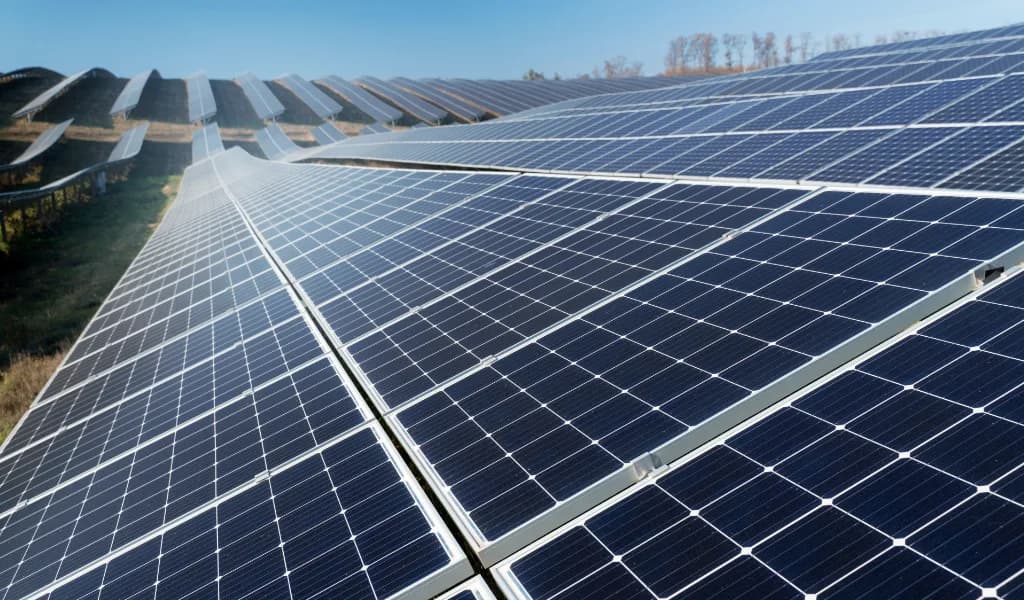
Polycrystalline panels look blue and speckled. Made from many small crystals melted together. About 15% efficient. Cheaper to make, common on big solar farms.
Thin-film panels are flexible. Some you can roll up. Made by spraying a thin layer of solar material onto plastic or metal. 10 to 19% efficient depending on the type, and they go places other panels can't.
Each one is the right pick for a different situation. A small house roof? Go mono. A big sunny field with a tight budget? Go poly. A camping trip or a curved boat hull? Go thin-film.
→ Use the solar panel calculator
What A Panel Actually Looks Like Inside
Pop one open and you'll find six layers stacked like a sandwich.
Tempered glass on top. Letting light through, keeping rain out.
The cells in the middle. Black or blue squares of silicon.
A sticky clear layer called the encapsulant holds it all together and keeps moisture out.
A back sheet seals the bottom. An aluminum frame wraps the edges. A small junction box on the back is where the wires come out.
No moving parts. Nothing to break. The whole thing lasts 25 to 30 years.
→ Look inside an actual solar panel
From Panel To Plug
The panel makes electricity, but the wrong kind for your house. Two flavours of electricity exist. AC is what comes out of your wall sockets. DC is what comes out of a battery. Solar panels only make DC.
So you need a translator. An inverter turns the panel's DC into the AC your fridge and TV understand.
If you're storing power in batteries for night use, you also need a charge controller. That's a small box between the panel and the battery, and it makes sure the battery doesn't get cooked on a sunny day.
→ The full story of AC vs DC power
→ All the electronic parts in a solar setup
Why Solar Keeps Getting Better
The first working solar cell was built at Bell Labs in 1954. It caught about 6% of the sunlight that hit it. The cells they put on the early space satellites were the only place anyone could afford to use solar back then.
Today's best panels catch 23%. By 2030, panels stacking silicon with a new material called perovskite could push past 30%.
Solar keeps getting cheaper too. The same panel that cost $100 per watt in 1976 costs less than $0.30 per watt today. That's a 300-times drop.
What sounds futuristic today might be normal in five years.
→ Where solar panels are heading next
→ How to calculate your solar energy needs