

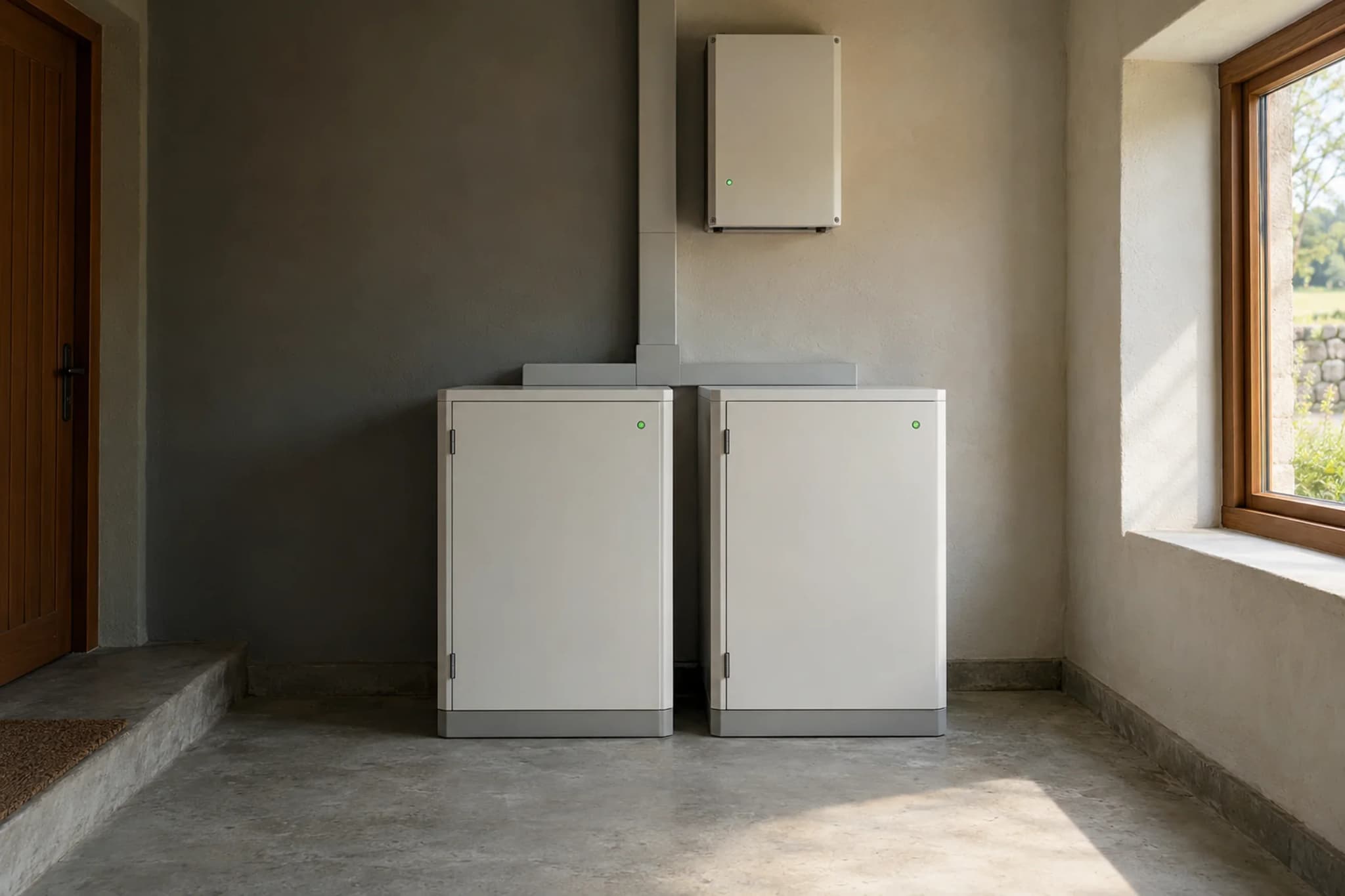
What is a LiFePO4 battery? It is a lithium battery of the lithium-ion family, with a cathode made of lithium iron phosphate. LiFePO4 is the chemical formula for that material, and LFP is the short name.
This page looks at it as the solar battery bank of an off-grid house or cabin. Every number was checked on 18 November 2026 against the sources listed at the bottom.
LiFePO4 Battery Safety: One Heat Test, Four Very Different Results
In 2024, a study in Frontiers in Chemistry put four kinds of lithium-ion cell through the same thermal runaway test. All were 18650 cells, tested in an accelerating rate calorimeter.
Thermal runaway is what the National Fire Protection Association (NFPA) calls a rapid uncontrolled release of heat from a cell.
The LFP cell reached a maximum temperature of 239.26 °C. Three other lithium-ion chemistries ran far hotter: NCM811 reached 462.52 °C, NCA 491.84 °C and LCO 545.11 °C.
The speed is the bigger surprise. The LFP cell's peak heating rate was 0.36 °C per minute, while the NCM811 one's was 12,218.52 °C per minute.
That still doesn't make an LFP battery harmless. A Sandia National Laboratories white paper reports that the gas LFP vents is flammable too.
What Type Of Battery Is A LiFePO4, And How Does It Work?
It is a lithium-ion type. Battery University describes LFP as a lithium-ion chemistry with a LiFePO4 cathode and a graphite anode, and says phosphate was discovered as a cathode material in 1996.
The cathode and the anode are the two sides of a cell. When the battery gives power, lithium ions move from the anode to the cathode. On the way they cross the electrolyte and a separator that lets them pass.
In the graphite, the ions are stored between its layers. Scientists call that "intercalation", a fancy word for slipping in between, like cards pushed between the pages of a book.
Victron gives one LFP cell a nominal voltage of 3.2 V. Nominal is the name-tag voltage, because the real one moves: Battery University gives a typical operating range of 2.50 to 3.65 V per cell.
Makers join cells in series, one after the other, so the voltages add up like stacked Lego bricks. Victron's datasheet spells it out: a 12.8 V battery is 4 in series, and a 25.6 V battery is 8.
Sixteen at 3.2 V each make 16 x 3.2 V = 51.2 V, and EPEVER's LFP5.12KWH51.2V-P20R1 is a 16-cell pack of that kind.
What Are LiFePO4 Batteries Used For?
One use is stationary storage, a battery that stays in one place. PNNL, a US Department of Energy lab, writes that two chemistries dominate stationary lithium-ion storage: LFP and NMC. Its report covers utility-scale applications, not home packs.
On this site, 48 V nominal is the DIY limit. Our page on 12 V, 24 V and 48 V systems explains where a 51.2 V lithium pack sits.
Li Ion Battery vs LiFePO4: Energy Density, Heat And Lifespan
LiFePO4 is itself lithium-ion, so the real match is LFP against other lithium-ion chemistries, such as NMC and NCA.
Our lithium-ion guide covers how these batteries work and last. Battery University puts the three side by side:
| Battery University's table | LFP | NMC | NCA |
|---|---|---|---|
| Specific energy | 90 to 120 Wh/kg | 150 to 220 Wh/kg | 200 to 260 Wh/kg |
| Thermal runaway | 270 °C | 210 °C (higher when empty) | 150 °C (higher when empty) |
Specific energy is energy density by weight: how much energy one kilogram of cell holds. Battery University calls those figures estimated averages at the time of publication, and LFP holds the least of the three.
- Solid: up to the low end of a range, or the table's one figure
- Light and dashed: on to the high end of the range
So what does LFP give in return? A longer cycle life, in the one lab cycling test we have. Sandia National Laboratories cycled small commercial 18650 cells of all three kinds at 15, 25 and 35 °C, and LFP had the longest cycle life across all conditions.
At the same cycle count, LFP kept on average 7% more capacity than NCA and 9% more than NMC.
The LFP cells in that test were 1.1 Ah each, not house batteries, and the gap shrank when Sandia compared by energy delivered.
LiFePO4 vs Lead-Acid: How A LiFePO4 Deep Cycle Battery Compares
A deep cycle battery is built to be emptied a long way and refilled, again and again. How far you empty it is called the depth of discharge.
Lead-acid first. Slides from Sandia National Laboratories give it 500 to 1,000 cycles and a round-trip efficiency of about 80%, the share of the energy put in that comes back out. Victron's datasheet gives 92% for its Lithium Battery Smart.
For LFP, cycle life comes from maker sheets, and every sheet sets its own conditions:
- Victron Lithium Battery Smart: 2,500 cycles at 80% depth of discharge and 5,000 at 50%, to 80% of nominal capacity, with no charge rate or temperature given.
- EPEVER LFP5.12KWH51.2V-P20R1: at least 5,000 cycles at 80% depth of discharge, 25 °C and 0.5C.
- Battle Born BB10012: 3,000 to 5,000 "deep discharge cycles", with no test conditions on the sheet.
Battery University notes that flooded lead-acid needs water and a 16-hour charge every 6 months to prevent sulfation. An LFP battery has no water to top up.
What To Look For In A LiFePO4 Battery: BMS, Cold Limits, Fuel Gauge
Start with the BMS, the battery management system. Battery University says it protects the battery on charge and discharge, and disconnects it if set limits are exceeded or a fault occurs. Our BMS guide helps you choose one.
Then check cold-weather performance. Victron's Lithium Battery Smart 12.8/100, for example, gives 100 Ah at 25 °C. At 0 °C it gives 80 Ah and at -20 °C 50 Ah, all at a discharge current of up to 1C.
Charging in the cold is stricter. Victron's manual sets a charging range of 5 to 50 °C, while EPEVER's sheet for its 51.2 V pack says 0 to 55 °C. On these two sheets the lower limit sits around freezing, so follow your own battery's sheet.
- Charging allowed
- Blue dashes: 0 °C
Last comes the fuel gauge. Battery University writes that LFP has a "very flat voltage discharge curve", so voltage is a poor indicator of charge. Our battery shunt page explains how to know how full your battery really is.
Are LiFePO4 Batteries Any Good? Advantages And Drawbacks
On cycle life, the lab and maker figures above say yes, and an LFP battery needs no watering.
Three drawbacks to plan around:
- Cold: less capacity on Victron's sheet, and maker charging limits around freezing.
- Energy density: 90 to 120 Wh/kg in Battery University's table, the lowest of the three chemistries.
- Empty and forgotten: Victron's manual warns that even with a BMS, small standby loads can drag a battery into damaging over-discharge.
Whatever you choose, have an experienced person check the wiring before it is switched on. Our battery calculator sizes the bank for your own house.
Sources
- Battery University, BU-205: Types of Lithium-ion
- Battery University, BU-216: Summary Table of Lithium-based Batteries
- Battery University, BU-214: Summary Table of Lead-based Batteries
- Battery University, BU-409b: Charging Lithium Iron Phosphate
- Battery University, BU-410: Charging at High and Low Temperatures
- Battery University, BU-908: Battery Management System (BMS)
- University of Washington, Clean Energy Institute: Lithium-ion battery
- Frontiers in Chemistry, 2024, vol. 12, article 1324840
- Sandia National Laboratories, Preger et al., SAND2020-8433J
- Sandia National Laboratories, white paper SAND2023-00556R
- Sandia National Laboratories, NECPUC webinar slides, 19 March 2021
- PNNL, 2022 Grid Energy Storage Technology Cost and Performance Assessment (PNNL-33283)
- NFPA, energy storage systems fact sheet
- Victron Energy, Lithium Battery Smart datasheet
- Victron Energy, Lithium Battery Smart manual
- Battle Born Batteries, BB10012 datasheet
- EPEVER, LFP5.12KWH51.2V-P20R1 datasheet
Hard Words
| Term | What it means |
|---|---|
| Lithium ion | A lithium atom with an electric charge. |
| Nominal voltage | The voltage a cell or battery is named after. Victron gives one LFP cell 3.2 V nominal. |
| Cycle | One charge followed by one discharge. |
| Thermal runaway | A rapid uncontrolled release of heat from a cell, in the NFPA's words. |
| Absorption and float | Two charging stages that makers list a voltage for. Float is the voltage held on a full battery. |
Common Questions
Is LiFePO4 the same as lithium-ion?
LiFePO4 is one kind of lithium-ion battery. Battery University lists it as a lithium-ion chemistry with a LiFePO4 cathode and a graphite anode. In its table, LFP has the lowest specific energy of three chemistries: 90 to 120 Wh/kg, against 150 to 220 Wh/kg for NMC and 200 to 260 Wh/kg for NCA.
How long can a LiFePO4 battery sit unused?
We only have maker figures. Victron gives a maximum storage time of 1 year at 25 °C for its Lithium Battery Smart when fully charged, and Battle Born lists a self-discharge of 2 to 3% per month for its BB10012. Victron's manual warns that a battery left after a low-voltage shutdown keeps self-discharging and can reach a cell-damaging voltage.
Do I need a special charger for a LiFePO4 battery?
Use the settings on your own battery's sheet, because the sources differ. Battery University gives 3.65 V per cell as the maximum charge for LFP, 14.6 V for a 12 V battery of four cells, and says float charge is not used.
Victron recommends 14.2 V absorption and 13.5 V float for its own 12.8 V batteries. Battle Born lists 14.2 to 14.6 V absorption and 13.4 to 13.8 V float for the BB10012.
Can a LiFePO4 battery be charged in cold weather?
Only inside the range on its sheet. Victron's manual gives 5 to 50 °C for charging its Lithium Battery Smart, and EPEVER gives 0 to 55 °C for its LFP5.12KWH51.2V-P20R1.
Battery University says charging consumer-grade lithium-ion below 0 °C (32 °F) causes metallic lithium plating on the anode. That page is about lithium-ion in general, not LFP alone.