

What's Actually Inside A Battery Pack
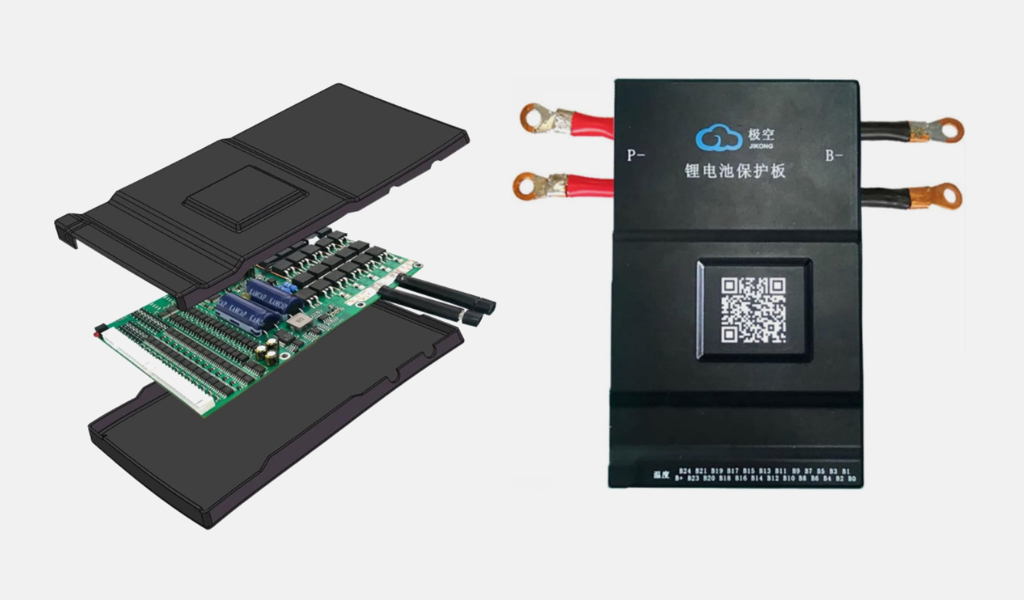
Open up a home battery and you don't find one big battery. You find a handful or sometimes a lot of small ones, packed in tight.
A typical 48-volt LiFePO4 home battery has 16 big prismatic cells inside, each about the size of a paperback book. Larger systems can stack many more.
If even one of those cells gets too hot, or drains too low, or charges too high, the whole pack is in trouble. Lithium chemistry doesn't forgive mistakes.
That's why every lithium battery has a BMS. It's the brain that watches every single cell, every second of the day.
What Does It Actually Watch?
Five things.
Voltage on every cell. If one cell drops too low or climbs too high, the BMS sees it instantly and reacts.
Temperature. Lithium batteries don't like being too hot or too cold. The BMS has temperature sensors and will shut things off before damage happens.
Current going in and out. Too much current too fast, the BMS pulls the plug.
Cell balance. Some cells charge a tiny bit faster than others. Over time the pack gets uneven. The BMS bleeds off the fast ones so the whole pack stays in sync.
State of charge. How full is the battery, overall.
It's doing all of this continuously, many times every second.
When You Actually Need One
For lithium batteries (lithium-ion, lithium polymer, LiFePO4), a BMS isn't optional. The chemistry needs babysitting. Without one, you've got a fire risk in your basement.
For lead-acid batteries, you don't strictly need one. Lead-acid is more forgiving. But a BMS still helps it live longer.
So how do you pick the right one?
Match The BMS To The Battery
Three numbers matter.
Cell count. A BMS is built for a specific number of cells in series. A "16S" BMS handles 16 cells. If your pack has 16 cells stacked up to make 48 volts, you need a 16S BMS. Wrong number, doesn't work.
Current rating. How much power flows through your battery at peak? If your inverter pulls 100 amps from the battery, you need a BMS rated for at least 100 amps. Get one with a bit of headroom (say 150A) so it's not running flat out all the time.
Chemistry. A BMS made for LiFePO4 expects different cell voltages than one made for regular lithium-ion. Match them.
Get those three right and you're ninety percent there.
Active vs Passive Balancing
You'll see two flavors of BMS sold. Active balancing and passive balancing.
Passive is the cheap kind. When a cell gets too full, the BMS turns the extra into heat and dumps it. Wasteful but it works.
Active balancing is smarter. When one cell is too full, the BMS moves that energy to a cell that's too empty. Nothing wasted. Better for the long run.
For a small system, passive is fine. For a bigger build that you want to last 10+ years, pay the extra for active.
The Bluetooth Question
Many newer BMS units talk to your phone over Bluetooth. You open an app, you see every cell's voltage, temperature, the whole picture.
Worth it. Saves you from opening up the battery every time you want to know what's going on.
→ Read more about home batteries