


The builder, not the electrician
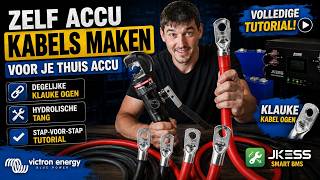
Most of Robbert's audience finds him through the Victron home-battery series: 3x 5 kVA Multipluses, 48 kWh of LiFePO4 storage, three phases, full transparency on the wiring choices. The natural assumption is that he is an electrician.
He isn't. Robbert has no formal training in electrical engineering. His way of talking about circuits in voltages and amps rather than the textbook "spanning" and "stroomsterkte" gives it away if you know the convention. He learned by taking things apart as a kid: an old radio, a computer, anything with a cover that could be unscrewed. School and the format of sitting still with a book didn't suit him. Curiosity and hands-on tinkering did.
That distinction matters because it shapes the whole channel. Robbert isn't writing tutorials. He's documenting what one self-taught builder figures out, gets wrong, gets corrected on in the comments, and re-films.
The path from a child taking radios apart
Programming came early, on QBasic in DOS. At 12 he wrote a game from scratch using the Wolfenstein 3D level editor as inspiration. He drove RC cars from a PC through the LPT printer port. Microcontrollers followed: Arduino, then his own PCBs. A walking NeoPixel robot that reacts when you come close. An "evil twin" version YouTube flagged as 18+ for language and movement.
The pattern stayed the same as the projects grew: a Tetris-playing coffee table in his daughter's bedroom, a handheld console built just to run Sonic, a Doom game console. There's a thing he wants to make, he sketches it, then he makes it.
The Efteling fairy ride in the veranda
The biggest example is the Droomvlucht, a Disney-style fairy ride at the Dutch Efteling theme park: cottages that float up and down, butterflies that flap in the dark, painted walls, soft lighting. Robbert took his kids there, then asked them on the way home if they wanted that at home.
Four weeks later, his back veranda had become a working Droomvlucht: walls repainted with stone-effect texture, ceiling closed in with artificial greenery, 11 hanging cottages that rise and fall on Google Home commands, and 8 butterflies in the ceiling. Each butterfly carries a stepper-motor driver and an ATtiny chip soldered chip-on-chip (no PCB, small enough to fit inside the wings) with randomized flapping patterns so no two move alike. The Brabant regional broadcaster picked up the video and came to film a feature.
The garden and the pool
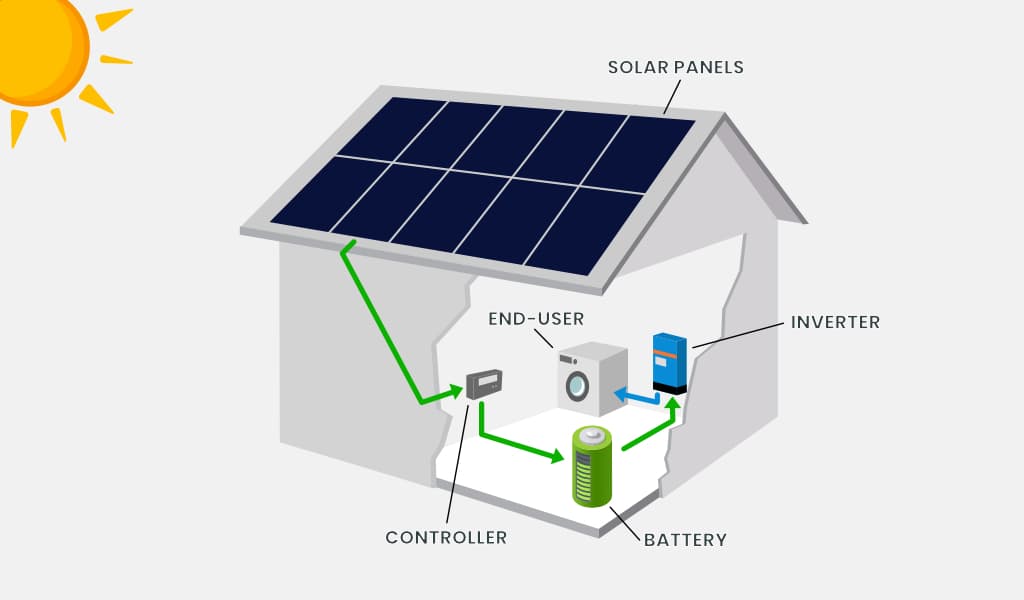
Then there's the garden. Before: tiles, a folding pool, nothing growing. Eighteen months of work later: a brick-lined in-ground pool, flexstone paving, a veranda, every pipe and cable underground, fences clad in artificial plants, banana trees and palms. The same garden carries the household's solar: 12 panels on the Droomvlucht veranda, another 6 going on the back-garden veranda, all feeding the Victron setup.
The rest of the catalog
The Victron build and the Droomvlucht are the two most-watched videos. They aren't representative. The catalog also includes:
- A fairground-style claw machine built from scratch. Three Arduino Nanos running in parallel: credits, game logic, sound and lighting. Three years of birthday parties later, it still works.
- A 4-wheel-drive electric kart from two hoverboards and a scooter frame. 36 V salvaged e-bike cells, 30 km/h top speed but 40 Nm of torque, enough to drag a 1300 kg station wagon out of a parking spot.
- An LED suit: 500 RGB NeoPixels addressable as a matrix, plasma effects, scrolling text. Worn under a white shirt with a backpack of gel batteries. Six hours of runtime at full output.
- A Crazy Cross car (Dutch motorsport for ridiculous vehicles): a Suzuki Alto with a foam cannon in the trunk, diesel injection on the exhaust for a smoke trail, a 2.3 m confetti cannon on the roof, and mid-race fireworks.
- A potato cannon built from transparent PVC pipe so the combustion is visible. Filmed in slow motion.
- A PVC-pipe canoe held together with duct tape, taken on an 8 km river run with two kids on board. Build cost: €25.
- A 3D-printed Hollebolle Gijs (the Efteling's gluttonous puppet) with an infrared sensor in the throat. Drop something in the mouth, it reacts.
- Yearly Halloween projection mapping on the neighborhood houses, including holographic fire in the windows.
- A reaction game where the slowest player gets a controlled electric shock: ~900 V at under 1 mA, current path engineered to go thumb to palm rather than through the body.
- A pool heater built from black-painted PVC electrical conduit. Cheaper than the dedicated solar pool hoses, keeps the pool at 30 to 32 °C.
The current side project
Alongside the home battery, Robbert is building a 4K Unreal Engine game from scratch: himself, his wife, and his kids as the playable characters, with his daughter as the lead. A Tomb Raider-inspired storyline set in Cambodia, plus a talking tree named Bergbast. One level, fully playable, currently in optimization.
The point isn't the game. The point is the same question he sets himself for every project: can one person, on a home PC, build a complete Unreal Engine game? He's checking.
Why he makes the videos
Robbert is direct about this: it isn't to make tutorials. It's to share what he's working on and to learn from the comments. When someone flagged the wrong AIC rating on the MEGA fuse in his 16 kWh battery video, he researched it, accepted he was wrong on camera, found the Adler EF3 as the drop-in fix, and filmed a follow-up.
The current channel is also his second. The first one (15 years of content) was terminated by YouTube over a meme in one of his earliest videos. No appeal, zero-tolerance policy, everything deleted. He started over three years ago. The old channel was quietly restored two years later, empty of subscribers.
The thing the channel is about
The consistent thread is the line he repeats on camera: everything in the world is for sale, but making it yourself is more satisfying than buying it. The home battery videos are the off-grid expression of that. The Droomvlucht, the LED suit, the pool, the kart, the puppet, the game all express the same idea in different materials. The 48 kWh Victron setup happens to be the one that taught most viewers his name.