
The Friendliest Off-Grid
Most people picture off-grid living as a remote cabin in the woods. But the most common kind of off-grid life in the world today isn't a cabin at all.
It's a campervan in a parking lot. A sailboat anchored off a Greek island. An old RV sitting at the edge of a desert. A fishing boat tied up far from any harbor.
Tens of millions of people live partly or fully off-grid this way. Not on principle, but because their home is on wheels or floating on water, and dragging a cable to a utility pole isn't an option.
And it turns out a boat or an RV is the easiest place in the world to go off-grid. The power needs are tiny. The system is compact. The whole thing can run on the same kind of solar you'd put on a house roof, just smaller.
Why It's Easier Than You'd Think
A normal house uses maybe 25 kilowatt-hours of electricity per day. A small RV often gets by on 2 or 3. A sailboat at anchor can go on 1 or less.
Why such a huge difference?
A boat or RV doesn't have a giant fridge, a clothes dryer, a dishwasher, a hot water tank running on electricity, and central air conditioning. It has a small compressor fridge (often 12 volt), LED lights, a few USB chargers, a water pump, maybe a fan or two. That's it.
And almost all of it runs on 12 volts directly, the same as a car battery. No inverter losses. No conversion. Power straight from the battery to the appliance.
So instead of needing a wall full of batteries and an array of panels covering your whole roof, an RV or boat can be totally self-sufficient with about 400 watts of solar and one good lithium battery.
That's a system you could carry in a single trip to your van.
A Typical Setup
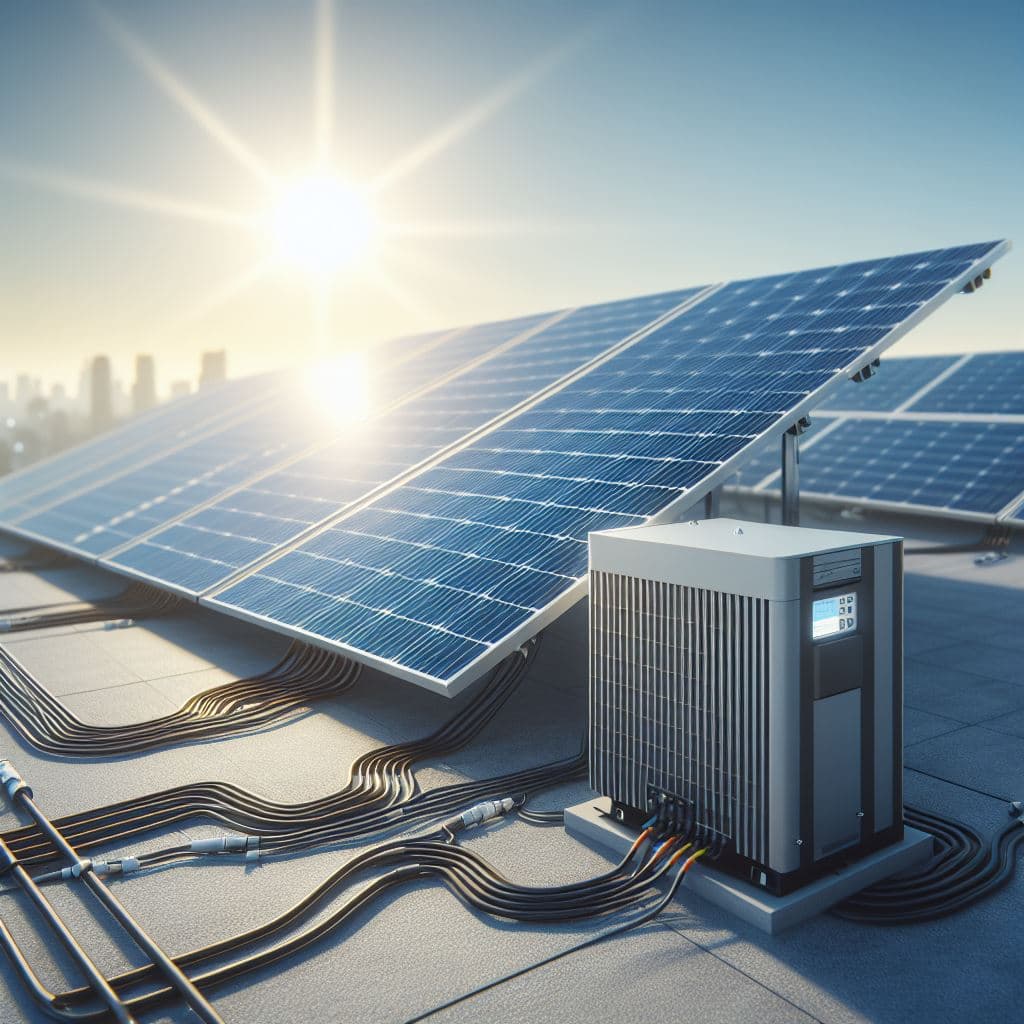
A common setup that works for most small RVs and sailboats looks like this.
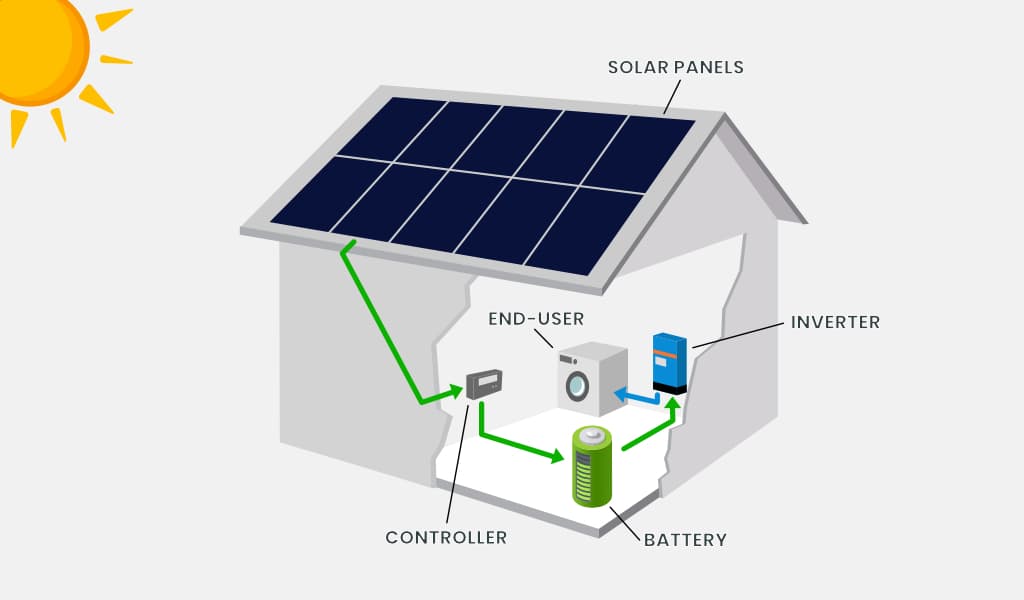
200 to 400 watts of solar on the roof. Often two panels, each around 100 to 200 watts. Wired in series or parallel depending on the layout.
A 200 to 400 amp-hour lithium battery (LiFePO4). That's 12 volts, so it stores roughly 2.5 to 5 kilowatt-hours of energy. Way smaller than a house battery, but way more than enough for a few days of normal living.
A charge controller (usually MPPT, around 30 to 50 amps).
A 2,000 watt inverter for the few things that need AC power, like a laptop charger or a small power tool.
A small DC-DC charger that tops up the house battery from the engine's alternator while you drive.
That's the whole list. Six parts. Total cost? Often 1,500 to 4,000 dollars if you do the install yourself. Less than a single year of motel rooms.
→ Portable solar power stations for travel
→ Picking the right battery for a small system
What Makes It Different From A House
There are a few real differences between off-grid on a vehicle and off-grid in a building.
Weight matters. Every kilogram of battery has to be carried around. A normal house battery weighs 60 to 100 kilograms. On a small boat or in a tiny RV, that's a real consideration. Lithium batteries are the obvious pick because they store 3 times more energy per kilogram than the old lead-acid ones.
Vibration matters. A boat on a wavy day, or an RV bouncing down a dirt road, shakes everything. Connections come loose. Components slide around. Everything has to be bolted down properly. A house battery that wobbles a bit is fine. A boat battery that wobbles can shake itself apart in a year.
Heat matters too, but in two directions. A van in the desert sun cooks the battery. A boat in the tropics drowns the electronics in humidity. Both need good ventilation and waterproofing.
And there's one big difference between RVs and boats specifically. Travel days. When the RV is moving, the panels are usually facing the wrong direction, or shaded by trees, or in a tunnel. So you can't rely on solar while driving. That's where the DC-DC charger comes in. It takes power from the engine's alternator and sends it to the house battery while you drive. Free top-up power, every day you travel.
Sailboats sometimes get a related setup with a small wind generator on the back of the boat. Wind isn't reliable, but on a windy passage at sea, a small turbine can run all day and night.
The Marine Twist
Boats add a few problems RVs don't have.
Saltwater corrodes everything. Cheap connectors that work fine in an RV will turn to powder on a boat in six months. Real marine wiring uses tinned copper (tin coating prevents the corrosion) and heavy waterproof connectors.
Ground faults are dangerous. On land, if there's a small leak of electricity to "ground", nothing happens. On a boat, ground is the water around the hull. A leak there can electrocute swimmers, or corrode your hull plates from the inside out (called galvanic corrosion). Serious sailors use isolation transformers and proper marine grounding.
Lightning. A sailboat in open water with a 15-meter mast is basically a lightning rod. Most boats have a lightning ground system that channels strikes safely. If yours doesn't, every electronic on the boat (including your panels and inverter) is one bad storm from being toast.
Despite all that, sailing off-grid is a beautiful thing. A 200-watt panel on the top of a small sailboat can keep the fridge cold, lights on, navigation electronics running, and a phone charged. Forever. As long as the sun comes up.
The RV Twist
RVs have their own personality.
When you park in the woods for a week, you're a small off-grid cabin. Solar makes power, the battery stores it, you live off it.
When you travel, you're charging from the engine while you drive. The faster you drive, the more the alternator dumps into your house battery.
When you're in a campground with electric hookups, you're plugged in like a normal grid-tied house. Most RVs have a built-in switch that handles all three modes automatically.
Heat in an RV is almost always propane. A propane furnace uses a tiny amount of electricity to run the blower and a lot of propane to make the heat. A small propane tank lasts a couple of weeks of cold mornings. Cheap, simple, works without sun.
A few hardcore RVers and boat owners have installed tiny wood stoves. Yes, in an RV. Marine wood stoves exist and are about the size of a microwave. They make a real fire with real flame. Charming as anything. Just be careful about the chimney clearances. Real wood fires in a small space, with kids and pets running around, ask for extra attention.
Water Is The Real Constraint
In a house, you have an unlimited water supply. In an RV or boat, you have a tank.
A typical RV freshwater tank is 100 to 200 liters. A 12-volt pump pulls water through small lines to the sink and shower. Use a normal-size shower and you can empty a tank in two days.
So everyone who lives in an RV or on a boat eventually learns to use way less water. Quick showers. Doing dishes with a sprayer instead of running the tap. Catching cold-tap water in a bucket while waiting for hot.
Boats sometimes have a watermaker. This is a small machine that pumps seawater through a fine filter under high pressure and produces fresh drinkable water on the other side. Magic. But it draws hundreds of watts while running, so on a small battery system it's only used for a few minutes at a time.
For most RVers, refilling the tank at gas stations, campgrounds, or rest stops is the standard move. Boats refill in harbors or by collecting rainwater off the deck during squalls.
Why People Do It
Off-grid on a boat or in an RV has a special pull.
You can wake up tomorrow with a different view out the window. Move because the wind shifts. Chase summer. Find a quiet beach in a sleepy season.
The power system is small enough that you can fix it yourself. You can hold the entire battery in two hands. You can swap a panel in a morning.
And the freedom of having no power bill, no water bill, no rent, on a system you built with your own tools, is something people remember for the rest of their lives.
Plenty of families have raised kids in campervans. Plenty of retirees have crossed oceans in 11-meter sailboats. Plenty of remote workers have spent five years on the road with no fixed address.
For all of them, the off-grid setup is the same simple kit. A few panels. One good battery. A small inverter. The same idea that powers a Finnish cabin, just shrunk to fit in something with wheels or a hull.