

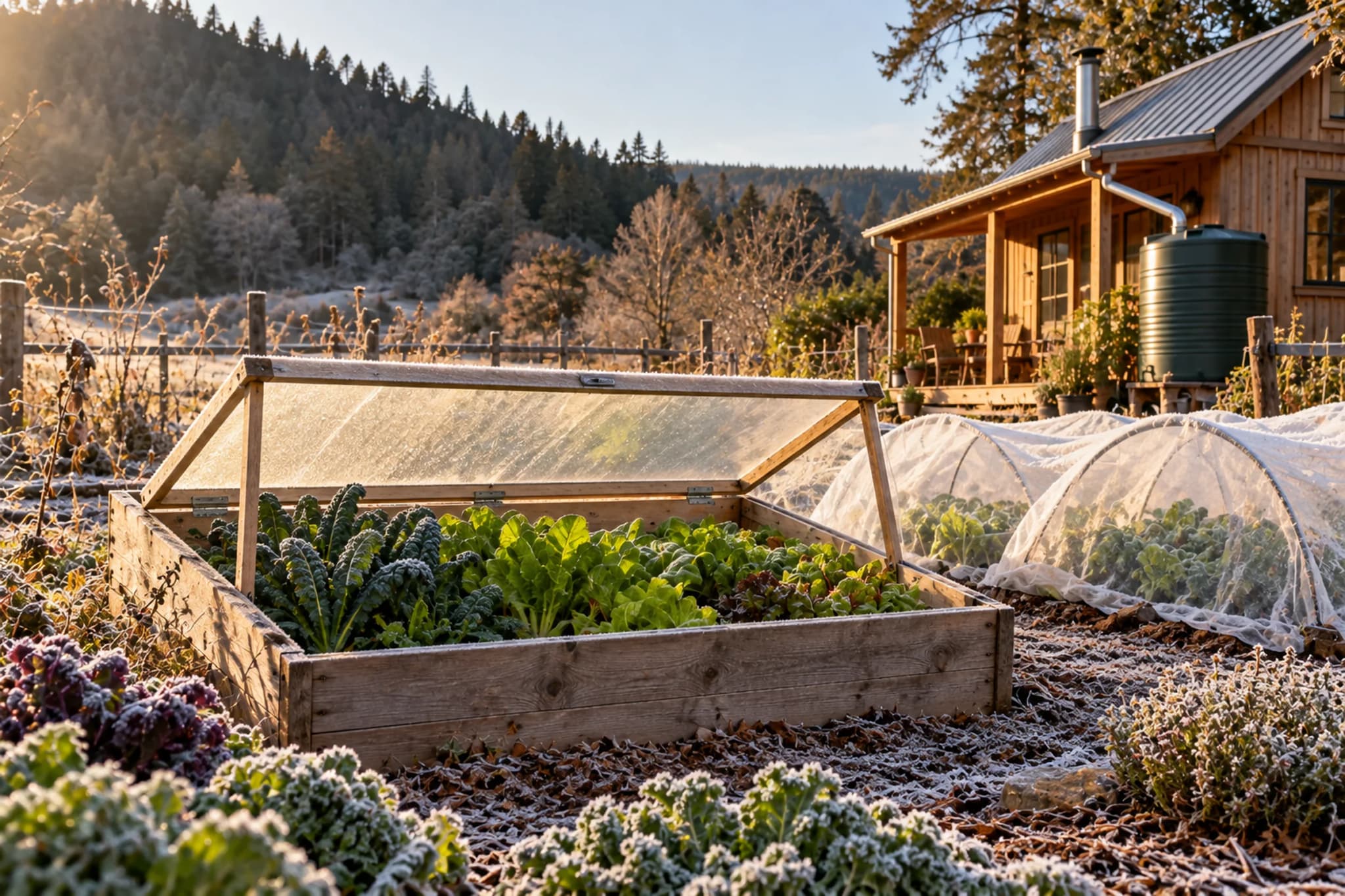
Why February Starts With A Packet Of Seeds
In January, a solar panel in Amsterdam makes about 1.1 kilowatt-hours a day for every kilowatt of panels. In February that same panel makes about 1.8 a day. That's more than half as much again, in one month.
In Ohio it climbs from about 2.3 to 2.9 a day. Either way, the sun is coming back, and so is the garden.
So this February homestead checklist starts with food: the seeds you order now become summer's dinners. Then it works through energy, the house, water and waste. Southern readers: your version of this month is August.
This month in three jobs: test the old seeds, sow the tomatoes, sharpen the tools.
Vegetables To Plant Now, Mostly Indoors
Step 1: Test Old Seeds Before You Order New Ones
That half-used seed packet from two summers ago might still be good. Or it might be duds.
Seeds are alive, just sleeping. Each year in the packet, a few more of them lose the strength to wake up.
Illinois Extension has an easy test. Put 10 seeds on a damp paper towel, slide it into a plastic bag and keep it somewhere warm. Then count how many wake up.
If 7 to 9 come up, the seeds are fine, so just sow them a bit thicker. If fewer than 5 or 6 sprout, buy new ones.
Step 2: Order Seeds You Can Save
When you choose varieties, look at the label. "Open-pollinated" seeds grow plants just like their parents, so you can save their seeds at harvest time and sow them again next spring.
Seeds marked "F1 hybrid" are different. Their own seeds won't grow into the same plant, a bit like a lego set that won't rebuild into the same model twice. Our guide to the off-grid garden explains how much to grow.
Ordering seed potatoes too? The RHS, Britain's big gardening charity, says to wake them up from late January in milder places, or by early March in colder ones. Stand them in egg boxes with the eyes on top, somewhere bright and frost-free. Gardeners call this "chitting".
After four to six weeks each one has short shoots about 5 cm long, and the first early potatoes go in the ground around late March.
Step 3: Sow Tomatoes And Peppers Indoors
So what do you plant in February? Mostly the slow growers, and mostly indoors. Summer is too short for them to grow from seed in the garden, so they need a head start on a warm windowsill.
Cornell University says to sow tomatoes indoors 6 to 8 weeks before you plant them out. They go outside one to two weeks after your last frost. Peppers are slower, so give them 8 to 10 weeks.
The University of Maryland gives onions and eggplant the same long 8 to 10 weeks, so their trays go in early too.
The cabbage family is quicker. Illinois Extension says cabbage and broccoli need 4 to 6 weeks indoors, and the young transplants are tough enough to go out without protection 4 to 6 weeks before the last frost. For the writer's own garden near St. Louis, that meant sowing by February 19.
Salad greens like cool weather. Lettuce shrugs off a light frost, though not a hard freeze, and it grows well in containers, so a pot of greens by the back door works fine. Maryland says lettuce transplants just 3 to 4 weeks old give an earlier harvest.
Spinach is tougher still. It can take heavy frosts, and the seed goes into the ground in early spring, once the soil warms to about 7 °C (45 °F).
Seedlings need lots of light. The University of Vermont says 14 to 16 hours a day, with the lamp no more than 15 cm above the plants. Too far away, and the growth turns tall and floppy, reaching for the glow.
Step 4: Clean And Sharpen The Tools
Pruners can carry plant diseases from one plant to the next, like a sneeze on a shared spoon. So clean them now, before the busy season.
Penn State says to wash them with soap first, then wipe them with 70% alcohol and don't rinse it off. Colorado State says weaker alcohol, around 50%, doesn't work well.
Then sharpen. File along the angle the blade already has, take off the rough edge on the back, and finish with a drop of oil.
Step 5: Tap The Maples (If You Have Them)
Here's a February treat. Maple sap starts to run when nights drop below freezing and days climb above it.
Sap is only about 2% sugar, so it takes about 40 litres of sap to boil down to one litre of syrup. That's a lot of firewood for one bottle, which is why real maple syrup costs what it does.
Stretch The Power Into Spring
Step 6: Make The Most Of The Returning Sun
The days are stretching, but February sun still counts for little. Our guide to average sun hours shows why winter months drag the yearly number down.
So keep the generator ready for a few more weeks of grey weather, and keep lead-acid batteries topped up instead of half full.
On the sunny days, use the extra. Charge tools, run the washing machine and fill the water tank while the panels are working, instead of saving those jobs for a grey day.
Step 7: Count The Power For Grow Lights
Those seedling lamps burn 14 to 16 hours a day, every day, for weeks. On an off-grid system that adds up.
Check the watts on the lamp's label and add it to your daily use. A lamp of 30 watts running 15 hours a day uses 450 watt-hours, about as much as a laptop charged several times over.
Watch The Roof As The Snow Melts
Step 8: Watch The Roof For Ice Dams
After snow, look at the edge of the roof. A thick ridge of ice with long icicles hanging down is called an ice dam.
It means heat is leaking from the house into the attic. That warmth melts the snow on the roof from below, the water runs down, and it freezes again at the cold edge. Behind the ice, water can leak under the roof.
Energy experts in Minnesota say sealing the air leaks and insulating the attic is the best fix. A US government building guide adds that a well-vented attic keeps the roof cold, so the snow stays frozen. Our guide to insulation shows where heat escapes.
Keep The Drinking Water Clean
Step 9: Change The UV Lamp
Many off-grid homes clean their water with a UV light. It's a lamp inside a glass tube that zaps germs as the water flows past, like a tiny tanning bed for bacteria.
The lamp's germ-killing light gets weaker over time, even while the lamp still glows. Viqua, a big UV maker, says to replace it after about 9,000 hours, which is about a year of running nonstop.
When you change it, clean the glass tube around the lamp too. Dirt on the glass blocks the light. Our guide to water filtration explains how UV fits with the other filters.
Keep The Compost Going Indoors
Step 10: Start A Worm Bin Indoors
Outside, the compost heap is half asleep. Inside, worms can keep turning scraps into soil all winter.
The EPA says compost worms are happiest between 15 and 25 °C, which is about room temperature. A bin in a cellar, a shed that doesn't freeze or under the sink works fine.
They can survive from just above freezing up to about 35 °C, as long as they have at least 10 cm of damp bedding, like shredded paper, to burrow into. Our guide to home composting explains how a worm bin works.
By March, the seed packets are sorted, the tools shine and the windowsill is full of green. The garden has begun, and it started on a windowsill.
Sources
- PVGIS, EU Joint Research Centre, monthly solar output for Amsterdam
- PVGIS, EU Joint Research Centre, monthly solar output for Ohio
- Illinois Extension, Are my seeds still good? Testing seed germination
- Illinois Extension, Welcome to my jungle: December 2016 (saving seed)
- RHS, Potatoes: grow your own
- Cornell University, Tomato growing guide
- University of Maryland Extension, Growing peppers in the home garden
- University of Maryland Extension, Starting seeds indoors
- Illinois Extension, Welcome to my jungle: January 2017 (hardy transplants)
- University of Maryland Extension, Lettuce
- University of Maryland Extension, Spinach
- University of Vermont Extension, Get a head start on the growing season
- Penn State Extension, Disinfecting tools, equipment, pots, flats and benches
- Colorado State University Extension, Sanitizing our garden tools
- UNH Extension, How to clean and sharpen your pruners
- Penn State Extension, Maple syrup: a taste of nature
- Center for Energy and Environment (Minnesota), Dealing with ice dams
- PNNL Building America Solution Center, Attic air sealing, insulating and ventilating for ice dam prevention
- Viqua, D4 Plus lamp and sleeve replacement instructions
- EPA, Composting at home
Hard Words
| Term | What it means |
|---|---|
| Kilowatt-hour | An amount of electricity: about what a small heater uses in one hour. |
| Germination | The moment a seed wakes up and sends out its first root and shoot. |
| Open-pollinated | Seeds that grow into plants just like their parents, so you can save and resow them. |
| F1 hybrid | Seeds from two different parent plants. Their own seeds won't grow true. |
| Chitting | Letting seed potatoes grow short sprouts in a bright, frost-free spot before planting. |
| Last frost | The date in spring after which frost usually stops. Tender plants go out after it. |
| Sap | The sugary water that flows inside a tree. Maple sap boils down to syrup. |
| Ice dam | A ridge of ice at the edge of a roof that traps melting snow behind it. |
| UV steriliser | A lamp that kills germs in water with ultraviolet light. |
| Worm bin | A box where special worms eat kitchen scraps and turn them into rich soil. |
Common Questions
What should I plant in February?
Mostly slow crops, indoors. Onions, peppers and eggplant need 8 to 10 weeks before they're planted out, and tomatoes 6 to 8, so they come first. Cabbage and broccoli follow with 4 to 6 weeks. Set seed potatoes in egg boxes to chit, and sow spinach once the soil reaches about 7 °C.
What garden jobs are there in February?
Test old seeds, order new ones, start the slow crops indoors and sharpen the pruners. The rest of this February homestead checklist covers power for grow lights, ice dams on the roof, the UV water lamp and a worm bin. In the southern hemisphere the same list belongs to August.
How do I test if old seeds are still good?
Put 10 seeds on a damp paper towel in a plastic bag somewhere warm. If 7 to 9 come up, sow a bit thicker. If fewer than 5 or 6 do, buy fresh seed.
How many hours of light do seedlings need?
About 14 to 16 hours a day, with the lamp no more than about 15 cm above them. A late-winter windowsill rarely gives that much, and seedlings that go short turn tall and floppy.
What causes ice dams on a roof?
Heat leaking into the attic melts the snow from below, and the water freezes again at the cold roof edge. Sealing air leaks and insulating the attic is the best long-term fix.
How often should a UV water lamp be replaced?
About once a year. Viqua rates its lamps for 9,000 hours of nonstop use, and their UV light fades over time even while they still glow, so go by the calendar, not the glow.