

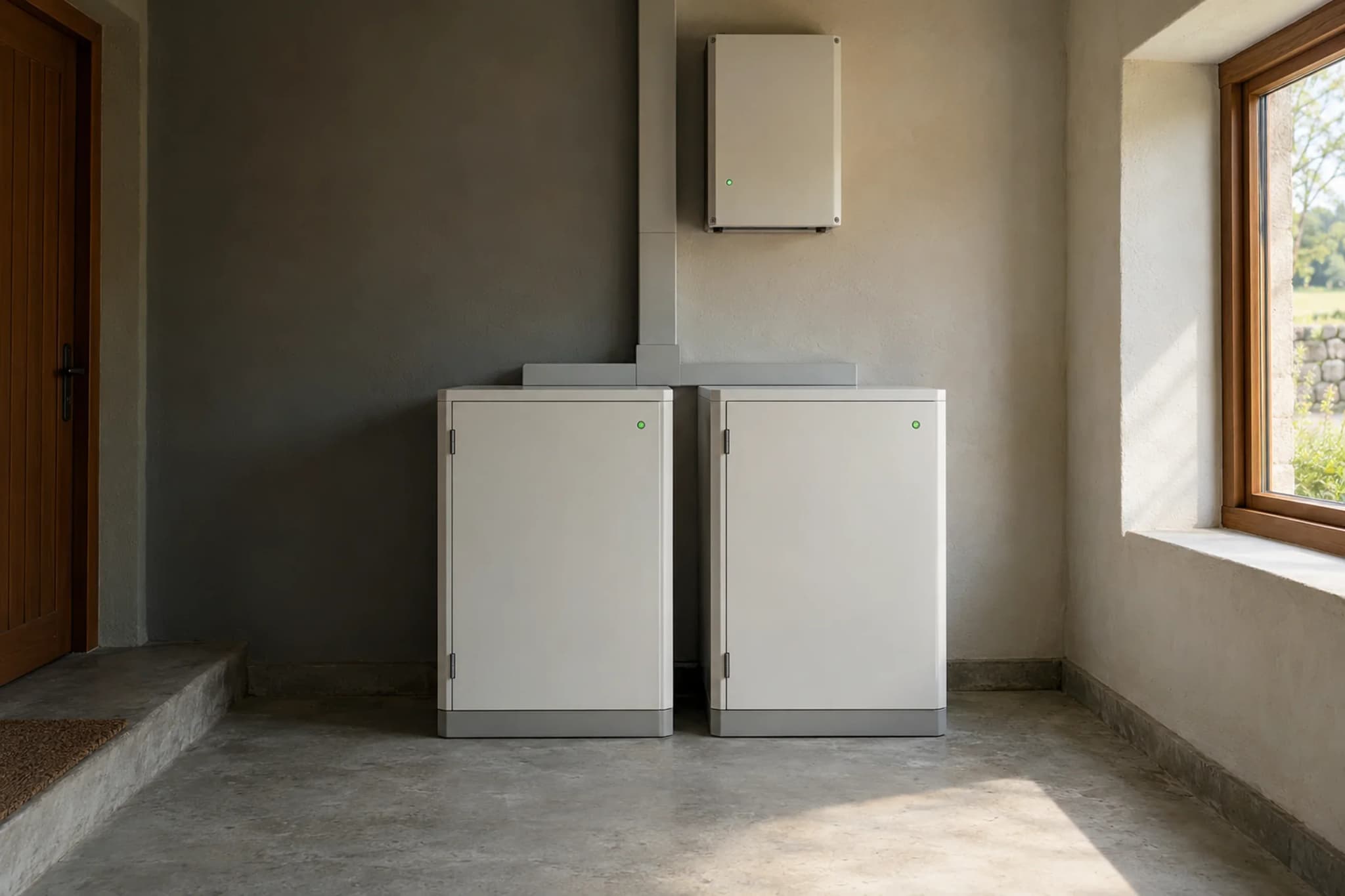
This page explains high voltage battery systems: home batteries built from stacked modules that work at hundreds of volts, always paired with a matching inverter. Read it from the top, or jump straight to the maker tables to compare real products. Then take the question list near the end to your installer.
Nine Out Of Ten New Home Batteries Use A Hybrid Inverter
In 2025, nine out of ten home batteries fitted in Germany came with a hybrid inverter. That figure comes from HTW Berlin, a university research group that compares home batteries with lab tests.
A hybrid inverter is one box that handles the solar panels, the battery and, where there is one, the grid. HTW Berlin writes that hybrid inverters work especially well with so-called high voltage batteries, because small voltage differences keep conversion losses low.
So what makes a battery "high voltage"? The answer looks a lot like a tower of lego bricks.
What Is A High Voltage Battery?
A high voltage battery is a stack of battery modules joined in series, one after the other. Each module is a box full of cells, like one lego brick. Join the bricks in series and their voltages add up, so the tower gets taller with every brick.
BYD's HVS module, for example, is named 102.4 V. Two of them are named 204.8 V, four are 409.6 V and five are 512 V. In use, a five-module stack works between 400 V and 600 V.
Makers call that first number the "nominal" voltage. That's just a fancy word for the battery's name tag, because the real voltage moves up and down as it charges and empties.
Across the makers we checked, stacks run from about 100 V to 980 V. It depends on the maker, the number of modules and, for Huawei, whether the house has one phase or three. A 48 V battery sits far lower: SMA's Sunny Island 48 V inverter accepts 41 to 63 V.
Five makers in our tables state lithium iron phosphate cells, LFP for short: BYD, Sungrow, Fox ESS, Pylontech and Huawei. Our lithium-ion battery guide explains what LFP is.
BYD's and Pylontech's stacks also have a control unit, a bit like the captain of a team. BYD calls it the Battery Control Unit and puts it on top of the modules, while Pylontech builds a control module into its stack. BYD's own word for the whole stack is a "tower".
The Battery And Its Hybrid Inverter Are A Matched Pair
A high voltage battery can't run your lights on its own. It needs a hybrid inverter, the translator box that turns the battery's DC power into the AC power your sockets use.
And not just any inverter. Sungrow's manual puts the rule plainly: "The entire battery voltage range must be completely within the permissible range of the inverter".
It's like a foot in a shoe. The whole foot has to fit, from heel to toe.
BYD writes that its battery "must only be operated in connection with a compatible inverter", and it keeps a list of the inverters that qualify. Fronius adds that compatibility with its GEN24 Plus "varies depending on the battery storage type and capacity class".
The stack size limits power too. SMA writes that "The battery limits the maximum overload, the continuous load and the amount of energy that can be provided by the battery". On SMA's 10 kW inverter, the smallest BYD HVS stack (5.1) gives only 2.4 to 6 kW.
High Voltage Battery Makers Compared
Checked on 12 November 2026 against each maker's own datasheet or manual.
"Usable" is the energy the maker says you can take out. BYD, Sungrow and Huawei measured it at 25 °C while emptying the battery fully. Where a maker prints no usable figure, the table says so.
| Battery | Voltage range | Usable energy per stack | Stacks per system |
|---|---|---|---|
| BYD Battery-Box Premium HVS (2 to 5 modules) | 204.8 to 512 V named, 160 to 600 V in use | 5.12 to 12.8 kWh | Up to 3 in parallel |
| BYD Battery-Box Premium HVM (3 to 8 modules) | 153.6 to 409.6 V named | 8.28 to 22.08 kWh | Up to 3 in parallel |
| Sungrow SBR064 to SBR256 (2 to 8 modules) | 128 to 512 V named, 108 to 584 V in use | 6.4 to 25.6 kWh | Not stated in the documents we read |
| Huawei LUNA2000-5/10/15-S0 (1 to 3 modules) | Single-phase: 450 V named, 350 to 560 V. Three-phase: 600 V named, 600 to 980 V | 5, 10 or 15 kWh | Up to 2 per inverter, 30 kWh at most |
| Fox ESS ECS4100 H2 to H7 (2 to 7 modules) | 115.2 to 403.2 V named, 97.2 to 459.9 V in use | Not printed (Fox gives nominal energy and a 90% depth of discharge) | Not stated in the documents we read |
| Pylontech Force-H2 (2 to 5 modules) | 192 to 480 V named | Not printed (Pylontech gives system capacity and a 95% depth of discharge) | Up to 6 in parallel |
| SolarEdge Home Battery 400V (one unit, not a stack) | 350 to 450 V | 9.7 kWh (SolarEdge says linking over RS485 could drop it to 9.5 kWh) | Up to 3 per inverter |
Pylontech's brochure prints 480 V for five modules, but heads the same block "192~384 V". Apart from Huawei's 30 kWh, none of the makers prints a total for several stacks together, so ask the installer what the whole bank holds.
For a reality check: the home batteries HTW Berlin tested in 2026 held 6.6 to 15.0 kWh usable each, named between 192 V and 512 V.
Can A High Voltage Battery Run With No Grid?
For an off-grid home, this is the big question. BYD gives the clue: its battery "could be operated in on-grid, off-grid and backup modes with compatible inverters". So the inverter decides.
Two different jobs hide behind the word "off-grid". Backup means the house has a grid, and the battery takes over during a power cut. True off-grid means there is no grid at all, every single day.
Most makers describe the first one.
- Plus (+) DC wire
- Minus (-) DC wire, dashed
- AC wire, moving dashes
| Inverter (battery it pairs with) | No grid, in the maker's words | Backup power | Switch-over time |
|---|---|---|---|
| Sungrow SH5.0RT to SH10RT (SBR) | "capable of operating off-grid to ensure an emergency power supply for protected loads in the event of a grid interruption or blackout" | 5 to 10 kVA, three-phase | Under 20 ms |
| Huawei SUN2000 L1, single-phase (LUNA2000) | "The pure off-grid ESS is mainly used in the scenario where there is no grid" | 2,000 to 5,000 W off-grid, by model | Under 3 s with the Backup Box |
| Huawei SUN2000 M1, three-phase (LUNA2000) | "cannot work in the pure off-grid mode" | One phase only, up to 3,300 VA with Backup Box-B1 | Under 3 s |
| Fronius Symo GEN24 Plus (BYD HVS/HVM, Fronius Reserva) | No true off-grid statement in the datasheet | PV Point: 3,000 VA on one phase. Full Backup: 6, 8 or 10 kVA, three-phase, needs extra switch parts, not on the 3.0 to 5.0 models | About 15 s (PV Point), about 10 s (Full Backup) |
| SMA Sunny Tripower Smart Energy (BYD HVS/HVM) | Backup during a power cut; no grid-free claim in the datasheet | 5 to 10 kW across three phases, 1,660 to 3,330 W on one phase | 30 ms to 10 s, adjustable |
| GoodWe ET G2, 6 to 15 kW | Lists a "Max. Output Apparent Power without Grid"; its bigger 18 to 50 kW guide describes "a system operating fully off-grid" | 6 to 15 kVA, with 60-second peaks of 12 to 18 kVA "only if PV and battery power is enough" | Not in the datasheet |
| Fox ESS H3 Smart (ECS) | "When the grid is off, system will supply emergency power from PV or battery" | 5 to 15 kW; one phase gets at most a third of that | Under 20 ms |
| Deye SUN-5K to 25K-SG01HP3 | "Programmable multiple operation modes: On grid, off grid and UPS." | Rated 5 to 25 kW AC; off-grid peak of 1.5 times rated power for 10 s | Not given in the manual |
Under 20 milliseconds is less than a fiftieth of a second. Ten seconds is long enough to count to ten in the dark.
Only Huawei, in the manuals we read, names a pure off-grid mode for a house with no grid, and only for its single-phase inverters. Deye also lists an off-grid operating mode, and GoodWe's bigger range describes a system "operating fully off-grid", as the table shows. If you have no grid connection at all, ask for the exact page in the manual that says your pair can do it.
What Happens When The Battery Runs Empty?
Sungrow is blunt about it: "If there is no available power from batteries or PV modules in backup mode, the backup power supply will be automatically terminated."
The same manual says the system "cannot guarantee backup power in all circumstances". Sungrow and GoodWe both say their systems are not for life-support medical equipment.
Huawei explains its pure off-grid mode step by step. By default the battery stops feeding the house at 5% charge. When the sun comes back the next day, it starts again once the charge has climbed to a level the manual does not give.
GoodWe warns that a fully off-grid battery left low through dull, rainy weeks "may become excessively discharged", which can damage it. Its guide for the 18 to 50 kW range suggests keeping at least 30% in reserve. When several dull days leave the charge too low, GoodWe says to recharge from a generator or the grid.
BYD, Pylontech and GoodWe also describe a "black start", a way to wake the battery when there is no sun and no grid to start the inverter. Ask your installer to show you when it is needed.
Generator Input: Which Systems Can Charge From A Generator?
GoodWe's advice above ends with a generator. So can these systems charge from one? Among the high voltage hybrids we read, the answers differ a lot.
- Deye SG01HP3: the clearest yes. Its datasheet says "Support storing energy from diesel generator". The manual shows a generator input, a signal wire that can start the generator by itself, and a setting for the charge level that triggers it (30% in the manual's example).
- GoodWe: in its 18 to 50 kW range, a generator connects through an automatic transfer switch, a box that flips the house between grid and generator. On the grid port it also needs an external meter. GoodWe says the generator must be bigger than all the backup loads together. The 6 to 15 kW ET G2 datasheet does not mention a generator.
- Fox ESS H3 Smart: the manual mentions an "external generator" only as a source that feeds the house and the grid. It describes no generator input or start signal.
- Sungrow, Huawei, BYD, Fronius and SMA: we found no generator input in the documents we read. That is not proof there is no way, so ask.
Cold Weather: When Can These Batteries Charge?
A battery in a cold shed can refuse to charge, even on a sunny winter day. Here are the limits each maker prints.
| Battery | Charging | Working range | Heater |
|---|---|---|---|
| BYD HVS/HVM | Charges more slowly between -10 and +5 °C | -10 to +50 °C | None stated |
| Huawei LUNA2000 | When cold, heats up first (up to 2 hours) before it charges; slower below -10 °C | -20 to +55 °C | Built in, about 300 W |
| Sungrow SBR | 0 to 50 °C | Discharge -20 to 50 °C | None stated |
| Fox ESS ECS | 0 to 55 °C | Discharge -10 to 55 °C | None stated |
| Pylontech Force-H2 | No separate limit given | 0 to 50 °C | Cold areas need a heating system |
| SolarEdge Home Battery 400V | No separate limit given | -10 to +50 °C | None stated |
Huawei says its heating "consumes rechargeable power", which lowers the system's efficiency in cold weather. While it heats, the battery doesn't charge. Pylontech is short and clear: "In cold area the heating system is required."
- Charging range
- Charges more slowly, light and dashed
- Working range (Sungrow, Fox ESS: discharge), hollow and dashed
- Blue dashes: 0 °C
How Do You See The State Of Charge?
The state of charge, or SOC, is how full the battery is, in percent. It works like the battery icon on a phone.
On the stack itself you mostly get small lights. Pylontech uses four LEDs, each one worth 25%. Huawei, Sungrow and Fox ESS also show it with LEDs on the battery.
For an exact percent, you open the inverter's app. Huawei uses FusionSolar, Sungrow uses iSolarCloud and Fox ESS uses FoxCloud 2.0. SMA's inverter shows its data on a smartphone, tablet or laptop, and BYD's Be Connect 2.0 app reads the battery status.
None of the high voltage documents we read mentions adding a separate battery monitor, so the app is your fuel gauge.
That number is an estimate, though. BYD says the SOC "may not be accurate before a full charge and discharge" after setup. Pylontech asks for a full charge about every 3 months, and GoodWe suggests a full charge and discharge every 6 months.
48 V Battery Vs High Voltage Battery: Side By Side
Neither is better overall. They do the same job in different ways.
Think of a water hose. Voltage is how hard the water is pushed, and current is how much water flows. Push harder, and a smaller flow does the same work.
Our own sum, ignoring losses: 3,000 W from a 48 V battery takes about 62.5 A. From a 409.6 V stack, BYD's name for four HVS modules, it takes about 7.3 A. That's less than an eighth of the current for the same power.
| 48 V battery | High voltage battery | |
|---|---|---|
| Voltage | 41 to 63 V on SMA's Sunny Island, 38 to 60 V on Victron's 48 V Quattro | About 100 to 980 V, by maker, size and, for Huawei, phase |
| Current for 3,000 W (our sum, no losses) | About 62.5 A | About 7.3 A at 409.6 V |
| How it grows | Often by joining modules in parallel | More modules in series up to the maker's count, then whole stacks side by side where allowed |
| Inverter | 48 V inverters from several makers, such as SMA, Victron and Sol-Ark | Only a compatible inverter (BYD, for one, keeps a list) |
| With no grid | Inverters built for it exist: SMA calls its Sunny Island "FOR ON-GRID AND OFF-GRID APPLICATIONS" | Depends on the inverter; most pairs are built for backup |
| Who fits it | Check the battery's and the inverter's own manuals | The makers write that only qualified people may fit it |
Each side has its own trade-offs. Alpha ESS, a maker that sells both kinds, says the lower current of high voltage "allows for the use of thinner cables". HTW Berlin says high battery voltage helps the inverter's efficiency.
But some high voltage batteries carry a voltage converter inside that costs efficiency, and HTW says datasheets can't give a reliable comparison.
A distributor of Deye inverters adds a high voltage catch: "a weaker module in the system can significantly reduce the overall capacity."
This Is Installer Work
A high voltage battery is not a do-it-yourself project. You don't fit one, extend one or rewire one on your own, and this page doesn't explain how, on purpose.
The makers say the same in their own words. BYD writes that its instructions "may only be performed by qualified persons". Huawei says "Only certified electricians are allowed to operate the device."
Fox ESS names "authorized and qualified technicians", and Pylontech calls its Force-H2-V2 "a high voltage DC system, operated by skilled/qualified personnel only."
Questions To Ask Your Installer
Bring these questions, and ask for the answers in writing. A German solar kit seller puts it simply: high voltage or low voltage alone "verspricht keine Versorgung bei Netzausfall", which means it doesn't promise power in a blackout.
- Is this battery on the maker's approved list for this exact inverter?
- Does the battery's whole voltage range fit inside the inverter's battery window?
- How many kWh will the system actually let me use?
- In a power cut, which circuits get power, how much (steady and peak), on one phase or three, and how fast does it switch over?
- Can this pair run a house with no grid connection at all? Please show me the page in the manual.
- What happens when the battery is empty and there's no sun, and how does it start again?
- Can a generator charge it, and how is the generator connected?
- Where will the battery sit, and what happens below freezing? Does it have a heater?
- How will I see the state of charge, and how often does it need a full charge to stay accurate?
- Can I add modules or whole stacks later, and up to how many?
Sources
- BYD: Battery-Box Premium HVS and HVM Operating Manual
- Sungrow: SBR064 to SBR256 high voltage LFP battery datasheet
- Sungrow: SH5.0RT to SH10RT hybrid inverter datasheet
- Sungrow: SH5.0RT to SH10RT user manual
- Huawei: LUNA2000-5/10/15-S0 datasheet
- Huawei: LUNA2000-(5-30)-S0 user manual
- Huawei: LUNA2000-(5-30)-S0 quick guide
- Huawei: FusionSolar residential datasheet
- Fronius: Symo GEN24 and GEN24 Plus datasheet
- SMA: Sunny Tripower Smart Energy datasheet
- SMA: Sunny Tripower Smart Energy approved batteries
- SMA: Battery-backup planning guide, maximum power of the loads
- SMA: Sunny Island 4.4M, 6.0H and 8.0H datasheet
- Deye: SUN-5K to 25K-SG01HP3-EU-AM2 datasheet
- Deye: SUN-5K to 25K-SG01HP3-EU-AM2 user manual
- GoodWe: ET G2 hybrid inverter datasheet
- GoodWe: Residential solution commissioning guide, 18 to 50 kW
- Fox ESS: H3 Smart hybrid inverter datasheet
- Fox ESS: H3 Smart user manual
- Fox ESS: ECS4100 battery datasheet
- Fox ESS: ECS battery user manual
- Pylontech: Residential BESS brochure
- Pylontech: Force-H2-V2 operation manual
- SolarEdge: Home Battery 400V datasheet
- Sol-Ark: Limitless 15K datasheet
- Victron Energy: Quattro 3 to 15 kVA datasheet
- HTW Berlin and aquu: Stromspeicher-Inspektion 2026
- Alpha ESS: High voltage vs low voltage batteries
- solar-kit.eu: Deye inverters, high and low voltage batteries
- photovoltaik.info: Hochvolt- oder Niedervolt-Speicher
Hard Words
| Term | What it means |
|---|---|
| High voltage battery | A home battery made of modules stacked in series, working at hundreds of volts DC. |
| Module | One box of battery cells. Several modules make a stack. |
| Stack | Modules joined in series. BYD calls a stack a "tower". |
| Hybrid inverter | One box that handles the solar panels, the battery and, where there is one, the grid. |
| Nominal voltage | The voltage a battery is named after. The real voltage moves up and down around it. |
| Usable energy | How many kWh the maker says you can take out of the battery, under its test conditions. |
| Backup | Power from the battery during a grid power cut, often only for chosen circuits. |
| Switch-over time | How long the house is without power between the grid failing and the backup taking over. |
| State of charge (SOC) | How full the battery is, in percent. |
| Black start | Waking the battery and inverter when there is no grid and no sun to start them. |
Common Questions
What is a high voltage battery?
A high voltage battery is a home battery built from modules stacked in series, so it works at hundreds of volts DC instead of about 48 V. The stacks we checked run from about 100 V to 980 V, depending on maker, size and, for Huawei, single- or three-phase. It always needs a compatible hybrid inverter.
Is a high voltage battery better than a 48 V battery?
Neither is better overall. A high voltage stack moves the same power with far less current: about 7.3 A at 409.6 V against about 62.5 A at 48 V for 3,000 W, ignoring losses. But it only works with approved inverters and needs a qualified installer, and HTW Berlin says datasheets cannot reliably compare efficiency.
Can a high voltage home battery system run a house with no grid?
Sometimes, but most pairs are built for backup during a power cut. In the documents we read, only Huawei names a "pure off-grid" mode, and only with its single-phase inverters (its L1 range gives 2,000 to 5,000 W off-grid). Deye lists an off-grid mode, and GoodWe describes fully off-grid systems in its bigger range. Ask your installer for the page that says so.
Can I install a high voltage battery myself?
No. The makers write that only qualified people may fit these batteries: BYD says "qualified persons", Huawei says "certified electricians" and Pylontech says "skilled/qualified personnel". The stack works at hundreds of volts DC and has to be matched to an approved inverter, so fitting, extending and starting it is installer work.
How big can a high voltage battery get?
Of the stacks with a printed usable figure, the biggest hold 22.08 kWh usable (BYD HVM, eight modules) and 25.6 kWh usable (Sungrow SBR256, eight modules). Some makers allow more than one stack: BYD up to three, Huawei two for 30 kWh at most, and Pylontech up to six. The inverter's battery voltage window still has to fit.
Can a generator charge a high voltage battery?
With some inverters. Deye's SG01HP3 hybrid has a generator input and can send a start signal to the generator. GoodWe connects a generator through an automatic transfer switch in its 18 to 50 kW range. For Sungrow, Huawei, Fronius and SMA we found no generator input in the documents we read, so ask your installer.
Do high voltage batteries charge in the cold?
Most of the ones we checked limit charging near freezing. Sungrow SBR and Fox ESS ECS charge from 0 °C, Pylontech Force-H2 works only from 0 °C, and BYD charges more slowly between -10 and +5 °C. Huawei's LUNA2000 has a built-in heater of about 300 W and warms up before it charges. Pylontech says cold sites need added heating.