

In the 1880s, two of America's most famous inventors had a fight that shaped your house.
On one side: Thomas Edison. He'd built the first electrical grids in New York City using direct current, called DC.
On the other side: Nikola Tesla. Working with industrialist George Westinghouse, he pushed alternating current, or AC.
They couldn't both win. AC and DC don't mix.
The fight got nasty. Edison's team electrocuted dogs and calves in public to make AC look dangerous, and in 1888 they killed a horse the same way. The point was always the same: show a crowd that AC could kill a big animal, and hope people would stop wanting it in their homes.
It didn't work. AC won anyway. That's why your wall socket is AC. And it's why your phone charger has a brick on it.
What's The Difference?
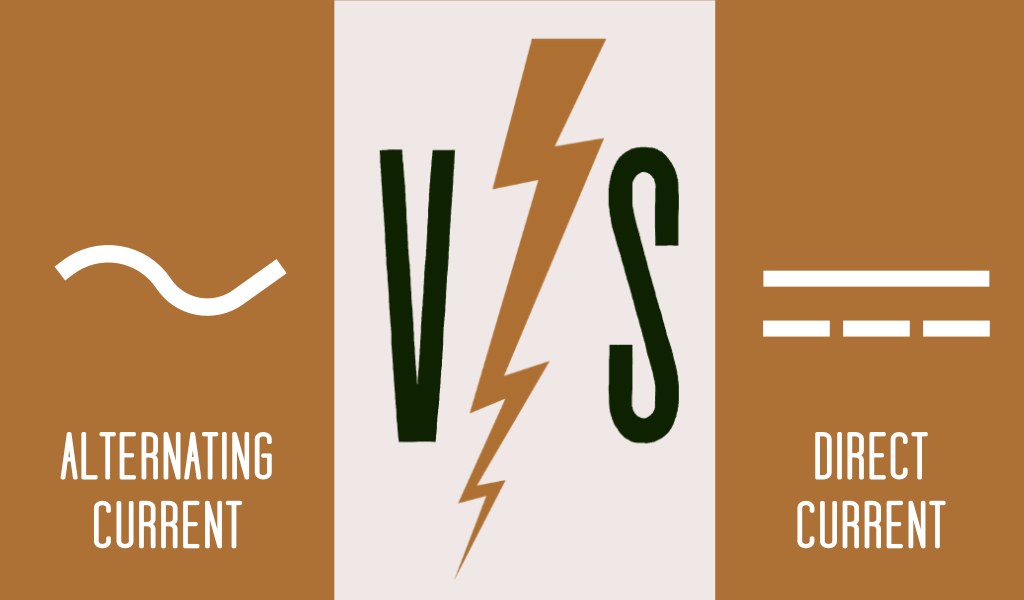
DC is electricity that flows in one direction. Like water flowing down a hose. Electrons march from one end of the wire to the other.
AC flips direction many times a second. In the US, 60 times per second. In Europe, 50.
Think of two kids on a swing. DC is one kid pushed steadily one way. AC is the kid swinging back and forth, back and forth.
That sounds like a weird way to move electricity. Why would anyone choose the swinging version?
Why AC Won
One word: distance.
DC is a pain to send long distances. You lose huge amounts of power as heat in the wires.
AC has a trick DC doesn't. A device called a transformer can step the voltage up to very high levels (hundreds of thousands of volts) before sending it down a wire. High voltage means low current. Low current means less heat. Less heat means less power lost.
Then at the other end, you step the voltage back down to something safe for your house.
This trick only works with AC. With DC, you're stuck with the voltage you started with.
In 1895, Tesla and Westinghouse won the contract to build the first big power plant at Niagara Falls. It sent AC electricity 25 miles to Buffalo. Once that worked, the future was decided.
So Why Does DC Still Exist?
Because almost everything inside your house wants DC.
Your phone, your laptop, your TV, LED lights, your car battery, solar panels. All DC.
Your wall socket has AC. Your devices want DC. Every charger you own is a little box that converts one to the other. That brick on your phone charger? That's where it happens.
A USB cable is so much smaller than a power cable because USB is already DC at low voltage.
Why This Matters For Off-Grid
A solar panel makes DC. A battery stores DC. An LED light wants DC. So in an off-grid system, DC is everywhere naturally.
But your fridge, your washer, your microwave? They want AC, because they were designed for normal AC sockets.
So most off-grid setups use an inverter. A box that turns DC from your panels and batteries into AC for your appliances. Every conversion loses a few percent of the power as heat. For off-grid living, where every watt costs real money, those losses add up.
When To Use DC Direct
Some off-gridders skip the inverter for parts of the system.
LED lights: built-in DC versions exist and run more efficiently.
Fridges: DC fridges (often sold as "RV" or "marine") don't need an inverter.
Phones, laptops: USB-C can charge them straight from a 12V or 24V system with the right adapter.
Saving 5-10% on inverter losses sounds small, but on a tight off-grid budget, it can be the difference between making it through a cloudy week and running out.
When To Use AC
Most people stick with AC for the main house wiring. The reason is boring but real: every appliance you can buy is designed for AC. A 120V AC fridge from any store costs half what a 12V DC fridge from an RV supplier does.
So the practical setup is: AC for the house, DC for the parts where it's cheap and easy, and an inverter to handle the rest.
The Long View
The war Edison and Tesla fought is mostly settled. AC for distribution, DC inside the device.
But it's not over. High-voltage DC transmission lines are now appearing for very long distances (like a solar farm 500 miles from a city). They actually beat AC at extreme distances. Modern electronics solved the voltage problem Edison couldn't.
So in a strange way, Edison wasn't wrong. He was just 130 years early.
→ How sunlight becomes electricity