

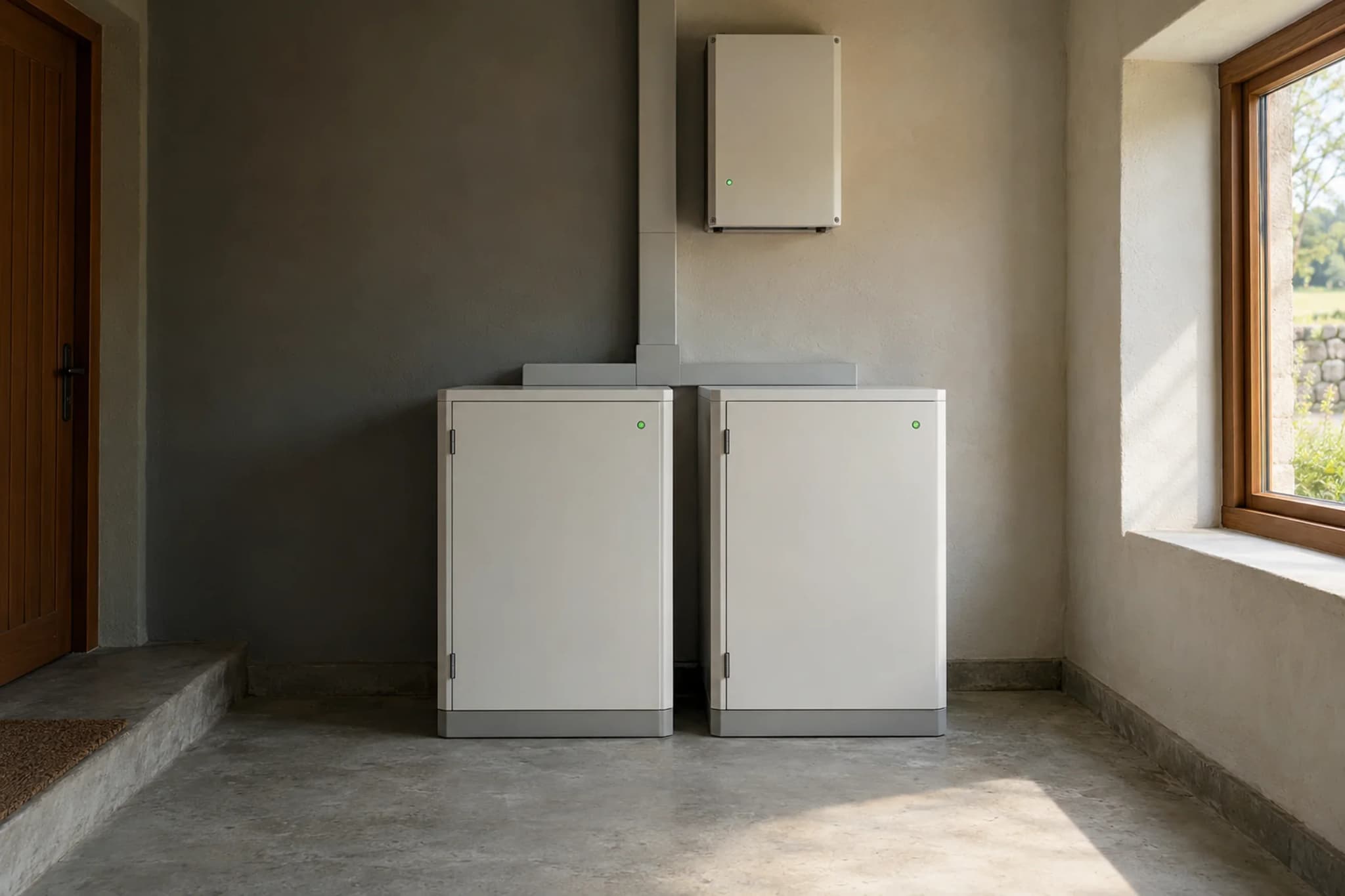
The Plug-In Home Battery: A Plug, And A Catch
A big home battery like the Tesla Powerwall 3 gets wired into the house. It holds 13.5 kWh, and with a Tesla Gateway 3 or Backup Switch it offers whole-home backup.
A plug-in home battery is a different animal, because it comes with a plug. One example, the EcoFlow STREAM Ultra, has a rated capacity of 1.92 kWh and weighs 23.1 ±0.5 kg. Its manual says the grounded plug goes into a grounded outlet.
So this battery is connected to your home through an ordinary wall socket. It can fill up from solar panels or from the grid, then hand that power back to the house later.
There's a catch that is easy to miss, though. In a power outage, the EcoFlow only powers appliances that are plugged into the battery itself. The rest of the house does not switch over to battery power on its own.
Plug In Solar With Battery: How The Storage Box Works
Solar panels and batteries work with DC electricity, while your wall sockets carry AC. Something has to translate between the two, and that translator is called an inverter. The US Department of Energy sums up the job in one line: "a DC input becomes an AC output".
Some models take solar panels straight in. The Anker SOLIX Solarbank 2 E1600 Pro, for example, has 4 solar inputs with a maximum input power of 2400 W.
Others fill up through the socket. The Marstek Venus-E calls itself an "AC-coupled" energy storage system: it can be charged by the grid and supply power to the grid and the household loads.
So how does the battery know how much to send? It asks a meter. With the Anker in its Self-Consumption mode, a Smart Meter calculates the power the household loads need and sends it to the battery, and the excess is stored.
With no meter and no plan set, the Anker "will discharge 200W to home loads at all times". It's like a garden hose left on at one steady trickle, whether anyone is thirsty or not.
The self-consumption calculator shows what you keep at home with and without a battery.
Plug In Battery Backup: What Happens In A Power Outage?
A plug in battery backup like the EcoFlow STREAM Ultra is not whole-home backup: it powers what is plugged into the battery itself, and that's it.
For appliances on other home outlets, the manual is blunt: "if there is a grid power outage, the device will not automatically switch to battery power to supply the load".
Even on the battery's own AC outlets, the switch "may take up to 3 seconds". The manual adds that the device "is not designed to function as an uninterruptible power supply (UPS)". That is a supply that doesn't get interrupted.
- Amber: DC from the panels
- Green: AC with power
- Grey: no power
- Dotted: the meter's message
- Arrowhead: the way the power runs
Other makers build in a socket just for outages. On the Zendure SolarFlow 800 Pro it takes over "within 20ms" and gives 1000W of continuous power. The Marstek Venus-E has a BACKUP socket "for powering loads during electricity outages".
Why would a battery stop feeding a house that needs power? The EcoFlow STREAM Ultra lists "Anti-islanding Protection" among its features, and the US Department of Energy says small inverters, such as those attached to a household solar system, "will disconnect themselves from the grid and shut down" when a disruption in voltage or frequency lasts a long time or is larger than normal.
There's a people reason too. The CDC warns that a generator plugged into a household circuit can send power back to the lines. That backfeed "can seriously injure or kill repair workers or people in neighboring buildings".
Our guide to the two kinds of solar system explains why one of them goes dark in a blackout.
Portable Plug In Battery Or Home Battery: Which Is Which?
These three options are easy to mix up. Here is one example of each, with the numbers its maker gives.
| Kind | Plug-in home battery | Portable power station | Hard-wired home battery |
|---|---|---|---|
| Example | EcoFlow STREAM Ultra | Anker SOLIX C1000 Gen 2 | Tesla Powerwall 3 |
| Energy it holds | 1.92 kWh rated capacity | 1,024 Wh | 13.5 kWh nominal battery energy |
| In an outage | Powers what is plugged into its own AC outlets, switch may take up to 3 seconds | UPS switchover 10 ms | Whole-home backup with a Tesla Gateway 3 or Backup Switch |
The portable power station is the carry-along kind, and the Anker example weighs 24.9 lb. Our guide to portable power stations shows what they run and how to choose one.
A hard-wired home battery like the Powerwall 3 is connected to the home's electrical service. Our page on how home batteries work covers the chemistry and the types.
How Much Electricity Does A Balcony Solar System With Battery Make?
One 400 W panel on a south-facing balcony railing in Berlin makes 0.83 kWh a day, averaged over the year. That figure comes from PVGIS, the EU Joint Research Centre's solar tool, for a panel hanging straight up and down.
The season moves it a lot: 0.91 kWh a day in June, but 0.41 kWh in December. Tilt the same panel to 35 degrees and the yearly average becomes 1.15 kWh a day.
And the battery makes nothing itself. It stores the excess solar and hands it back when the house asks.
Why The Wall Socket Sets The Limit
A wall socket is not a bottomless pipe, and makers set their own limits. The EcoFlow STREAM Ultra's default feed-in power "is 360W" through a standard home socket. Going higher, up to 800W on a single unit, takes a different socket setup that the manual spells out, not a standard home socket.
Why so careful? UL Solutions describes what can happen when plug-in solar, PIPV for short, feeds a circuit. Its words: "the combined current from the utility and PIPV source can exceed conductor ratings without tripping the circuit breaker".
Think of two hoses pushing water into one pipe.
- Solid green: AC from the grid
- Dashed green: AC from the plug-in battery
- Box: the circuit wire
Do Plug-In Home Batteries Work?
Yes, for the job they are built for. They store power from solar panels or the wall socket and feed it to the house, and some keep plugged-in appliances on in an outage.
They are helpers, not power plants. The EIA says the average US household uses about 10,500 kWh of electricity a year, and the EcoFlow example stores 1.92 kWh at a time.
Know what the plug can and can't do before the lights go out.
Sources
- EcoFlow, STREAM Ultra user manual (copy hosted by Solar Power Supply)
- Anker, SOLIX Solarbank 2 E1600 Pro user manual
- Zendure, SolarFlow 800 Pro user manual (copy hosted by Solarcamp24)
- Marstek, Venus-E user manual (copy hosted by Venturama Solar)
- Anker SOLIX, C1000 Gen 2
- Tesla, Powerwall 3 datasheet
- US Department of Energy, Inverters and Grid Services Basics
- CDC, Power outage worker safety (archived page)
- UL Solutions, Safety Considerations for Plug-In Photovoltaic (PIPV) Systems
- EIA, 2020 RECS Table CE5.3b
- EIA, British thermal units (Btu)
- EIA, Electricity use in homes
- Ready.gov, Power Outages
- PVGIS 5.3, Berlin, slope 90
- PVGIS 5.3, Berlin, slope 35
- PVGIS 5.3, Phoenix, slope 35
Hard Words
| Term | What it means |
|---|---|
| Inverter | The translator inside the box. In the US Department of Energy's words, "a DC input becomes an AC output". |
| Smart meter | A meter that tells the battery how much power the household loads need. |
| Feed-in power | The power a plug-in battery sends into the house through its plug. On the EcoFlow STREAM Ultra the default is 360W. |
| Backfeed | Power sent back to the lines from a household circuit. The CDC warns it can seriously injure or kill repair workers. |
| UPS | Short for uninterruptible power supply: a supply that doesn't get interrupted. |
Common Questions
Do plug-in home batteries work?
Yes, for what they are built to do. A plug-in home battery stores power from solar panels or the grid and feeds your household loads through a wall socket. In an outage, the EcoFlow STREAM Ultra, for example, only powers appliances plugged into its own AC outlets, so it is not whole-home backup.
Is there a battery pack that you can plug into?
Yes. A portable power station is a battery with its own AC output. The Anker SOLIX C1000 Gen 2, for example, holds 1,024 Wh, gives 2,000 W max AC power with a 3,000 W peak, and weighs 24.9 lb.
Can I charge a battery in my house?
Yes. A plug-in battery charges from the grid or from solar panels. The EcoFlow STREAM Ultra, for example, has a max charging power of 1050W, and the Marstek Venus-E has a rated grid charging input of 2.5kW.
Can I add a battery to my existing solar panel system?
Yes, an AC-coupled battery is one way. The Marstek Venus-E, for example, starts charging when its current transformer (CT) detects the PV system feeding electricity back to the grid. It supplies power when the CT detects an active load.
What is the best backup source for a power outage?
It depends on what has to stay on. A plug-in battery such as the EcoFlow STREAM Ultra powers what is plugged into its own AC outlets, while a hard-wired Tesla Powerwall 3 with a Tesla Gateway 3 or Backup Switch offers whole-home backup. Ready.gov says generators "should always be used outdoors and at least 20 feet away from windows, doors and attached garages".
Will a 400W solar panel run a fridge?
Sometimes, on paper. EIA data puts the most-used fridge in US homes at an average of 2.11 million Btu of electricity a year. At 3,412 Btu per kilowatthour, our own arithmetic makes that about 1.7 kWh a day.
PVGIS gives a 400 W panel a yearly average of 0.83 kWh a day on a vertical railing in Berlin and 2.0 kWh a day at a 35 degree tilt in Phoenix.