
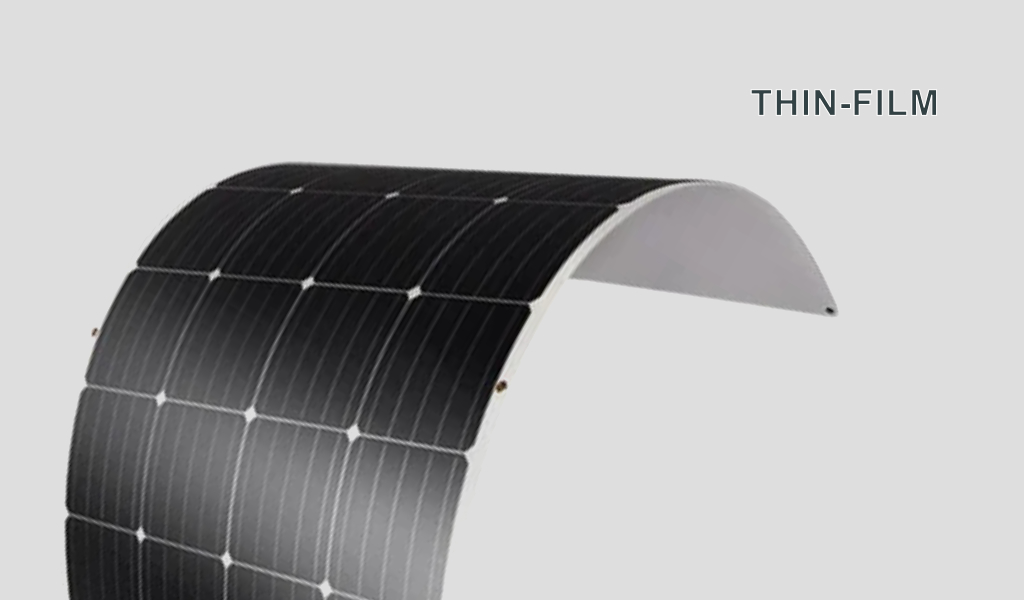
Pick up a regular solar panel and you'll struggle. They're heavy, stiff, and breakable. A 350-watt panel weighs about 20 kilos and is the size of a coffee table.
Now imagine a solar panel you can roll up like a yoga mat. Stick on the curved roof of a van. Glue to a backpack. Tape to the side of a tent.
That's thin-film. And the way it pulls off this trick is genuinely clever.
What Makes It Thin
A regular solar panel uses slices of silicon about as thick as four sheets of paper stacked together. Tiny by normal standards, huge by solar standards.
Thin-film panels use a layer thousands of times thinner than that. We're talking the thickness of a single layer of plastic wrap, sprayed onto a flat sheet.
The "film" in the name is literal. Scientists spray, evaporate, or print a layer of solar-catching material onto a roll of metal, plastic, or glass. The material is so thin you could practically see through it.
Less material means less weight. Less weight means it bends.
→ How sunlight becomes electricity
What's Actually In That Film
Here's where it gets interesting. Thin-film panels aren't made of regular silicon. There are three main flavours.
Amorphous silicon (a-Si). Silicon, but in a messy form. Instead of being grown as a crystal, the atoms are sprayed on randomly. Scientists call this "amorphous". That's just a fancy word for "no crystal pattern, atoms just sitting wherever". Cheap, but the least efficient of the bunch.
Cadmium telluride (CdTe). A mix of two metals, cadmium and tellurium. Most thin-film solar farms use this one because it's cheap to spray and decently efficient. The catch? Cadmium is toxic if it leaks, so recycling has to be done carefully.
Copper indium gallium selenide (CIGS). A blend of four different elements. The hardest to make, but the most efficient of the three. Some CIGS panels are catching 20% of the sunlight that hits them, matching regular silicon.
→ How monocrystalline panels stack up
→ How polycrystalline panels stack up
How Efficient Are They Really
Thin-film efficiency depends on the type. Old-style amorphous silicon catches around 6 to 9%, modern CdTe is up around 18 to 19%, and CIGS sits between 14 and 17% in commercial panels.
A regular silicon panel catches 15 to 22%.
So thin-film ranges from well behind silicon to roughly matching it, depending on which kind. If you want maximum power on a small roof, plain silicon is usually still the easier choice.
But here's where it earns its keep. A thin-film panel handles partial shade better. If a tree shadow falls across one corner of a rigid silicon panel, the whole panel's output drops badly. Thin-film loses only the shaded part. The rest keeps working.
It also handles heat better. On a 40-degree day, a thin-film panel barely notices. A rigid silicon panel can lose 15% of its output.
→ How many sun hours does your area get?
Where Thin-Film Actually Wins
This is where the story gets fun. Thin-film panels show up in places no other solar panel can reach.
Backpacks. Sewn into the fabric so your phone charges while you hike.
Boats. Glued to the curved deck where rigid panels would snap.
Roofs of trucks and RVs. Light enough that the vehicle's suspension barely notices.
Tent fabrics. A small camping tent that runs your lights all night just from sitting in the sun all day.
Office building windows. A material called transparent thin-film lets visible light through but catches the heat. The window powers itself.
Satellites. Light, foldable, and tough enough to survive being launched into space.
Some hospitals have thin-film roof tiles that look like regular tiles from the street but quietly make electricity.
When Thin-Film Is The Right Pick
Pick thin-film when:
- You need to bend, roll, or shape the panel
- The panel will sit on something that can't carry heavy weight (boat, RV, backpack, tent)
- You're putting solar in a hot or partly-shaded spot
- Looks are everything (it can blend into roofs and walls)
Pick something else when:
- You have a regular roof and just want maximum power
- You're working with a tight budget per watt (cheap polycrystalline beats thin-film on price-per-power)
- You want the longest possible lifespan
What They're Not Good At
Older thin-film panels lost efficiency faster than silicon. Modern CdTe and CIGS panels are warrantied to about 85% output at 25 years, very close to silicon. The old amorphous silicon panels were the ones that faded fast.
They also produce less power per square meter, so you need a bigger area to make the same energy. Not always practical.
→ Use the solar panel calculator
How They Fit Into A System
The same as any other solar panel. The panel makes electricity in the form called DC. Your house wants AC.
An inverter is the translator box that swaps DC for AC.
If you're storing power in batteries, a charge controller goes between the panels and the batteries to stop a hot day from frying them.
→ The difference between AC and DC power
→ All the electronic parts in a solar setup
Where Thin-Film Is Heading
The crazy part is that thin-film tech is exactly where the next big leap in solar is happening.
Researchers are working with a material called perovskite. It's a kind of crystal you can spray on like paint. Early lab versions are catching 30% of the sunlight that hits them. That's nearly twice as efficient as today's best thin-film.
If perovskite holds up outside for 20 years (the hard part), solar paint and solar fabric stop being science fiction. A wall that powers itself. A jacket that charges your phone while you walk.
What sounds futuristic today might be on store shelves in five years.
→ Where solar panels are heading next