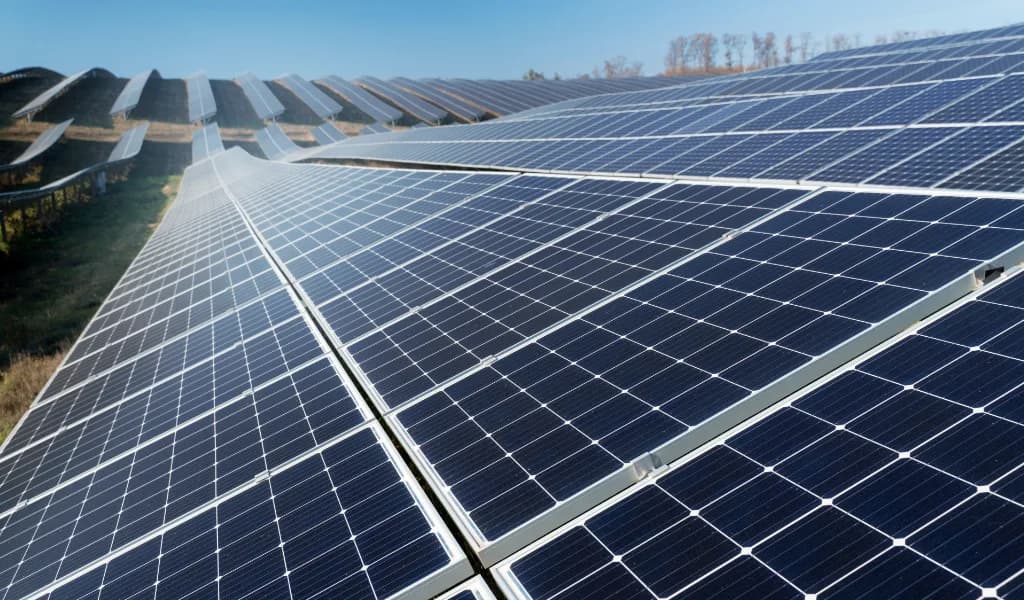

Solar panels you see today are already old technology. The first one was built at Bell Labs in 1954.
What's wild is that solar keeps getting better every year, even after 70 years of progress. Cheaper. More efficient. In stranger places than anyone imagined back then.
Here's what's around the corner.
Perovskite: The Material Changing Everything
The big one. Perovskite is a kind of crystal you can spray or print, like ink.
Early perovskite solar cells in labs are already catching more sunlight than the best silicon panels. The current world record is around 33%, compared to about 23% for the best silicon.
Stacked on top of a regular silicon panel, perovskite can push the combined cell past 30%. That's a huge leap.
The catch? Perovskite breaks down faster than silicon. Today's best cells last maybe 5 years outdoors. Silicon panels last 30.
If researchers can fix the lifespan (and they're getting close), perovskite panels could roll out as soon as 2027 or 2028. Your next solar install might be twice as powerful as the one you'd buy today.
→ How sunlight becomes electricity, the full story
Solar That Goes Where Panels Can't
The boring picture of solar is a rectangle on a roof. The exciting picture is solar in places nobody thought of.
Solar windows. Glass that looks like normal glass from the street but catches sunlight and turns it into electricity. Already in some office buildings. Your house window could power your lights.
Solar fabric. Threads with tiny solar cells woven in. A tent that powers your camping lights. A jacket that charges your phone while you walk.
Solar paint. Researchers in Australia have made a paint that catches sunlight and produces hydrogen fuel from water vapour. Roll it on a wall and the wall makes fuel.
Solar roof tiles. Roof tiles that look like normal slate or terracotta but quietly make power. Already on sale, just expensive.
What sounds like science fiction today might be in stores in five years.
→ How thin-film panels go where rigid ones can't
Bigger Roofs, Bigger Batteries
The trend in panel size is straightforward. Bigger and more powerful.
A 2010 home panel made about 250 watts. A 2025 panel makes 450 watts. By 2030, 600-watt panels will be common.
The same trend is happening with home batteries. The cost per kilowatt-hour stored has dropped by 90% since 2010. A 10 kWh battery that cost 15,000 euros in 2012 costs 5,000 today and will cost 2,000 by 2030.
This is the math that's driving solar from "nice idea" to "default choice" in most regions.
Better Cells On Today's Panels
Not all the progress is in new materials. A lot is happening to good old silicon too.
PERC cells (Passivated Emitter and Rear Contact) add a reflective layer behind the silicon. Light that would have escaped gets bounced back into the cell. About 1 to 2% better efficiency.
TOPCon cells are an upgrade on PERC. Even better at catching the last bits of light. Now standard on many new panels.
HJT cells (heterojunction) layer different kinds of silicon for extra efficiency in heat. The best ones push 23%.
Bifacial panels catch sunlight from both sides. Mount them right and the underside picks up light reflected off the ground. 10 to 20% more power from the same panel.
These tweaks add up. Today's best monocrystalline panels make 30% more power than the same-size panel from 10 years ago.
→ How polycrystalline panels stack up
Smarter Systems
The panels are getting better. So is everything else in the system.
Smarter inverters sync with the grid in real time. They store solar in batteries when prices are low and sell to the grid when prices are high. Some pay for themselves in arbitrage alone.
Smarter charge controllers squeeze every last watt out of mismatched panels. Even shaded or dusty panels make better power.
AI-driven monitoring spots a failing panel weeks before it fully dies. Service calls drop. Downtime drops.
→ All the electronic parts in a solar setup
Better Recycling
Old solar panels used to be a problem. They piled up in landfills.
That's changing. New methods can recover the glass, the silicon, and the aluminum from old panels and use them in new ones. Some plants in Europe already recycle 95% of an old panel's mass.
By 2030, a "circular" solar industry is realistic. The panels you install today might be recycled into the panels your grandkids install in 2055.
The Cost Curve
Here's the number that explains everything.
In 1976, solar cost about $100 per watt to make. In 2010, it cost $4 per watt. Today, it costs less than $0.30 per watt.
That's a 300-times drop in 50 years. And it's still falling.
A home solar setup that cost 50,000 euros in 2010 costs 12,000 today. By 2030, the same setup will likely cost 6,000.
Solar isn't a luxury technology anymore. It's the cheapest electricity in human history.
→ How to calculate your solar energy needs
→ Use the solar panel calculator
What This Means For You
If you're thinking about solar today, two things to know.
Today's panels are already very good. Waiting for "the next big thing" rarely pays off. The panels you can buy now will save you money for 25 years.
But the rest of the system (batteries, inverters, monitoring) is improving fast. A modular setup that lets you swap in better batteries later is smarter than locking everything in today.
Either way, the long-term trend is clear. Solar gets better, cheaper, and stranger every year. Twenty years from now, your roof might be doing things we can't fully picture yet.