
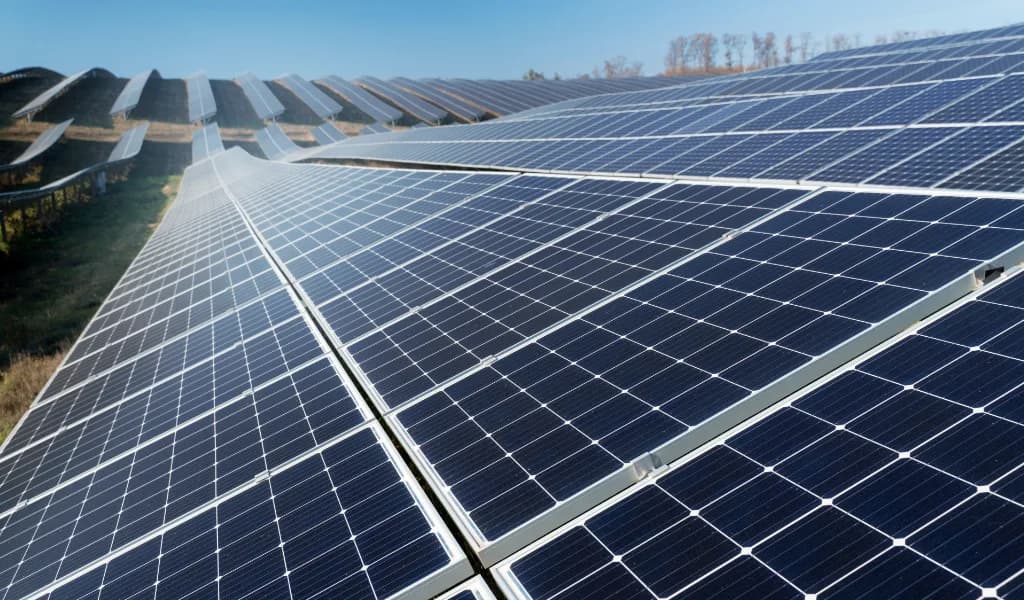
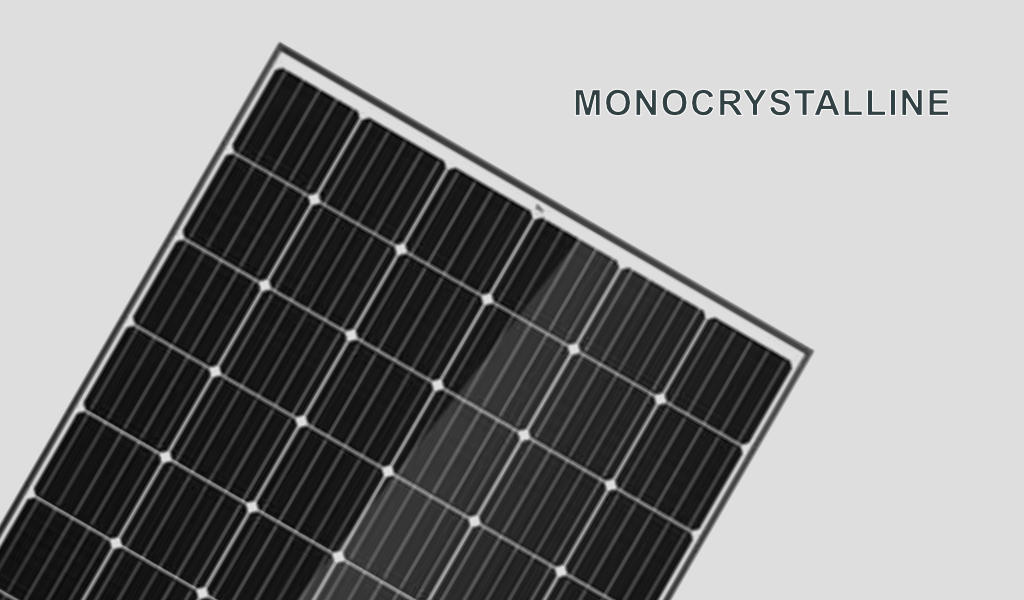
Take a walk through a nice neighbourhood and look up. The black panels on the roofs are almost all monocrystalline. They're the sleekest, the most efficient, and the most expensive of the three main solar types.
Worth it? Sometimes yes, sometimes no. Here's how to tell.
What Makes Them "Mono"
Every solar panel is made of silicon. Mono panels are made from one big, pure crystal of it.
To make one, factory workers melt silicon at over 1400 degrees, then slowly pull a single growing crystal out of the liquid. The crystal grows into a long log, like a perfectly clean candle. They slice that log into wafers thinner than a credit card. Each wafer becomes one cell. Lots of cells go into one panel.
That single-crystal structure is what makes the panel black, smooth, and good at its job. The electrons inside have a clear, straight path. No bumps. No detours.
The downside? Growing that crystal takes a lot of time and a lot of energy. That's why mono panels cost more.
→ How a panel turns sunlight into electricity
How Efficient Are They Really
A mono panel turns about 20% of the sunlight that hits it into electricity. The best ones in 2025 are pushing 23%.
That sounds small. It's actually the highest of any panel you can buy off a shelf.
Compare it to the alternatives. Polycrystalline panels catch about 15%. Thin-film panels catch 10 to 19% depending on the type.
So what does that mean in real life? If you have a small roof, mono lets you fit more power into the same space. If you have a huge field, the cheaper panels often win on total cost.
→ Use the solar panel calculator
They Last A Long Time
A good monocrystalline panel keeps working for 25 to 30 years.
The panel slowly loses a tiny bit of efficiency each year. After 25 years, most are still at 80% of their original power. Some early 1980s panels are still pushing electricity into homes today.
That long life is part of why people pick them. You pay more once, and then they sit on your roof making free power for two or three decades.
They're A Bit Picky About Heat
There's a weird thing about solar panels that surprises people. They actually work worse when they're really hot.
A mono panel on a 35-degree summer day might lose 10% of its output compared to a cool spring day. That's not a flaw of mono specifically, it's how silicon behaves. But it's worth knowing.
In hot climates, this matters. Mounting panels a few inches off the roof lets air flow underneath and cool them down.
When Mono Is The Right Pick
Pick monocrystalline when:
- Your roof space is small and you need maximum power per square meter
- You care about how it looks (clean black beats blue-speckled for most people)
- You're planning to stay in your house for 10+ years so the higher cost pays back
Pick something else when:
- You have a huge sunny field and a tight budget (polycrystalline wins on price per watt)
- You need flexible or curved panels (only thin-film bends)
- You're in a very hot region with extreme heat year-round (cheaper panels with similar losses might make more sense)
→ How polycrystalline panels stack up
→ How thin-film panels go where rigid ones can't
Cleaning And Care
Mono panels don't need much. Rain handles most of the cleaning.
Once or twice a year, spray them with a hose to wash off bird droppings and dust. Skip the high-pressure washer. Skip the abrasive sponge. Soap and water on a soft brush is plenty.
A quick visual check now and then catches problems early. Cracks, cloudy spots, or burn marks mean it's time to call the installer.
How They Fit Into A Full Solar Setup
A panel on its own can't run anything. You need a few more pieces.
The panel makes electricity, but it's the wrong kind for your house. An inverter changes it into the kind your wall sockets use.
If you're storing power, you also need a charge controller between the panels and the batteries.
→ The full story of AC vs DC power
→ All the electronic parts in a solar setup
Where The Tech Is Heading
Mono is the most mature of the three solar types, but it's still getting better.
Newer cell designs called PERC and TOPCon are squeezing out another percent or two every few years. A panel built in 2030 might catch 25% of the sunlight that hits it, up from 20% today.
The real wildcard is a material called perovskite. Stacked on top of silicon, it could push panels past 30% efficiency. That's not theory anymore. Working samples exist.