
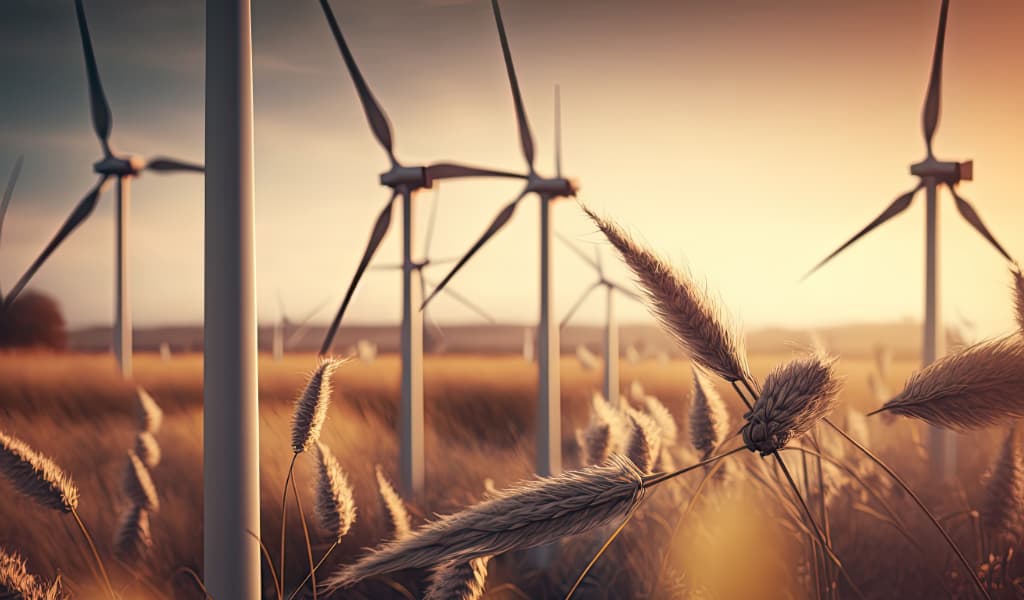
Horizontal axis wind turbines already dominate wind power. The future is about pushing them further: bigger, smarter, and into places they couldn't reach before.
Longer Blades
The fastest way to catch more wind is to make the blades longer. The wind-catching area grows with the square of the blade length, so doubling a blade quadruples the power.
The newest offshore turbines have rotors over 250 metres across. One blade is longer than a soccer field. These giants spin slowly, maybe 8 turns a minute, but their sheer size means a single turbine can run 20,000 homes.
The trick is keeping them light enough. New carbon fibre and resin recipes are letting engineers go bigger without making the blades unmanageably heavy.
Floating Platforms
Out at sea, the wind is stronger and steadier than anywhere on land. But planting a turbine in the seabed only works where the water is shallow enough, maybe 50 metres deep.
The newest play is floating turbines. The whole turbine sits on a giant floating platform, anchored with cables. The platform rolls a little in the waves, but the turbine keeps spinning.
This opens up deep ocean sites that were impossible before. Places like the open Atlantic, the Mediterranean, the deep North Sea. The wind out there is strong and steady in ways nothing on land matches.
Smarter Grids
Wind is intermittent. Sometimes it howls, sometimes it's dead calm. That's a problem for power grids that need a steady supply.
The fix is smart grids. Computer-controlled networks that can shift power around in real time, store excess in big battery banks, and pull from other sources (like solar or hydro) when the wind drops.
The smarter the grid gets, the more wind it can absorb without instability. Some countries (Denmark, Scotland, parts of Germany) already run on 40-60% wind on good days.
New Countries Joining In
Wind power has been a Europe and North America story for decades. That's changing fast.
India, Brazil, South Africa, Vietnam, and a dozen other countries are now building wind farms at speed. Some of these places have phenomenal wind, and lower labour costs to install. The next decade of growth probably happens there.
Better Materials, Smaller Footprint
Old turbine blades were made of fibreglass and couldn't be recycled. When they reached end of life (usually around 25 years), they ended up in landfills.
New blade designs use recyclable resins that can be broken back down into raw material at the end of their life. Companies like Siemens Gamesa have already started shipping these.
This is a big deal for keeping wind power genuinely clean from start to finish.
→ Read more about the components of a HAWT
→ Use the yearly kWh calculator
In 30 years, the white propellers on the horizon will be more common, larger, smarter, and cleaner to build and retire. The trajectory of wind power is still going up.