
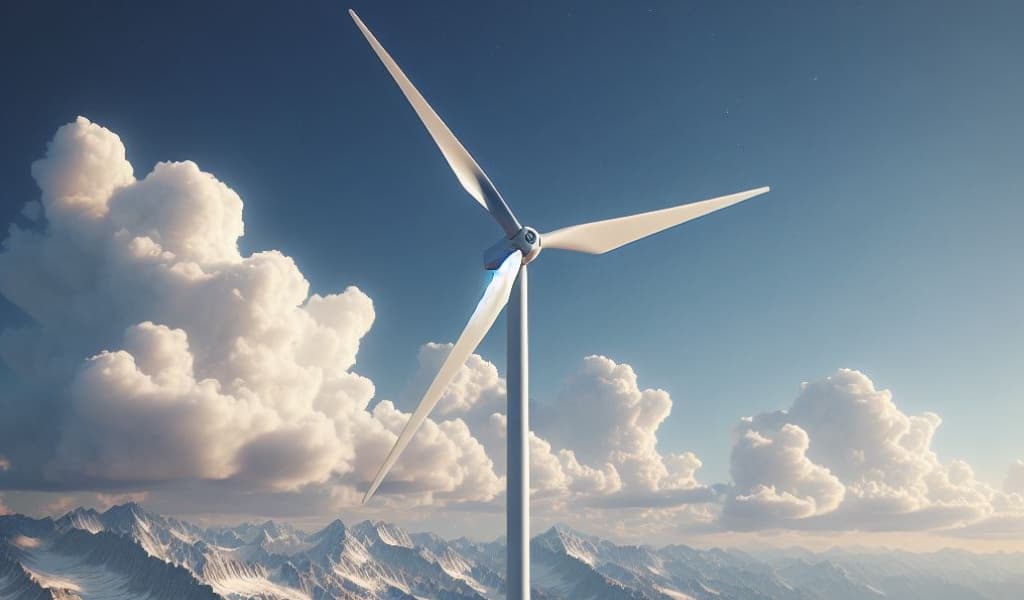
From the ground, a wind turbine looks like a pole with a propeller. But the real magic happens in the box at the top of the tower. Here's what's inside.
The Blades
The blades are where it starts. Two or three of them, slim and long, sweeping through the sky.
They look simple. They're not. The cross-section of a blade is shaped exactly like an airplane wing. When air flows past it, the curved top creates lower pressure than the flat bottom. That pressure difference is lift, the same force that holds a jumbo jet in the air.
A wind turbine's blades aren't being pushed by the wind. They're being pulled by the air slipping past them. Scientists called this aerodynamic lift, but it's just the same wing trick.
The Rotor
The rotor is the hub at the centre where all the blades meet. It's bolted to a thick shaft that runs into the nacelle (the box at the top of the tower).
When the blades spin, the rotor spins. When the rotor spins, the shaft spins. That spinning is what we want.
It's just like a kid's pinwheel, only the size of a school bus.
The Gearbox (Sometimes)
Here's a weird quirk. The blades spin slowly. A home turbine might spin around 100 turns a minute. A giant offshore turbine spins more like 7 or 8 turns a minute. That's way too slow to make electricity efficiently.
So most turbines have a gearbox that takes the slow spin from the blades and ramps it up to a fast spin for the generator. Same idea as bicycle gears: pedal slowly, the wheel spins fast.
Some newer turbines skip the gearbox entirely. They use a special "direct drive" generator that can make electricity even at slow speeds. Fewer parts to break. Quieter, too.
The Generator
The generator is the magic box. The piece of the puzzle where spinning becomes electricity.
Inside the generator is a strong magnet and a coil of wire. Spin the magnet inside the coil and electricity flows out the wire. That's the trick we've been using since Michael Faraday discovered it in the 1830s.
The faster the magnet spins, the more electricity comes out. So the gearbox-and-generator combo turns the slow blade spin into a fast generator spin, which makes a steady flow of electricity.
The electricity comes out as direct current (DC) at first. The same kind of power a battery makes.
Power Electronics And Controls
The DC from the generator isn't quite ready for use. It needs to be cleaned up and (usually) converted to AC, the kind of electricity that comes out of wall plugs.
That's where the power electronics come in. A bunch of computer-controlled switches that tweak the voltage and the shape of the electricity until it's safe and useful.
If you're storing power in a battery bank, you'll also need a charge controller and an inverter outside the turbine. The charge controller stops a strong gust from cooking your battery. The inverter translates DC into AC for your house.
→ All the electronic parts in a wind setup
→ Components of a HAWT in detail
So when you see a turbine on the horizon, here's what's happening. Wind pulls the blades. The blades spin a shaft. The shaft (maybe through a gearbox) spins a magnet. The magnet pushes electricity through a coil. The electricity flows down the tower and into homes. Five steps. That's all.