

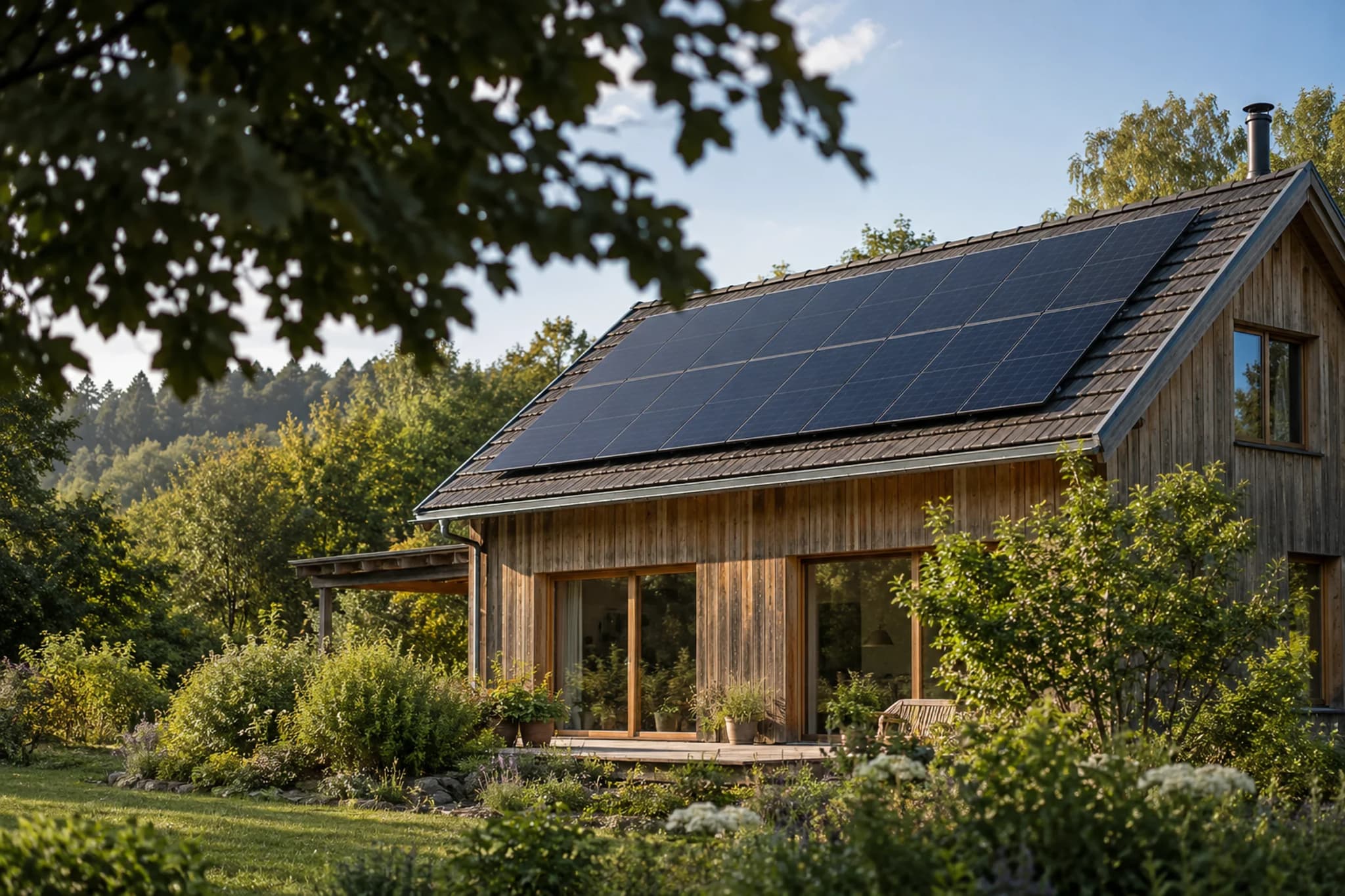
Four Off-Grid Solar System Examples Side By Side
A camper van can live on two solar panels. A family home in Germany gets ten, and it still runs short in December. Both are sized with exactly the same five steps.
These off-grid solar system examples walk through a van, a weekend cabin, a tiny house and a family home, start to finish. Each one ends with a parts list you can follow with just a pencil, plus links to the calculators that give the same answers, give or take rounding.
One honest warning first. The daily loads below are example numbers we built from typical device wattages, not measured averages from real homes. Your habits will be different, so put in your own numbers with the energy use calculator before you buy anything.
| Van | Weekend cabin | Tiny house | Family home | |
|---|---|---|---|---|
| Battery voltage | 12 V | 24 V | 48 V | 48 V |
| Daily load (example) | 0.74 kWh | 1.75 kWh | 4.0 kWh | 10 kWh |
| Battery size on the label (2 days, 80% depth of discharge) | 1.85 kWh, 154 Ah | 4.86 kWh, 203 Ah | 11.1 kWh, 231 Ah | 27.8 kWh, 579 Ah |
| Solar panels | 2 x 200 W (400 W) | 4 x 200 W (800 W) | 6 x 400 W (2.4 kW) | 10 x 400 W (4.0 kW) |
| Charge controller (example size) | 100/30 MPPT | 100/30 MPPT | 150/45 MPPT | 150/70 MPPT, or two 150/45 |
| Inverter (example size) | 800 VA, optional | 800 VA | 3000 VA | 5000 VA, or 8000 VA above about 3,200 W continuous load |
| In a Berlin December | Not sized for winter | 0.74 kWh a day, under half the load | About 56% of the load | About 37% of the load |
- DC (one line for the plus and minus pair)
- AC
- Arrow: the way power runs
The Five Steps Behind Every Example
Every system here is built like a lego tower, one brick on top of the last. Change the bottom brick, your daily load, and every brick above it moves too.
Step 1: Add up the daily load
Multiply each device's watts by the hours it runs in a day. A 50 W laptop used for 5 hours is 250 watt-hours (Wh), and 1,000 Wh make one kilowatt-hour (kWh), the unit on an electricity bill.
Step 2: Size the battery
A battery is a backpack full of electricity. Each example gets two days of autonomy, a fancy way of saying the battery alone can run everything for two days with no sun at all. The sum is:
daily load × 2 days ÷ (0.8 × efficiency) = battery size on the label
The 0.8 is the depth of discharge, which is how far you let the battery empty. Some makers of lithium iron phosphate (LiFePO4) batteries allow more. Battle Born's datasheet, for example, says all 100% of its capacity is usable, but we plan with 80% to stay on the safe side.
The efficiency is 0.9 when power goes through an inverter, because we count about 10% as lost in the inverter and cables. The van runs almost everything straight off 12 V, so it uses 1.0; if you add the inverter for plug-in loads, use 0.9 for those.
Divide the answer in watt-hours by the battery voltage and you get amp-hours (Ah), the number many batteries are sold by. Our guide to choosing a battery explains the rest. The battery calculator rounds amp-hours up and kWh to one decimal, so it can show one amp-hour more and, for example, 1.9 kWh where this page says 1.85.
Step 3: Count the panels
Each panel makes its size in kilowatts times the daily yield. The daily yield is how many kWh one kilowatt of panels makes per day, averaged over a whole year, after losses from heat, dirt and cables.
These examples use yields from PVGIS, the free solar tool from the European Commission: 2.79 kWh per kilowatt per day for Germany (Kassel) and 2.81 for the Netherlands. Your own number is on our sun hours page.
That's a yearly average, and winter is far worse. In a Berlin December the same kilowatt of panels makes only about 0.93 kWh a day, so every home-sized example gets a winter check too. That December figure is for Berlin, the city our other winter pages use. Kassel, where the yearly yield above comes from, makes a little less in December, about 0.88 kWh, so the winter shares below are slightly on the kind side.
Step 4: Pick the charge controller
A charge controller is a gatekeeper between the panels and the battery. It lets in as much as the battery can safely take, and no more. The MPPT kind, short for "maximum power point tracking", squeezes the most power out of the panels.
Its size comes from one sum: panel watts ÷ charging voltage = charge amps. The charging voltage is 1.2 times the battery voltage. That's 14.4 V for 12 V, 28.8 V for 24 V and 57.6 V for 48 V.
Controllers carry names like 100/30. On a 100/30 the first number is the highest panel voltage it accepts (100 V) and the second is the most current it pushes into the battery (30 A). Victron names all its MPPT controllers this way, so a 150/45 takes up to 150 V and charges at up to 45 A. Other brands name theirs differently, so check the datasheet.
Panels make more voltage on frosty mornings. So take the panel voltage from your panel's datasheet and check that a whole row of panels stays under that first number on the coldest day. The charge controller calculator does this cold check for you.
Step 5: Pick the inverter
An inverter is a translator. It turns the battery's DC power into the AC power that normal plugs use. Two numbers decide its size:
- Continuous load: everything that runs at the same time. Multiply it by 1.25 for headroom, because inverters give less power when they get warm.
- Peak load: the short burst when a fridge or pump motor starts. The inverter's peak rating has to cover it.
Inverters are often sold in VA (volt-amperes). For these examples 1 VA counts as 0.8 W, so a 3000 VA inverter gives 2,400 W.
One last sum: continuous watts ÷ (battery voltage × 0.9) = amps in the battery cables. That current shows how much the battery cables carry today. Size the cables and the main fuse for the inverter's full rated power, not just today's load: our fuse guide and cable calculator take it from there.
Why do the examples climb from 12 V to 48 V? Higher voltage works like higher water pressure: it moves the same power with less current, just as more pressure pushes the same water through a thinner hose. At low voltage, big power means huge currents and very thick cables.
Victron's wiring guide puts the preferred limit at 3000 VA for 12 V and 5000 VA for 24 V, with 48 V from 5000 VA up.
Off-Grid Solar System For Van Trips
This first example is a camper van used on summer trips. Almost everything runs on 12 V straight from the battery, the same way the lights in a car do.
Example load list (swap in your own):
| Device | Watts × hours | Wh a day |
|---|---|---|
| 12 V compressor fridge | Measured average, see below | about 300 |
| LED lights | 4 lights × 5 W × 4 h | 80 |
| Laptop | 50 W × 5 h | 250 |
| Phones | Charging | 40 |
| Roof vent fan | 10 W × 6 h | 60 |
| Water pump | Short bursts | 10 |
| Total | 740 Wh (0.74 kWh) |
The fridge figure is our own arithmetic from Dometic's page for its CFX3 45 fridge. It lists an average draw of 1.03 Ah per hour at 32 °C outside and 4 °C inside. Over 24 hours that's roughly 24.7 Ah, or about 297 Wh at 12 V, and a cooler day uses less.
Battery. 0.74 kWh × 2 days ÷ (0.8 × 1.0) = 1.85 kWh, which is 154 Ah at 12 V. Two 12 V LiFePO4 batteries of 100 Ah hold 2.56 kWh on the label (each one is 100 Ah × 12.8 V = 1,280 Wh, and 12.8 V is the usual LiFePO4 rating), so they cover it with room to spare.
Panels. 0.74 kWh ÷ 2.81 (the Dutch yield) = 0.263 kW, so one 200 W panel is not enough. Two of them make 400 W, and on a van the roof space usually sets the limit anyway.
Charge controller. 400 W ÷ 14.4 V = 27.8 A. A 30 A controller fits, for example a 100/30 MPPT, which is rated for 440 W of panels on a 12 V battery.
Inverter. You only need one for things with a normal plug. With 300 W running at once, 300 × 1.25 = 375 W, and with a 600 W start-up peak, an 800 VA inverter (700 W continuous, 1,600 W peak) is the smallest size in the calculator. At 300 W it pulls about 27.8 A from the battery. If everything you own runs on 12 V, skip it.
Parts list by type:
- 2 solar panels of 200 W, with roof mounts and MC4 connectors (the click-together plugs on solar cables)
- 1 MPPT charge controller, 30 A class
- 2 LiFePO4 12 V batteries of 100 Ah, or one of 200 Ah, each with a BMS
- 1 inverter of about 800 VA, optional
- Main battery fuse, busbar and DC cables, sized with the fuse calculator and cable calculator
- Battery monitor with shunt
- Optional: a DC-DC charger that tops up the battery from the engine while you drive
Watch for three things. Roof vents throw shade on the panels, 12 V cables need to be thick, and most lithium batteries must not be charged below freezing.
→ Van battery in the calculator
→ Van panels in the calculator
→ Van inverter in the calculator
Off-Grid Solar System For Cabin Weekends
Next is a weekend cabin in Germany, used mostly in summer. It has a normal plug-in fridge, so this system runs on 24 V with an inverter.
Example load list (swap in your own):
| Device | Watts × hours | Wh a day |
|---|---|---|
| Fridge | 150 W × 8 h | 1,200 |
| LED lights | 6 lights × 8 W × 4 h | 192 |
| Laptop | 50 W × 5 h | 250 |
| Phone and radio | Charging and listening | 60 |
| Water pump | 100 W × 0.5 h | 50 |
| Total | 1,752 Wh, call it 1.75 kWh |
The fridge runs 8 hours out of 24 because its motor switches on and off all day.
Battery. 1.75 kWh × 2 days ÷ (0.8 × 0.9) = 4.86 kWh, which is 203 Ah at 24 V. Buy about 5 kWh of LiFePO4 at 24 V. That could be one 24 V battery of 200 Ah, or two 12 V batteries of 200 Ah in series, which means joined end to end like the batteries in a flashlight so their voltages add up. On the label that is 200 Ah × 25.6 V = 5.12 kWh, just above the 4.86 kWh; in amp-hours it looks a little under 203 only because we divide by 24 V, not by the 25.6 V a LiFePO4 battery really sits at.
Panels. 1.75 kWh ÷ 2.79 = about 0.63 kW. Four 200 W panels make 800 W. In a Berlin December those 800 W make only about 0.74 kWh a day, under half the load, so this cabin is a summer and weekend system.
Charge controller. 800 W ÷ 28.8 V = 27.8 A. A 100/30 MPPT fits again, because on a 24 V battery it is rated for 880 W of panels. The four panels could go in two rows of two, if the voltages on your datasheet fit under 100 V on a cold day.
Inverter. With 350 W running at once, 350 × 1.25 = 438 W, or 547 VA. When the fridge and pump start together the peak is about 1,200 W. An 800 VA inverter at 24 V (700 W continuous, 1,600 W peak) covers both. At 350 W it pulls about 16.2 A from the battery, half of what the same load would pull at 12 V, so the cables can be thinner and lose less.
Parts list by type:
- 4 solar panels of 200 W, with mounts
- 1 MPPT charge controller, 30 A class
- A 24 V LiFePO4 battery bank of about 5 kWh, with a BMS
- 1 inverter-charger of 800 VA, an inverter that can also charge the battery from a generator
- Main fuse, battery disconnect switch and DC cables, sized for the inverter's full rating, with the fuse calculator
- Battery monitor
- Optional: an input for a small generator
The usual mistake is falling in love with the cabin and using it in the dark weeks too. Then this system is too small, and you need more panels, more battery or a generator.
→ Cabin battery in the calculator
→ Cabin panels in the calculator
→ Cabin inverter in the calculator
Off-Grid Solar System For Tiny House Living
The third example is a tiny house lived in all year, on 48 V.
How much does a tiny house really use? Researchers at UC Berkeley measured one called THIMBY, just 18.5 square meters. Averaged over three years it used 1,343 kWh a year, about 3.7 kWh a day. Nobody lived in it for one to two months each year, and yearly use ranged from 1,159 to 1,464 kWh.
That was less than their own design predictions of 1,979 and 2,442 kWh a year. THIMBY was designed to run off-grid, but it has an optional grid connection and drew power from the grid in winter at its latest site, so it is a load benchmark here, not a tested off-grid design.
Example load list (an assumption close to that benchmark):
| What | kWh a day |
|---|---|
| Fridge | 1.2 |
| Lights | 0.3 |
| Laptops and TV | 0.8 |
| Water pump and ventilation | 0.3 |
| Induction cooking and microwave | 0.7 |
| Water heating and other loads | 0.7 |
| Total | 4.0 |
Battery. 4.0 kWh × 2 days ÷ (0.8 × 0.9) = 11.1 kWh, which is 231 Ah at 48 V. Buy about 12 kWh, for example a 48 V battery of 250 Ah.
Panels. 4.0 kWh ÷ 2.79 = just over 1.4 kW, so four 400 W panels (1.6 kW) match the yearly average. Year-round, this example takes six (2.4 kW). In a Berlin December those six make 2.4 × 0.93 = 2.23 kWh a day, still only about 56% of the load. A generator, or cutting the big loads in the dark weeks, has to fill the gap.
Charge controller. 2,400 W ÷ 57.6 V = 41.7 A. That fits a 150/45 MPPT, which is rated for 2,600 W of panels on a 48 V battery.
Inverter. With 1,500 W running at once, 1,500 × 1.25 = 1,875 W, or 2,344 VA. The peak is 3,000 W. A 3000 VA inverter at 48 V (2,400 W continuous, 5,500 W peak) covers it, and at 1,500 W it pulls about 34.7 A from the battery.
Keep that inverter somewhere cool. Victron lists its MultiPlus-II 3000 VA at 2,400 W at 25 °C, but only 2,200 W at 40 °C and 1,700 W at 65 °C. And plan for a part playing up: THIMBY's inverter did not work properly in off-grid mode several times in its first year.
Parts list by type:
- 6 solar panels of 400 W, wired in rows that fit your datasheet voltages
- 1 MPPT charge controller, 45 A class
- A 48 V LiFePO4 battery pack of about 12 kWh, with a BMS
- 1 inverter-charger of 3000 VA
- Main DC fuse or breaker sized for the inverter's full rating, for example a Class T fuse (see the fuse calculator)
- AC distribution board for the house circuits
- Battery monitor with shunt
- Grounding and surge protection as the manufacturer's manual describes; see grounding and surge protection
- Optional: a generator input
→ Tiny house battery in the calculator
→ Tiny house panels in the calculator (it shows the yearly minimum of four; the six are our winter choice)
→ Tiny house inverter in the calculator
Off-Grid Solar System For A Family Home
The last example is a family home using 10 kWh a day. That's an assumption for a home planned to use little. The average American home bought about 10,791 kWh in 2022, around 30 kWh a day, so this one uses about a third of that.
Battery. 10 kWh × 2 days ÷ (0.8 × 0.9) = 27.8 kWh, which is 579 Ah at 48 V. Buy 28 to 30 kWh of LiFePO4. Our guide to how many solar panels you need works out a similar home with three days of storage instead.
Panels. 10 kWh ÷ 2.79 = about 3.6 kW, so nine 400 W panels (3.6 kW) match the yearly average. This example takes ten (4.0 kW). In a Berlin December those ten make about 3.72 kWh a day, only 37% of the load. A generator, or managing the loads, is part of this system, not an extra.
Charge controller. 4,000 W ÷ 57.6 V = 69.4 A. A 150/70 MPPT is rated for 4,000 W of panels on a 48 V battery, so it sits right at its rated power. Two 150/45 controllers, each with half the panels, also work. Check the voltage and current from your panel's datasheet either way.
Inverter. With 3,000 W running at once, 3,000 × 1.25 = 3,750 W, or 4,688 VA. The peak is about 6,500 W, our assumption for a well pump and a fridge starting together. A 5000 VA inverter at 48 V (4,000 W continuous, 9,000 W peak) covers that, and at 3,000 W it pulls about 69.4 A from the battery.
That 5000 VA size only works up to about 3,200 W of continuous load, because above that the load times 1.25 is more than its 4,000 W. Then the example steps up to 8000 VA at 48 V (6,400 W continuous, 15,000 W peak), or two inverters working side by side.
Parts list by type:
- 10 solar panels of 400 W, with roof or ground mounts
- 1 MPPT charge controller of 70 A, or 2 of 45 A
- A 48 V LiFePO4 battery bank of 28 to 30 kWh, with a BMS and a Class T main fuse
- 1 inverter-charger of 5000 VA (8000 VA above about 3,200 W continuous)
- AC panel for the house circuits
- Battery monitor with shunt
- A generator, optionally with auto-start
- DC cables and main fuse sized for the inverter's full rating (about 93 A for 4,000 W at 48 V), with the fuse calculator and cable calculator
→ Family home battery in the calculator
→ Family home panels in the calculator (it shows the yearly minimum of nine; the tenth is our choice)
→ Family home inverter in the calculator
Mistakes These Examples Are Built To Avoid
Most off-grid trouble starts with a number that looked fine on paper:
- Expecting the yearly average to work in winter. In Berlin, a kilowatt of panels makes about 0.93 kWh on a December day, against 2.88 on an average day of the year.
- Forgetting the start-up burst. Fridge and pump motors pull extra for a moment, so the inverter's peak rating matters.
- Staying on 12 V for a big system. The currents get huge and the cables get thick.
- Treating the whole label as usable. We plan with 80% even when the maker says 100%.
- Skipping the cold-morning check. A row of panels makes more voltage in frost.
- Expecting parts to last forever. Even a research tiny house had inverter trouble in its first year.
Which Example Is Closest To You?
Pick the example that looks most like your life and copy its shape. Then swap in your own loads, your own sun from PVGIS and your own winter, and run the five steps again.
The van and the cabin can live on sun alone in summer. The tiny house and the family home live mostly on sun, with a generator or smaller loads for the darkest weeks. That's normal off-grid in a cloudy country.
Sources
- U.S. EIA, How much electricity does an American home use?
- Dometic, CFX3 45 compressor cooler product page
- Victron Energy, MultiPlus-II 230 V technical specifications
- Victron Energy, Wiring Unlimited: DC wiring
- Victron Energy, SmartSolar MPPT 100/30 and 100/50 technical specifications
- Battle Born Batteries, BB10012 data sheet
- PVGIS, Photovoltaic Geographical Information System (European Commission JRC)
- Siegner, Webster, Bolliger and Kammen, tiny house energy study, UC Berkeley (2022)
Hard Words
| Term | What it means |
|---|---|
| Watt-hour (Wh) and kWh | How much electricity gets used. A 50 W laptop for 5 hours is 250 Wh, and 1,000 Wh is 1 kWh. |
| Amp-hour (Ah) | How batteries are often sold. Watt-hours divided by the battery voltage. |
| Days of autonomy | How many days the battery alone can run everything with no sun. Two in these examples. |
| Depth of discharge | How far you let a battery empty. These examples plan with 80%. |
| Daily yield | How many kWh one kilowatt of panels makes per day, averaged over a year, after losses. |
| MPPT charge controller | The gatekeeper between panels and battery that gets the most power out of the panels. |
| Inverter | The translator box that turns battery DC into the AC that normal plugs use. |
| VA (volt-amperes) | The size many inverters are sold by. Here 1 VA counts as 0.8 W. |
| LiFePO4 | Lithium iron phosphate, the lithium battery type used in all four examples. |
| BMS | Battery management system, a small guard circuit inside the battery that protects its cells. |
Common Questions
How big of a solar system do I need to go off-grid?
It depends on your daily load and your sun. As worked examples, a van using 0.74 kWh a day gets 400 W of panels, a cabin using 1.75 kWh gets 800 W, a tiny house using 4.0 kWh gets 2.4 kW and a home using 10 kWh gets 4.0 kW, all with German or Dutch yearly sun.
How many solar panels does it take to run a tiny house?
In this example, six 400 W panels for a tiny house using 4.0 kWh a day all year in Germany. Four would match the yearly average. Even six cover only about 56% of that load in a Berlin December, so a generator or cutting loads fills the gap in the darkest weeks.
What size off-grid solar system does a cabin need?
A weekend cabin using an example 1.75 kWh a day gets four 200 W panels, a 30 A MPPT charge controller, about 5 kWh of 24 V battery for two days without sun, and an 800 VA inverter. That works for summer and weekends. In a Berlin December those panels make only about 0.74 kWh a day.
How much battery does a camper van need?
For a van using an example 0.74 kWh a day, mostly on 12 V DC, the battery needs 1.85 kWh on the label. That's 154 Ah at 12 V for two days without sun, planned at 80% depth of discharge. Two 100 Ah LiFePO4 batteries, 2.56 kWh together, cover it.
Can an off-grid solar system run all winter?
Only if you size it for winter, and in northern Europe that gets big fast. In a Berlin December one kilowatt of panels makes about 0.93 kWh a day, against 2.88 on an average day of the year. Most year-round homes there add a generator or cut loads in the darkest weeks.
Why do bigger off-grid systems use 48 V?
Higher voltage moves the same power with less current, so the cables can be thinner and lose less. Victron's wiring guide puts the preferred limit at 3000 VA for 12 V and 5000 VA for 24 V, with 48 V from 5000 VA up. By that guidance the tiny house's 3000 VA inverter could also run on 24 V, and 5000 VA sits right on the line between 24 V and 48 V. Both home-sized examples use 48 V anyway, because it halves the current again (about 69 A instead of 139 A for the family home) and leaves room to grow.
What are the disadvantages of an off-grid solar system?
Winter is the big one: panels sized for the yearly average fall short in the dark months, so many systems need a generator. Parts can also fail, and there is no grid to fall back on. A UC Berkeley tiny house study saw its inverter stop working properly in off-grid mode several times in the first year.