
Walk into a solar shop and they'll quote you "a 7 kilowatt system, around 25 panels". That sounds confident. It's also mostly wrong.
The right number of panels depends on you. Your electricity use. Your roof. Your weather. A house in sunny Spain needs half the panels of the same house in cloudy Scotland.
Here's how to figure out your real number, in five steps.
Step 1: How Much Power You Actually Use
Grab a power bill. Look for the kilowatt-hours (kWh) number. That's the unit electricity companies use to measure how much you used.
A typical European house uses about 10 kWh a day. An American house uses closer to 30 kWh. A small cabin off the grid might use 3 or 4.
You can be more accurate by walking around your home with a list. A fridge uses about 1 kWh a day. A TV uses 0.5. A laptop uses 0.2. A washing machine uses 1 per load.
Add it up. That's your daily target.
→ Use the yearly kWh calculator
→ How to calculate your solar energy needs
Step 2: How Much Sun You Get
Solar panels don't make power evenly throughout the day. They peak around noon and taper off at the edges. People simplify this by counting "peak sun hours".
One peak sun hour means one hour of full-strength sunlight. A long, weak winter day might only give you 2 peak sun hours. A bright summer day in Arizona gives you 7.
A few rough numbers by region:
- The Netherlands: 3 to 4 peak hours a day, averaged across the year
- Germany: 3 peak hours
- Southern Spain: 5 peak hours
- Texas: 5 to 6 peak hours
- Arizona: 6 to 7 peak hours
→ How many sun hours does your area get?
Step 3: Do The Math
The formula is dead simple.
Daily power needed (kWh) ÷ peak sun hours = solar array size (kW)
So if you use 10 kWh a day in a region with 4 peak sun hours, you need a 2.5 kW solar array.
10 ÷ 4 = 2.5
A typical modern solar panel is rated at 400 watts (0.4 kW). So you'd need about 7 panels.
2.5 ÷ 0.4 = 6.25, round up to 7
That's your starting estimate. Easy.
→ Use the solar panel calculator
Step 4: Add A Safety Buffer
Real life is messy. Clouds happen. Dust covers the panels. The angle is never perfect. Panels lose a tiny bit of efficiency each year.
So most installers add 20 to 30% on top of the calculated number.
Our 7-panel example becomes 9 panels in the real world. Better to have a little extra than to run out of power.
If you're going fully off-grid (no backup from the city grid), bump the buffer higher. 50% is not crazy. A few cloudy days in a row will drain your batteries fast if you cut it too close.
Step 5: Match The Panels To Your Roof
Now you need to make sure the panels actually fit and make sense for your roof.
How much space do you have? A typical 400W panel takes about 2 square meters. 9 panels need 18 square meters of clear, sunny roof.
Which way does the roof face? In the northern hemisphere, south is best, east and west work, north doesn't. The opposite in the southern hemisphere.
How shaded is it? A tree, a chimney, or a neighbour's roof that throws shadow on part of your array will hurt your output.
If the space is tight, use monocrystalline panels. They make more power per square meter. If you have a big sunny field, polycrystalline is cheaper per watt. For curved or odd surfaces, thin-film is the answer.
A Real Example
Let's run through a real one. A family in Berlin uses 12 kWh a day. They live in a region with about 3 peak sun hours in winter.
12 ÷ 3 = 4 kW array
4 kW ÷ 0.4 kW per panel = 10 panels
Add a 30% buffer for cloudy weeks = 13 panels
That's the answer. 13 modern panels, total roof space of about 26 square meters, facing south.
In summer, they'll make way more than they need. In winter, they might just barely cover it. If they're fully off-grid, they need batteries to bridge the dark months.
→ What to think about before going off-grid with solar
The Other Pieces You'll Need
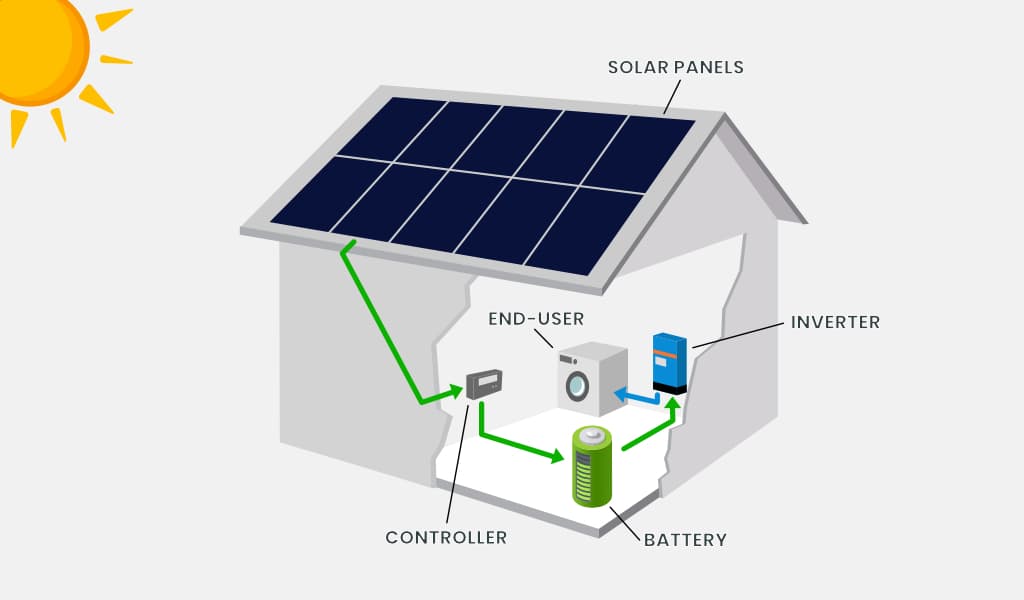
Panels are only half the story. To make the power useful, you also need:
- An inverter to change DC to AC
- A charge controller if you're using batteries
- Batteries to store power for the night
- Wires, fuses, and a safety switch to tie it all together
→ All the electronic parts in a solar setup
→ The full story of AC vs DC power