


A van electrical system is a tiny power station that travels with you. One house battery sits in the middle. The sun, the engine and a campsite plug fill it up, and a fuse box sends the power out to the fridge, the lights and your phone.
Every van life electrical system works that way, from a weekend camper to a sailboat. Here is each part, where it sits, how much energy it really gives, and what it costs.
How Do Van Life People Get Electricity?
 Illustrative image
They make it themselves, from three sources. Roof solar charges the battery when the van is parked, and the engine charges it while driving. At a campsite or marina, a shore power cable does the job.
Think of the house battery as a bucket of water. Three hoses can fill it, and a few taps drain it. As long as the hoses put in more than the taps take out, the lights stay on.
How Much Power Does A Camper Van Use?
 Illustrative image
An average US home uses about 30 kilowatt-hours of electricity a day. A medium campervan can get by on about 1.
One UK van builder added up a normal day. A 12 volt fridge ran all day, plus LED lights, the water pump, a heater fan, a laptop, phones and 15 minutes of microwave. The total was about 1 kilowatt-hour, and the fridge alone ate more than half of it.
The fridge is the hungry one because it never really stops. One UK van builder counts a 50 liter compressor fridge at about 24 watts on average, because the compressor runs about 40% of the time. That's about 0.58 kWh a day, or roughly 48 amp-hours from a 12 volt battery, and more in hot weather.
A diesel heater is the surprise. Webasto lists its Air Top 2000 STC, now replaced by a newer model, at 14 to 29 watts while it runs, and 0.12 to 0.24 liters of diesel an hour. Starting up takes more power for a few minutes. So it's cheap in electricity and pays its way in fuel instead.
Lights, a roof fan, a laptop and the water pump are small, but they add up. Write down each device's watts and hours, and the consumption calculator adds them up for you.
A Van Electrical System Diagram, In Plain Words
Most van wiring diagrams look like a plate of spaghetti. But under all the lines, almost every one has the same few components:
| Part | Where it sits | What it does |
|---|---|---|
| House battery | In the middle, in a strapped-down box | Stores the energy for everything in the van |
| Main fuse | Right next to the battery's plus terminal | Cuts everything off if a big cable shorts |
| Fuse box | Between the battery and the small loads | Gives each light, pump and socket its own fuse |
| Solar charge controller | Between the roof panels and the battery | Lets the right amount of solar current in |
| DC-DC charger | Between the starter battery and the house battery | Charges the house battery from the engine |
| Shore charger | Between the campsite plug and the battery | Charges the battery from mains power |
| Inverter | Next to the battery, with its own fuse | Turns 12 volt power into wall-socket power |
The house battery is separate from the starter battery that cranks the engine. Keep the living loads off the starter battery, so a night of lights and fridge never leaves you with an engine that won't start.
- Plus (+) cable
- Wall-socket (AC) power
- Fuse
- Wall-socket side: a job for an electrician
The charge controller works like a traffic cop for the solar current. Most vans use an MPPT controller, the smart kind, and Victron says it gets 10 to 30% more out of the same panels than a simple PWM one.
An inverter is a translator box. It changes the battery's 12 volt power into wall-socket power for the few things that need it, like a laptop charger or a coffee maker. Plenty of van appliances run on 12 volts straight from the battery, like in a car.
Charging From The Roof: How Much Solar Really Makes
 Illustrative image
In a European summer, 400 watts of solar panels lying flat on a van roof make roughly 2 kWh a day. In December they make only a small part of that, and in the north almost nothing.
Those numbers come from PVGIS, a free solar tool from the European Commission. We asked it about 400 watts of flat panels, after normal losses, in three places:
| Place | Per day in June | Per day in December |
|---|---|---|
| Málaga, southern Spain | about 2.4 kWh | about 0.8 kWh |
| Lyon, France | about 2.0 kWh | about 0.3 kWh |
| Amsterdam, Netherlands | about 1.75 kWh | about 0.15 kWh |
So a 1 kWh van can live on 400 watts of solar in summer, even in Amsterdam. In winter it can't, and that's why the other two hoses matter.
- Per day in June
- Per day in December
- About 1 kWh: what a medium campervan gets by on
There are three main kinds of panels, and the choice mostly comes down to mounting:
| Type | Mounting | Price per watt (Victron, at the time of writing) |
|---|---|---|
| Rigid panel | Glass front, on a roof rack | about 0.50 to 1.00 euro |
| Flexible panel | Glued straight onto the roof | about 2 euros |
| Portable folding panel | Set up on the ground at camp | about 1.00 to 1.50 euros |
Flexible panels stick to a curved roof, but Victron warns they wear out sooner. It also says to use proper PV cable from the panels, because standard cable isn't made for that job.
Charging While You Drive: Alternator And DC-DC Charger
The engine has its own small generator, called an alternator. Its main job is refilling the starter battery, but while you drive it can charge the house battery too.
The catch is lithium. A lithium battery can swallow far more current than many alternators can make for long, and an alternator pushed that hard can overheat. A DC-DC charger sits in between, like a tap that only opens so far, so the alternator is never asked for more than it can give.
Newer vans add a second twist. Their "smart" alternators, on Euro 5 and Euro 6 engines, change their voltage and can cut their output. Victron built its Orion XS charger to still pull a proper charge from those alternators.
A good DC-DC charger also notices when the engine is running, so it doesn't drain the starter battery once you park. The Orion XS comes in 700, 1,000 and 1,400 watt versions, and you can limit how much current it takes from the alternator.
What about a cheap split charge relay or battery isolator? It simply joins the two batteries while the engine runs and passes the alternator's voltage straight through. It doesn't limit the current or adjust the voltage, so a lithium battery can pull more than the alternator should give, and a smart alternator's changing voltage may not charge it well.
Engine charging burns a little extra fuel. And lithium batteries can be damaged if they're charged in the cold. Victron's own lithium batteries should only be charged between 5 and 50 °C, so check your battery's limit. The Orion XS stops charging lithium below freezing.
Wiring And The Fuse Box: Keeping Every Cable Safe
Think of a cable as a water hose. Push a lot of current through a thin one and it heats up, like trying to drink a milkshake through a coffee stirrer. And the longer the cable, the more power it loses on the way.
Victron's free wiring guide gives a quick rule for up to 5 meters of cable in total, plus and minus together. The cable's size in square millimeters should be about the current in amps divided by 3, so 30 amps needs about 10 mm². The guide aims to lose less than 2.5% of the voltage along the way.
Length counts both ways: out on the plus cable and back on the minus cable. Here's a slice of Victron's table, with the most amps each size should carry:
| Cable size | Total length up to 5 m | Up to 10 m | Up to 20 m |
|---|---|---|---|
| 6 mm² | 18 A | 9 A | 5 A |
| 10 mm² | 30 A | 15 A | 8 A |
| 25 mm² | 75 A | 38 A | 19 A |
| 50 mm² | 150 A | 75 A | 38 A |
A fuse is a weak spot built on purpose. It melts before the cable can get hot enough to start a fire. Victron's rules are simple: the fuse goes in the plus cable, there's always a main fuse right after the battery, and every device on the battery gets its own fuse.
Pick each fuse for the weaker of the two, the cable or the device. With a lithium bank, at least one fuse must be able to safely break the huge current a shorted lithium battery can push, and Victron calls that mandatory. Our fuse guide walks through the sizes.
Many people wire the 12 volt side themselves. Anything on the wall-socket side, like a shore power inlet or the inverter's sockets, is a job for an electrician.
Shore Power: Plugging In At A Campsite Or Marina
At a campsite or marina, a cable from a post brings in mains power. A battery charger, or an inverter/charger that does both jobs, turns it into battery power.
That's the same power as in a house, and it can hurt you the same way. The inlet, the safety switch (an RCD, called a GFCI in the US) and the sockets should be fitted by an electrician.
The Boat Twist: Corrosion And Shock
 Illustrative image
Salt water eats metal, so marine wiring uses tinned copper, which is copper with a thin coat of tin that resists the salt, plus heavy waterproof connectors. Boats also follow marine standards such as ABYC, which want the fuse on a charging cable within a few inches of the battery.
Shore power brings a real danger on boats. If it leaks from a fault into the water around a marina, the water itself carries current. Boating magazine quotes Ed Sherman of the ABYC: about 50 milliamps can paralyse a swimmer's muscles, and the swimmer drowns. The risk is highest in fresh water, like lakes and rivers. Salt water spreads the current away faster, but faulty dock wiring has killed swimmers in both.
This is called electric shock drowning, and BoatUS says it kills several people every year. It usually takes two ordinary faults: something that leaks, like an electric water heater or an old battery charger, and a broken or corroded ground wire in the shore cord that lets the leak reach the water. Faulty dock wiring can do it on its own.
A leak that size won't blow a fuse. So boats use an ELCI, a safety switch on the shore power line that trips at 30 milliamps, and they have been part of the ABYC standards since 2011. A galvanic isolator or an isolation transformer on the shore line also helps protect underwater metal from corrosion.
Shore power on a boat is never a DIY job. Have a marine electrician install it and test it for ground faults every few years. And never swim near docks, marinas or a plugged-in boat.
A tall mast in open water acts like a lightning rod, so many sailboats fit a lightning ground into the sea. Many also carry a small wind generator that charges day and night on a windy passage.
The RV Twist: Three Ways Of Living
 Illustrative image
An RV or camper lives in three modes. Parked in the woods it runs on solar, and on the road the DC-DC charger does the work. At a campground with hookups, it plugs into shore power like a house.
Heat in an RV is usually propane. The furnace uses a little electricity for its blower and propane for the heat, so it keeps working without sun. US RVs also have their own standards: NFPA 1192 for fuel, fire and life safety, the National Electrical Code for the wall-socket side, and an ANSI/RVIA standard for the 12 volt side.
What A Camper Van Electrical System Costs
 Illustrative image
Victron, a big maker of these parts, priced three DIY van setups in 2026. Each price covers the solar panels, controller, battery and small parts, at the time of writing:
| Setup | Panels | Battery | Price |
|---|---|---|---|
| Entry level, weekends | 215 W flexible | 100 Ah lead-acid (AGM) | 700 to 1,000 euros |
| Mid range | 610 W rigid | 2 x 100 Ah lithium | 1,800 to 2,500 euros |
| Well equipped | 800 W rigid | 3 x 100 Ah lithium | 3,500 to 5,000 euros |
A 100 Ah lithium battery at 12.8 volts holds about 1.3 kWh, so the mid-range bank holds about 2.6 kWh. That's about two days, at most two and a half, for a 1 kWh van with no sun at all.
Weight matters too, because every kilogram rides along. Lithium (LiFePO4) holds about 90 to 120 watt-hours per kilogram and lead-acid only 30 to 50, so the same energy weighs two to three times less. Our guide to battery selection helps you choose.
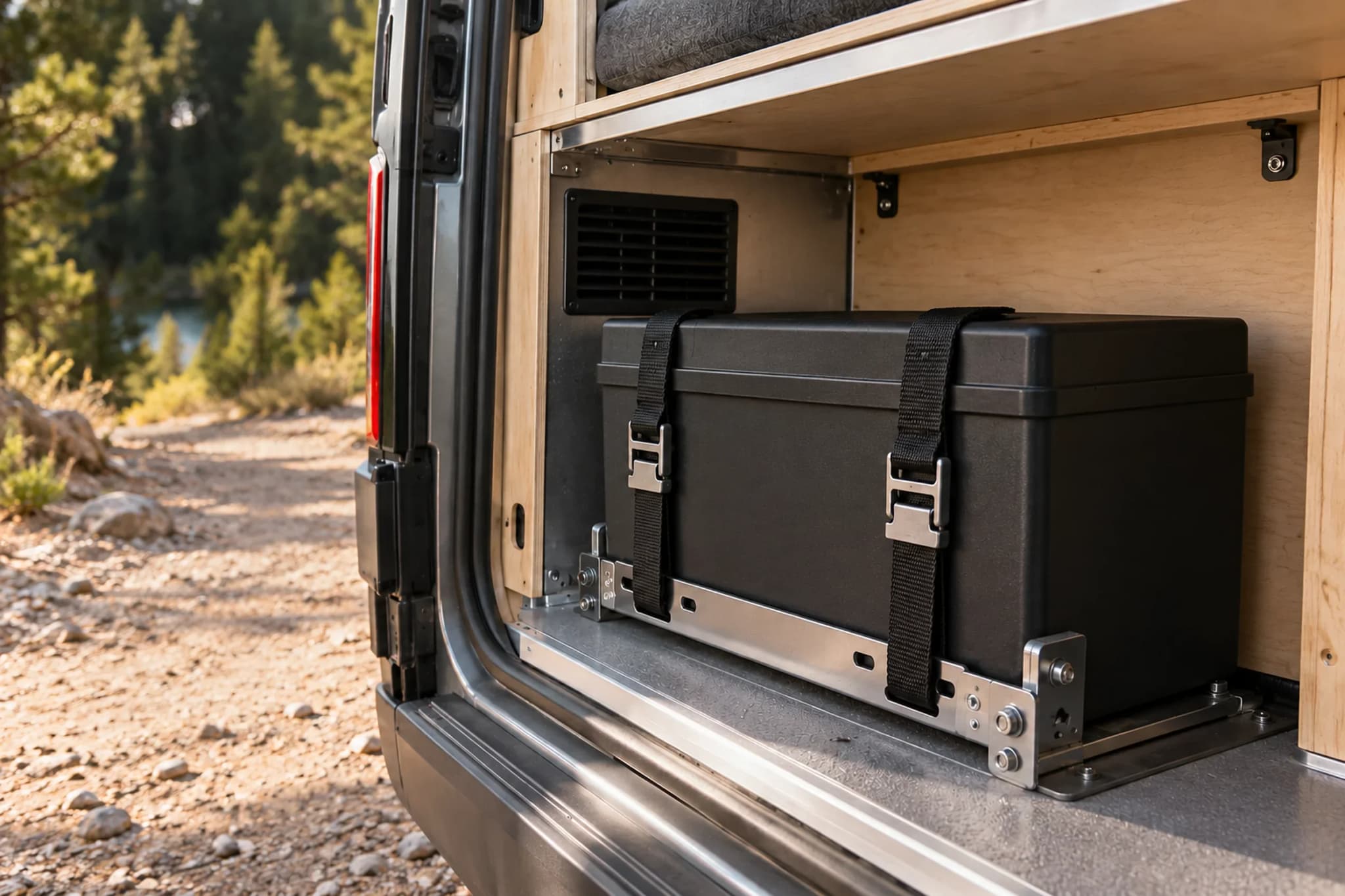
On a bumpy road, every part needs solid straps, brackets and bolts, like the battery box above.
Common Mistakes In A DIY Van Electrical System
- No main fuse, or a main fuse far from the battery.
- A cable too thin for its current, or only counting the plus cable's length.
- A plain battery isolator with lithium or a smart alternator.
- Normal cable instead of PV cable from the solar panels.
- A fuse sized for the device but too big for its cable.
- Charging lithium in the cold, below the battery's own charging limit.
- Swapping plus and minus on a DC-DC charger. Victron's Orion-Tr Smart isn't protected against that.
- Swimming near a marina, or running a boat on shore power without an ELCI.
Can You Build A Van Electrical System Yourself?
 Illustrative image
For the 12 volt side, many people do. It's the same idea that powers a cabin in the woods, shrunk to fit something with wheels or a hull.
Start with your daily use, then size the battery, then add solar for summer and a DC-DC charger for the dark months. Leave the wall-socket side, and a boat's shore line, to an electrician. On a boat, have a marine electrician check the 12 volt wiring too.
Power is only half of life on the road, though. Water often runs out first, because many camper van tanks hold only about 75 to 150 liters.
Sources
- PVGIS, Photovoltaic Geographical Information System (European Commission)
- US EIA, How much electricity does an American home use?
- Clear Cut Conversions, 12v solar panel wiring diagram for campervan
- Webasto, Air Top 2000 STC air heater
- Victron Energy, RV solar system costs: a complete guide
- Victron Energy, Wiring Unlimited: DC wiring
- Victron Energy, Orion XS DC-DC battery chargers
- Victron Energy, Orion-Tr Smart DC-DC charger isolated: installation
- Battery University, BU-216 Summary table of lithium-based batteries
- Battery University, BU-214 Summary table of lead-based batteries
- Boating, Key ways to prevent electric shock drowning
- BoatUS, Isolation transformers
- RVIA, Association and ANSI standards
- Victron Energy, Lithium Battery Smart: safety precautions
- Battle Born Batteries, Alternator charging RV lithium batteries
- ABYC E-11 (2003), as incorporated by reference
- OSHA, Ground-fault circuit interrupters
- Camper Report, How many gallons of water does an RV usually hold?
Hard Words
| Term | What it means |
|---|---|
| House battery | The battery that runs the living space, kept separate from the engine's starter battery. |
| Alternator | The engine's built-in generator. It charges the batteries while the engine runs. |
| DC-DC charger | A box that charges the house battery from the alternator and limits the current it takes. |
| MPPT charge controller | The smart controller between solar panels and battery that gets the most out of the panels. |
| Inverter | A translator box that turns 12 volt battery power into wall-socket power. |
| Shore power | Mains power from a post at a campsite or marina, brought in by cable. |
| Amp-hours (Ah) | How much current a battery can give over time. 100 Ah at 12.8 volts is about 1.3 kWh. |
| LiFePO4 | Lithium iron phosphate. Two to three times lighter than lead-acid for the same energy. |
| Tinned copper | Copper wire with a tin coating that resists salt water. |
| ELCI | A safety switch on a boat's shore power line that cuts the power when current leaks out. |
Common Questions
How do I wire a camper van electrical system?
Put the house battery in the middle, with a main fuse right at its plus terminal. From there, cables run to a fuse box for the small loads and to the solar charge controller, DC-DC charger, shore charger and inverter, each with its own fuse. Size every cable for its current and its total length, plus and minus together.
How much does a van electrical system cost?
Victron priced DIY van systems in 2026 from 700 to 1,000 euros for a weekend setup with 215 watts of solar and a 100 Ah AGM battery, up to 3,500 to 5,000 euros for 800 watts and 300 Ah of lithium. These cover the solar part only. A DC-DC charger, shore charger and inverter cost extra. Prices change, so treat these as a rough guide at the time of writing.
What size DC-DC charger do I need?
One your alternator can feed without overheating, and one that suits your battery type. Lithium can take more current than many alternators can make for long, so a good DC-DC charger lets you limit what it draws. Victron's Orion XS comes in 700, 1,000 and 1,400 watt versions. Check your alternator's rating before you pick.
Do I need an inverter in my van?
Only for devices that need wall-socket power, like a laptop charger or a coffee maker. Many van appliances, such as compressor fridges, lights and pumps, run on 12 volts straight from the battery. If you fit an inverter, give it its own fuse, and remember that a big one pulls a lot of current from a 12 volt battery.
Can solar alone power a van in winter?
Usually not in northern Europe. PVGIS shows 400 watts of flat panels making about 1.75 kWh a day in Amsterdam in June, but only about 0.15 kWh in December. Most vans fill the winter gap by charging from the engine through a DC-DC charger, and from shore power at campsites.
What's different about a boat electrical system?
Corrosion and shore power. Boats use tinned copper wiring and marine standards such as ABYC or ISO. Shore power leaking into the water can paralyse and drown swimmers, so boats need an ELCI safety switch, fitted and tested by a marine electrician. Never swim near docks, marinas or a plugged-in boat.
Should a van electrical system be 12 or 24 volts?
Victron's wiring guide suggests 12 volts for inverters up to about 3,000 VA and 24 volts up to about 5,000 VA. A higher voltage means less current for the same power, so cables can be thinner. If some devices only run on 12 volts, a DC-DC converter can feed them from a 24 volt system.