
From outside, a solar panel looks like nothing. A flat black or blue rectangle.
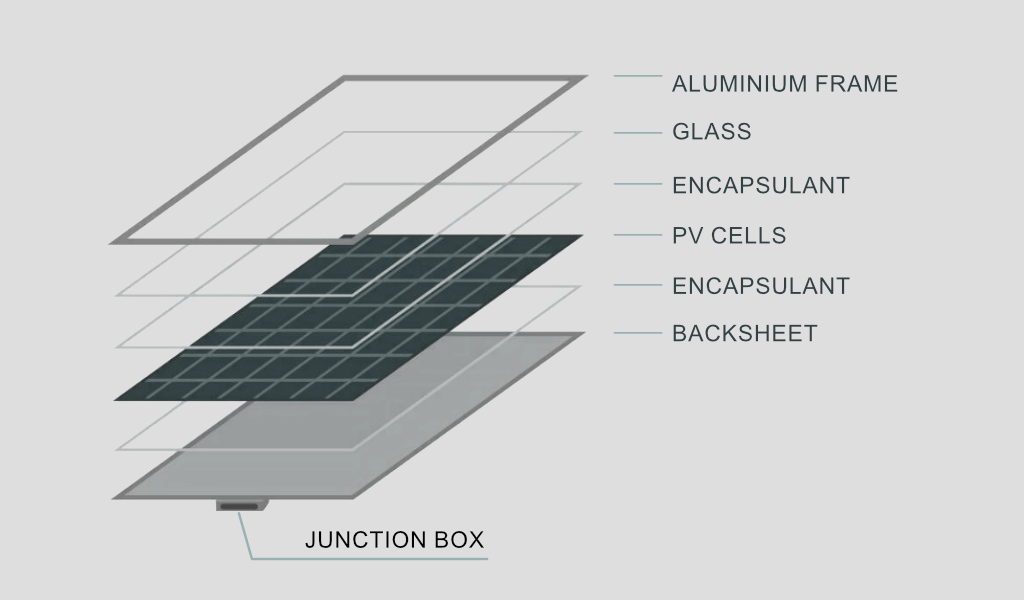
Inside, there are six layers, each doing one specific job. Take them away and the panel stops working. Stack them right and the sun gives you electricity for 30 years.
Let's walk through them, from the top down.
Layer 1: The Glass
The top is a sheet of super-strong tempered glass. The same kind they use on phone screens, but thicker.
It has to let sunlight through with almost no loss, and survive hailstones, sand, snow, and the occasional baseball.
Manufacturers test panels by firing 25-millimetre ice balls at them at 80 kilometres per hour. A good panel doesn't even chip.
Layer 2: The Cells
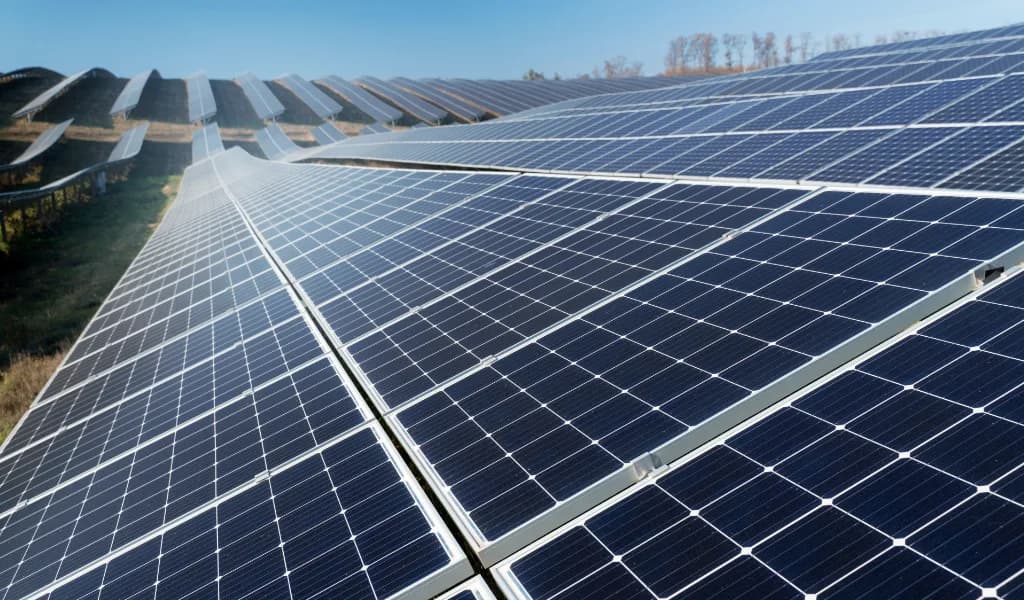
The black or blue squares you can see through the glass are the cells. Each one is a thin slice of silicon about as wide as a fist.
Silicon comes from sand, cleaned until it's about 99.9999% pure, then shaped into cells.
Scientists call silicon a "semiconductor". That just means it can move electricity around when something gives it a push. Sunlight is the push.
When light hits the cell, tiny particles inside (called electrons) start bouncing around like little balls. Wires on the back of the cell catch the bouncing electrons. That flow is your electricity.
→ How sunlight becomes electricity, the full story
→ Go deeper into how solar panels work
Layer 3: The Encapsulant
Between the glass and the cells is a clear, sticky layer called the encapsulant.
Think of it like the cheese in a grilled cheese sandwich. It holds everything together and keeps moisture out. When the panel heats up in the sun, the encapsulant gently melts and seals every gap.
Without it, water creeps in and cells corrode within a year or two. With it, a panel survives 30 years of rain.
Layer 4: The Back Sheet
Underneath the cells, there's a thin plastic back sheet. White on most panels.
Its job is simple. Stop water and dirt from getting in from below. Stop heat from cooking the cells. Reflect any stray light back up into the cells for a second chance to be caught.
Layer 5: The Junction Box
On the back of the panel is a small plastic box. About the size of a wallet. This is where the wires come out.
Inside the box are diodes. Diodes are like one-way valves for electricity. They make sure power flows out, not back in. They also stop a single shaded cell from dragging down the whole panel.
The junction box is where you connect the panel to the rest of your system. The charge controller, the inverter, the batteries.
→ All the electronic parts in a solar setup
Layer 6: The Frame
A sturdy aluminium frame wraps the whole sandwich. Strong, light, and rust-proof.
The frame keeps the glass from cracking when you bolt the panel to your roof. It also gives the mounting hardware something to grip.
Some thin-film panels skip the frame and use a flexible plastic edge instead. That's how you get the bendy panels that roll up.
→ How thin-film panels go where rigid ones can't
Why The Layers Matter
A solar panel is one of the simplest pieces of high tech ever built. Six layers. No moving parts. No fuel. Nothing to burn.
The same panel sits on your roof through summer heat, winter snow, and the occasional storm. It does its job for 25 to 30 years. Then you can take it apart and recycle the glass, the silicon, and the aluminum.
Some homeowners have had panels on the same roof for 20+ years and haven't paid an electric bill in all that time.
→ How many panels do you actually need?
→ Use the solar panel calculator
The Three Types Use The Same Layers
Whether it's monocrystalline, polycrystalline, or thin-film, the basic stack is the same. Glass on top, cells in the middle, junction box at the back, frame around the edge.
What changes is the cell layer. The black smooth single-crystal cells make mono panels. The blue speckled multi-crystal cells make poly. The painted-on layer makes thin-film.
The rest of the panel is identical.